
Welcome to my 2015 Anime Retrospective! In this yearly event, I spend a week rounding up some words on a bunch of anime I watched over the course of the previous year but didn't find time to write up sooner. These aren't necessarily my favorite shows of the year - more likely the shows I can find the most to say about, or that left significant impact on me.
My long-time readers may be wondering why there isn't a header image for this Retrospective. Traditionally I draw an image combining the characters and/or worlds of all the featured series; unfortunately I have not had time to design anything this year. That doesn't mean there won't be an image for the year ever - I may find time to do one before the end of the month, because after all, there's never not a good reason to draw. But there won't be anything prepared for the release of the reviews. If you enjoyed that detail of my Retrospectives, I apologize.
I imagine some of you will already be able to guess what shows of 2015 I am covering, maybe even if what order. To defy the cliche of going in order from worst to best and keep you all guessing, I'm going to start off with one of my favorite hits of the year: One Punch Man! So don your cape and slap on your red rubber gloves, it's time to seek evil and give it a good whack!
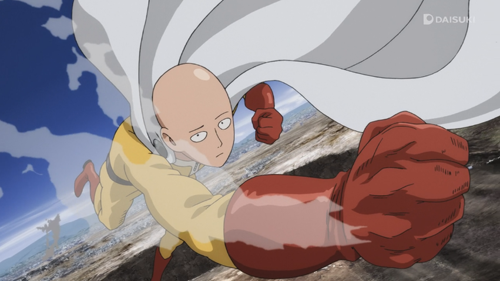
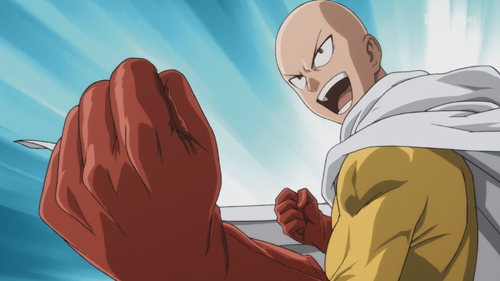
Deadbeat Saitama used to be just another out-of-work salary-man sifting from one worthless part-time job to the next, suffering eternal ennui from his unfulfilled life - until one day he found a new calling. He decided to become a superhero, the strongest hero the world has ever seen. After training his body to hell for 3 years straight so vigorously that he goes bald, he.....becomes the strongest hero in the world. So strong that he can defeat any threat with a single punch. But what's the point of being the strongest if no-one can offer you a challenge and the world doesn't even notice you?
From its humble beginnings as a web comic created by
Japanese artist ONE, to a fully serialized web manga illustrated by Yusuke
Murata of Eyeshield 21 fame, to a
12-episode anime series animated by Madhouse, One Punch Man has appeared from out of nowhere to dazzle the
roster. This wildly funny, thrill-a-minute battle spectacle which finds the
time to represent some biting social commentary and the existential ennui of
young adult life has left me befuddled. Never in my lifetime would I have ever
imagined we would come to a state of the industry where anime with its style
deeply rooted in classic shounen fighters could break into the mainstream. The
time of Dragon Ball has long passed
(though the new movies and Super anime would like to pretend it hasn't), and despite
the string of entertaining reboots from years of shounen past (Hunter x Hunter , Ushio and Tora), they still appeal to a niche base. The works of (90s
to late-2000s)-Gainax and Studio Trigger are long-lasting because of their
stable of talented animators and unique stories, moreso than for their action
tropes. The 90s were the strongest period for purebred shounen and nowadays
'action anime' gets lumped in with Light Novel tedium which barely tics a
register overseas. Times have changed. But One Punch
Man defies the reinvention of animated action; it does it right and even
more on top of it and manages to appeal to everyone. How did it do this?
Maybe
it's because it doesn't look like any other action anime on the market right
now. These days, the average consumer values clean, unbroken character design
over free abstract expression of movement. This is why so many animators are
fans of the 'pan and stand' technique - it saves time and money! Now I can't go
into a full-fledged conversation on sakuga (literally just the Japanese word
for "animation", but overseas it has taken on a meaning to categorize
animation that goes above and beyond the norms) or tell you the pros and cons
of particular named key animators - that's not my expertise. I can tell you that One Punch Man employs 'good' sakuga. A good piece of animation is
one that utilizes the fantastical quality of the medium. This is why I've always
loved Gainax/Trigger and Hiroyuki Imaishi. They were emblematic of the idea
that "if you can imagine it, you can animate it".
To OPM's name, director Shingo Natsume
brings the same level of diversity and talent he did to Space Dandy - not settling for one, conformed style but letting
various animators grit their teeth and bring their own flavor to their assigned
scenes. What you get is certainly not consistent, but a burst of flavor
dominating the senses every time Saitama throws his signature punch or when
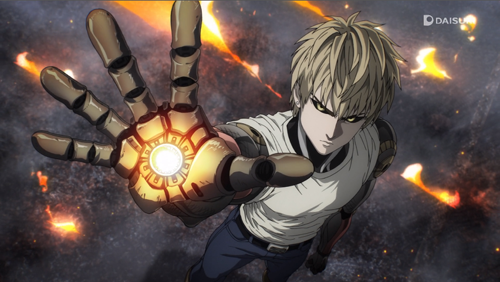
Genos goes on a one-man warpath. There is a grace and weight unique to each
characters' movements and modes of attack. Saitama is usually drawn uniformly
in motion to impart how little effort he invests into his actions most of the
time, whereas Genos' moving parts become heavily sketchy and amorphous - he
puts 110% into every attack and his
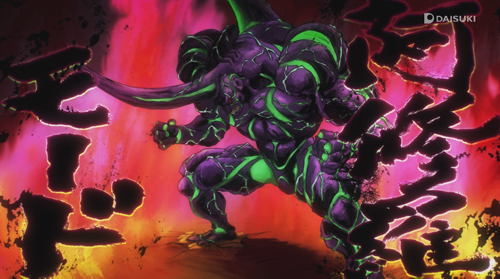
animation deforms and breaks rules of contiguous design to show it. Hulking monsters and transformations are drawn with thick outlines and vein-level detail emphasizing their terrible size and power. Fluid deformity
is a common technique found in OPM used
to showcase immense force - the animation is so hot-blooded it leaps off the screen in concentrated bursts. That is why it looks so good - the heart and soul of
the animators is directly translated into raw, passionate movement, while celebrating each
of their diverse talents in bringing the story to life, regardless of how
'neat' or 'polished' the end result is. This has become a calling card of sorts
for Natsume's directorial efforts and I hope many more titles are stuffed under
his belt in the future with that in mind.
Or
maybe it's because the show's set-up exhibits staying power despite its own
glaring limitations, or lack thereof. The character Saitama is a bit of a
mystery, both to his fellow unsuspecting heroes and the audience. He claims he
trained his body and mind vigorously for three years straight, but is that
really all? Basic physical training can reap benefits of that magnitude? Seems
a little fishy, and loyal disciple Genos agrees! There's no way honest,
completely normal, daily exercise can make you powerful enough to rupture solid
muscle and tissue in a single punch without even trying in just 3 years, right?
Who knows. But that backstory is ingenious to the strengths of Saitama's
character. He's a simple-minded, unassuming guy with a god residing in his body,
the origins of which aren't entirely clear. Nothing about his presentation
tells us to believe Saitama's story - moreover we're encouraged to question it at several
junctures. If you want; you don't have to let it puzzle you if you don't care,
and OPM's design allows for that.
Saitama is an enigma whose mix of peculiarly awesome strength and blasé persona
offers up a heaping helping of juicy main character soiree - if you really want him to be. On the flip
side, he's a relatable chum who just so happens to hold the gravitational force
of a thousand mac trucks in his fist - and that's awesome.
However
there's still One Problem, Man. We've established that Saitama is both an
everyman and larger-than-life protagonist, but that larger-than-life part
creates a narrative dilemma. If Saitama can defeat any enemy in one punch, as
the title proposes, won't every battle be over in a second? How is that going
to stay fresh and fun? That's a valid concern, one I shared when I was first
told of the concept. It's all in the menial details, the wind-up to the one
punch. These surrounding circumstances of a battle Saitama becomes a factor in
must be as strong as the man himself, because a key mood of action anime is
always missing in them: tension. A large swath of tension is kicked to the curb
as soon as you can comprehend a smidgen of Saitama's well of power: you know
he's going to win. The first patch-up to fixing this problem can be found in
the patchwork cyborg wonder himself, Genos. Everyone loves Genos, everyone
wants Genos to be acknowledged, and everyone wants to see Genos win. So OPM, wisely and to the viewer's
fingernail-biting chagrin, consistently has Genos get his shit kicked in by his
beastly opponents. Thus a new tension is born - not in anticipation for Saitama
to save the day (he undoubtedly will), but in anticipation for Saitama to show
up at all and draw the enemy's attention to protect Genos, or whoever else.
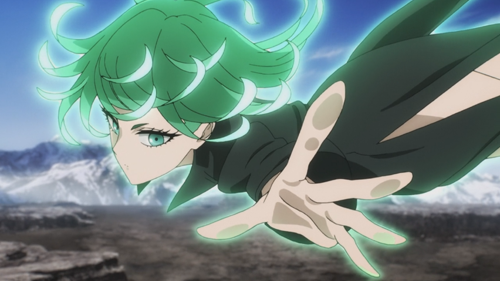
The
tension of a OPM battle is dependent
on the strength and likability of the supporting players who cast their die onto
the field. Sure, the spectacle of Saitama decimating his foe without a thought
is usually stunning on its own, but it might fall flat if the build-up was
weak. The immense roster of C, B, A, and S class heroes guarantees a large pool
of powers and characters to toss around, which is a bit of a double-edged
sword. There are memorable allies, like Silverfang, Speed-o-Sound Sonic (albeit technically not a hero), Mumen Rider, and Tornado, and then
there are.....dozens of forgettable names. And then there are outright
problematic heroes like Pretty-Pretty Prisoner (whose entire character is
reflective of Japan's unfortunately tolerable blind eye in making light of the
LBGT community - also he's a convicted rapist, which the anime blessedly
glosses over) who don't translate in a favorable light. Basically there's a lot of room for error and the comedic timing of the one punch balances a thin rope at all times. Though for me it only fell flat once.
Or even
maybe it's because One Punch Man dips
its gloved hand into social and corporate commentary, which, honestly, is
completely unnecessary given the strength of the elements discussed so far. But
the show covers a surprising range of topics when not posturing deliciously for
the camera. The idea that a superhero could be bored with their unlimited power
is not a new concept - famously the band
Five For Fighting deconstructed Superman's heroism in their song of the same
name. But that stems more from Kal El being an alien and not considered one
possessing super strength on his home planet. Still, an emo superhero? That's
no fun, who wants that? We all saw Man of Steel. Whether you think that was a
good film or not, what we can all agree on is Superman is a really hard
character to write. How do you humanize a guy who is basically a god?
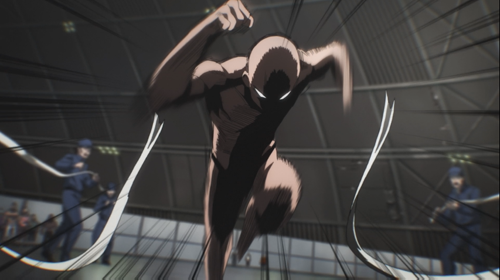
Well,
you could equate the career of a superhero with that of an office worker.
That's what One Punch Man does.
Saitama, disillusioned with the stress and tedium of 9-5 office work, is
inspired to become a superhero after he saves a kid from a crab monster. But
his zeal for the role was too great, and he trains his body so hard that he becomes an effective god on
Earth, and he soon discovers that being a hero is no fun if no villain nor
monster can pose any threat to you. Saitama is in the business for the thrill
of battle - for fun - and defeating enemies in one punch is boring. Like the
classic Twilight Zone episode "A Nice Place to Visit", heaven's no
haven if you get everything you want no strings attached; it's more like hell.
So Saitama exits one hell and overshoots the sweet spot to land smack dab into
another hell. On a grand perspective, nothing has changed and the deadbeat
hero-for-fun is still miserable. Poor guy.
Then
you've got the Hero Association, whose meritocratic system forcing heroes to
battle each other in a popularity contest to secure their livelihood is
completely antithetical to Saitama's own hero persona (ironic, because
the HA was founded inadvertently to celebrate his own actions). In One Punch Man, being a registered hero
means you're a commodity rallying for top shelf recognition. Self-centered
pretty boy A-Class hero Amai Mask represents the cutthroat nature of the
association: it's less important for a hero to be effective at hero-ing and
most important to have good PR. Beat-up bad guys where people can see you,
shake hands, hug babies, be attractive, that sort of stuff. Amai Mask himself
rarely fights evil at all - he treats his modeling and acting career as his
real job, but keeps a steady foothold on the top A-Class spot. An S-Class has too
much expectation to be on-call for high level threats, and by refusing to rise
in rank, he can force hero hopefuls to be stuck on a lower rung of the ladder.
He polices the top dogs in a despicably smug spot of comfort, and that smugness
is emblematic of the dark side of the business; it's a flawed system ripe for
exploitation, and which is very much exploited by people like Amai Mask. The organization is also full of corrupt instructors who will haze new recruits they don't deem strong enough, and greedy heroes who will sabotage the public image of their 'opponents' in order to secure their own ranking.
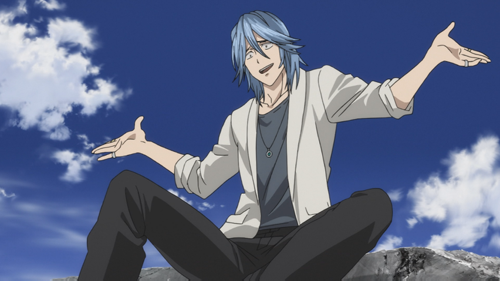
Again,
this isn't new territory - this neck of the woods was Tiger & Bunny's bread and butter. And if you want an in-depth exploration
of these themes, OPM isn't going to
give you as much as the former superhero program would provide, much less
something steeped in commentary like Samurai
Flamenco or Gatchaman Crowds. For
as well as the various elements of OPM bond together, the overall coverage of
the 'heroes as corporate tender' angle isn't that comprehensive; it doesn't
need to be. This is a true blue action series made for fans of action - the
social commentary is merely a bonus, perhaps a primer for those who would enjoy
sinking their teeth into one of the shows mentioned above in this paragraph.
And much like the strength of One Punch Man's gimmick depends on his
collaboration with his hero co-workers, the strength of the HA's gimmick
depends on its relation to Saitama himself. He's a jaded employee who performs
his job to technical satisfactory but operates via public mannerisms that
disagree with the structure's employee-management-clientele paradigm. His every
move rocks the foundation and reveals the chinks in the concrete, prompting
many a smug hero or officiator to raise an eyebrow at this disaffected young
upstart. But that's about as deep into socio-economics as the show delves - it's
really just a whole lot of surface definition with little volume beneath it.
I think
that's a pretty damn good way to describe One Punch
Man, actually: a whole lot of intricately detailed surface definition with
a modestly hollow structure beneath it. The best writing at work here is the
direction of visuals, not stories. The stories in play merely serve their basic
function, not going above and beyond because they don't need to. I'd conflate OPM's allowance for critical analysis with that of beloved kaiju
blockbuster Pacific Rim. Are there
flaws? If you think about the plot too much, heck yeah. Are there unanswered
questions? You'd better believe it! Does everything happening on screen make
perfect sense at all given moments? No way! But do you really care, when it LOOKS.
THIS. AWESOME?
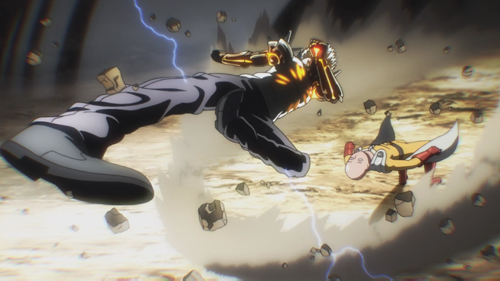
That's
what One Punch Man is. It's fucking
awesome. And that doesn't excuse it from being put under the microscope. But
its exuberance in its craft of animated action tickles my fancy of shounen
origins, as I'm the target audience. I'd argue it's even a bit unfair to call OPM a shallow narrative - the reality is
its story is developed exactly as much as it needs to be. If you took it any
further, it wouldn't be OPM anymore.
The make of ONE's creation was a seamless, easy-to-follow integration of
action, comedy, and commentary, none of which is particularly deep, but all of
which is tied together by a strong sense of proof of concept. OPM is immaculately designed to be an
easily accessible thing, and that passion was translated into gorgeous,
fist-pumping visual acuity via Murata's art and MADHOUSE's animation. It's just a superhero-story-for-fun, but oh
what fun we've had.
BONUS:
I feel
the quality of the character and my ability to relate to their predicament
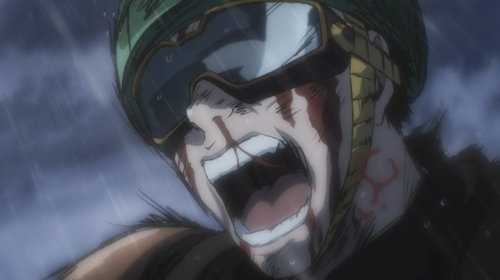
deems I offer this One Punch Man
side-hero a brief spotlight - one Mumen Rider. I've always recognized the need
of a partial observance of meritocracy in defining the workforce, in the regard
that you should be working the job that your skill set is most qualified for. In
school I was constantly told to 'aim high' and always try to be #1, not to
settle for menial work, but to always be seeking a challenge. And I agree with
the challenge part. But the construction of every business' company ladder is
integral to widespread success. You need the bottom rungs in working order if
you want the whole infrastructure to remain intact. This is a worldview not
everyone shares - some people do not rake in enough income and have to shoot
for higher paying jobs, or work multiple jobs and wring one's flexibility to
the bone. They view being closer to the bottom a sign of lacking skill,
gumption, or drive. Me, I'm a hard-worker, but I have no drive. I do not wish
to ascend the company ladder and make corporate one day. I'm perfectly happy
occupying a lower rung as long as I perform my duties at that level to the best
of my ability. I know that I am lacking in the kind of business savvy needed to
work my way up, so I don't prioritize occupational progression. If my talent is recognized and I get offers,
great, but that's not my goal.

No comments:
Post a Comment