


Tonight's review is very special to me. In the past year, few series have touched me so emotionally as Tokyo Ghoul. I put it on a level close to Fullmetal Alchemist - in that they are narrative giants with many perspectives to share told through the lens of a single, insular character study. For rating it so highly, I must treat it just as highly as a review, and so the content of this review is a bit different than normal.
I've said before that I will occasionally drop spoilers in reviews if I think there is no way around them. In this instance, this review is really more of a discussion and exhaustive round-up of the take away meanings in Tokyo Ghoul's complete narrative and the mental journey of protagonist Ken Kaneki. What that means is I will be spoiling events of the story, major events, from the first to the very last episode. Most reviews I write serve to suggest a show to a potential viewer. This time, I just want to *talk* about Tokyo Ghoul because I love it so much, and that's what I'm going to do. So consider it a primer that you need to be someone who has watched both seasons of Tokyo Ghoul in full before reading this review, as I share my lens with those who can consent with or argue against my interpretation. I apologize if this isolates anyone. The first few paragraphs are staunchly spoiler-free and I mention in the text where spoilers become open season.
With that long weaving of personal excuses out of the way, click on ahead to give my discussion of Tokyo Ghoul a read! I hope you enjoy it and are engaged to think by it. :)

This is another case of a vision in my head that is not even close to satisfied in reality with my level of talent, but I think this one was closer than most. In the end I should have been less conservative with shadows - a darker contrast against pervading light suits the mood of the show better. Kaneki's thematic positioning in the piece doesn't come across as cold as I'd imagined. I'm very happy with Touka's hair, though. I put extra time in to give her deserved detail.
College freshman Ken Kaneki goes on a date with Rize Kamishiro, a young woman he admires from his favorite coffee shop, after discovering they both love the same author. To his horror, Rize turns out to be a monster known as a "ghoul", humanoid monsters that require human flesh for sustenance. Both are critically injured by a falling beam in a construction site, and while Rize is apparently killed, Kaneki survives by receiving Riza's organs via an unsolicited transplant - this procedure transforms him into a half-human/half-ghoul hybrid against his will. Unable to suppress his new ghoul tendencies and struggling to hide his changes from society, Kaneki is taken in by the ghoul-run coffee shop Anteiku. Under their guidance, Kaneki learns how to function in everyday life as a ghoul, but in the face of elements that would seek to eliminate their existence, he is forced to descend deeper and deeper into an ugly world of pain and loss.
*This review covers both Tokyo Ghoul and Tokyo Ghoul Root A as a single
story, and contains spoilers for both*
Tokyo Ghoul is an anime which wears many masks. At times it
is a B-grade shock horror flick, at others a character-driven action melodrama,
at others a tragic hero's descent into madness for the sake of love, and at
others still a twisted eulogy on the dichotomy between humanitarianism and
hedonism. Normally a story trying to balance so many moods and themes would
collapse under its own weight, but Tokyo Ghoul pulls off every single one
surprisingly well. I dare say that it's a near masterpiece of its time; a true
testament to taking a schlock concept and delivering it in a way that legitimizes the content and elicits deep pathos. Full of action, drama, horror, sorrow, and despair, Tokyo Ghoul is a, albeit exceedingly depressing, narrative tour de force.
The immediate appeal of Tokyo Ghoul is in its level of
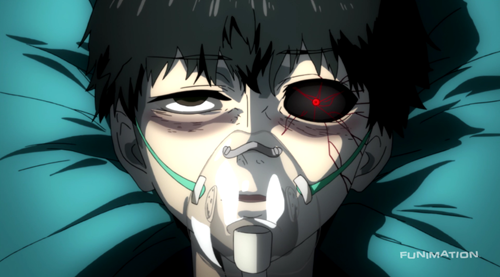
pedantic detail of its concept. Like the scientist in The Fly, Ken Kaneki's
body undergoes a gradual transformation after an innocent mistake leads to a
truth stranger than fiction. We are fed
his physical and psychological deformations in true Cronenbergian style; his
taste buds and palette are completely altered such that normal human food is
vile, and as a ghoul he becomes able to grow bulbous pustules on his skin that
can extend into blade-like weaponry. It's very gross, and director Shuhei
Morita scripts just the right amount of transformation logging vs mental psychosis
to keep our claustrophobic examination of Kaneki's new existence terribly
fascinating (I found the manga version of these events to repeat details too
often, such as overexplaining every single time he attempts to eat human food).
A unprecedented triumph of Tokyo Ghoul, even greater than its thorough dissection of
bio-horror, is its overwhelming, personal resonance with its
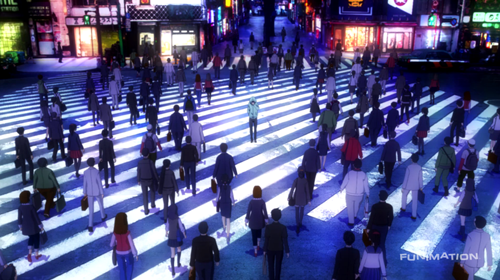
audience, which is staggering considering the world of this show is inhabited
by a cast of thousands. There are at least an odd dozen named characters both
on the side of the ghouls and the humans . How do we keep track and care about
them all? Well, this actually segues into a big problem I had with Parasyte - the maxim -. One of that
series' morals was how humans and parasites should learn to coexist, yet they
are not treated as equivalent species. The story keeps trying to convince you,
"No, humans are the real monsters," making the entire exercise of
treating the parasites as monsters a moot point. No attempt to care about
humans OR parasites in particular is made, but that's not surprising because
that show had very poor characterization. Tokyo
Ghoul on the other hand sets humans and ghouls on equal footing. Humans are
not unequivocally good and ghouls are not unequivocally evil. They share the same breadth of morals,
desires, and dreams. Their failure to understand this simple fact about each
other fuels the conflict between them. Ghouls survive by eating human flesh,
and in turn humans kill ghouls and turn their husks into quinque weapons designed
to kill more ghouls, creating an endless cycle of death where eventually it's
unclear which side is more at fault. It's a fucked up chicken or the egg
riddle: the first ghoul to devour a human, or the first human to kill a ghoul -
who's to blame? That we don't even know why or how ghouls exist to begin with
further obfuscates such an answer.
This is where Tokyo Ghoul is forced to work around the
issue of character agency. Plenty of named characters are given their own story
arcs, but it's only a 2-cour show, and there's just not enough time for
everyone to have their voice heard. A big problem with this adaptation is that,
for being so divergent from the source material to its benefit, it also makes
too much an effort to satisfy fans of that material, leaving in characters like
Tsukiyama who don't add much significance to the plot as a whole. So it's a
show stuffed with a few too many characters that end up feeling pointless. To alleviate
this stigma, the scale of the conflict at the heart of the story is evenly
distributed among all the bit players. There's a universal conscience of those
fighting for their right to live that makes the players truly feel like they're
important pieces of a larger whole. Their single, desperate thought - to live -
permeates through the wall that separates humans and ghouls, and through that
we see a battlefield where brothers and sisters all clinging to their shared
right to life hide behind masks, cloaks, and suits, brutally slaughtering each
other for nothing but their outward appearance: a bloody race war. The aspiration of these
battles is for a bridge to one day form as a new avenue of understanding and
end the fighting. Perhaps Kaneki, being a half-human/half-ghoul and thus being
the only one with a place in both worlds, can find within him the insight and
reason that can bring down their arms. Perhaps....but...
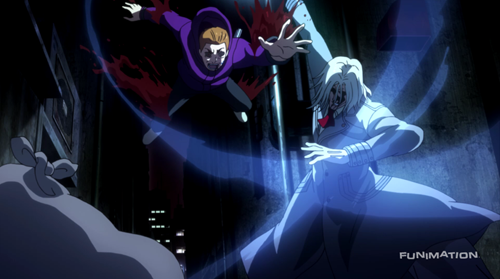
Here's the problem with that. Kaneki, by his own admission,
would make for a tragic and ineffectual hero, a premonition which comes to
absolute fruition through the course of the series. This seems to be a point of
contention when you discuss the differences between the manga and anime. Kaneki
is a bit player in a larger conflict, but the manga still depicts him in a
favorable light, as a hero to root for - it doesn't fully commit to the whole
'tragedy' thing. Kaneki is not a hero, not the typical brand of action hero. He
has the potential to BE a hero, but that's up to his actions. The character arc
of Ken Kaneki is, I think, one of the most fascinating and divertive hero's
journeys put to animation. The remainder of this review will be on this topic,
as I believe it justifies the existence of the whole series and it's impossible
to discuss Root A without touching on it. Spoilers will be heavy here on out.
Tokyo Ghoul is the chronicle of Kaneki's life becoming a
living hell that grows progressively more and more into despair. His journey
through Season 1 is a mental tug-of-war between his remaining grasps on
humanity and his now natural inclination toward ghoul-dom; a decision made all
the more difficult by the virtues and vices of both sides he encounters. First he
is cared for by the patrons of Anteiku, just a homely coffee shop on the
outside but a safe haven of the soul inside where ghouls can congregate openly
together and with those of humanity they can call friends. The 20th Ward is
stuffed with rough 'n tough ghouls only looking out for themselves until they
find commiseration and hospitality within the walls of Anteiku. Then Kaneki
becomes associated with the enigmatic Gourmet Tsukiyama, representative of the natural
instinct of the ghoul that wants no part of human coexistence outside of a food
source, and of the hubris that lords over the seedy underbelly of their
society: the same type of behavior Rize's apparition tempts Kaneki into
submitting to. Tsukiyama is a direct contrast to the brash, soul-searching
Nishiki, who seeks a happy, sharing life with his human girlfriend Kimi.
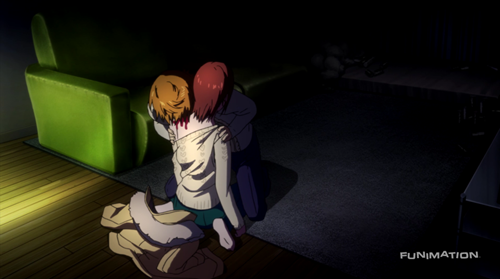
At the same time we learn about the Investigators - 'Doves'
- humans employed by the CCG, a regional taskforce stationed to cull the
ever-growing ghoul presence in Tokyo; they encapsulate humanity's knee jerk
reaction to treat monsters and monsters with no will of their own. In the eyes
of the ghouls, they are not law enforcement but government-sanctioned hunters. On
the Doves' side we get to know Investigator team Koutarou Amon and Kureo Mado;
Amon is a righteous man still wet behind the ears to the idea of a ghoul-human
coexistence, but Mado is a firecracker who will use any inhumane methods
against ghouls to complete his assignments, seeming to care little for their
albeit nonexistent rights - even when he is merely gathering information, he
kills any ghouls in his way regardless of their crimes. There is more to his
off-kilter cruelty than that, but he serves as a surface level image of
humanity's inability to attempt harboring harmony with unknown elements. The irony in Mado's actions are that he
fights for the honor of his family, but blindly tears apart countless ghoul
families like the Fueguchi's in the process. His kind are the counter-argument
to Kaneki's vie for humanity, his yearning to have a normal life with his best
friend Hide.
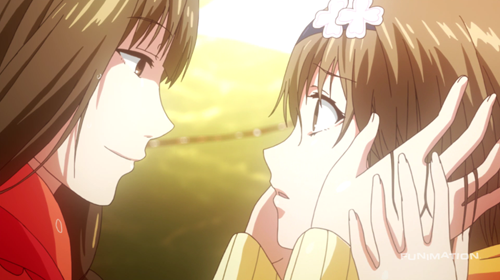
At the end of Season 1, Kaneki is captured by Aogiri
Tree, a ghoul-run organized crime ring that commits terrorist acts against the
CCG and their cronies. The world of humans and the world of ghouls are no more
or less virtuous than the other; both are populated with the same extents of
family, fear, and will to live, only making a clear direction that much harder
for our tragic hero. Each ugly truth of the world eats away at Kaneki, each
side locked in combat both outside and within his mind; all the while Rize's
influence picks at him from the deepest portions of his being, coaxing him to
go the path of least resistance and give in to his ghoul instincts: "to
eat". The Anteiku raid on Aogiri is merely a backdrop for the internal war
raging in Kaneki's mind as he desperately searches for an answer.
Due to his half-breed status, Kaneki is believed to be a key
figure in forging a peaceful end to resistance between ghouls and humans, that
one day he might find an answer that the previous generation could not. But as
the young man is tortured by Aogiri Tree to the brink of insanity, Kaneki seeks
a more immediate answer, requiring him to go beyond the point of no return: he trashes
his character's right to hero status and dives into his own darkness. For
self-preservation and to protect the only place left he can return to (Anteiku;
at this point, he reasons that a life with Hide is long gone), Kaneki chooses
power, but the only way he can attain power is to completely abandon his
humanity and commit a sin considered taboo even among ghouls: cannibalism.
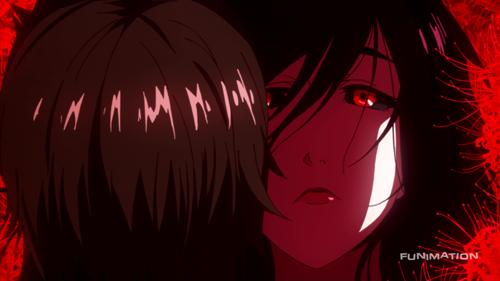
From this point on is where Season 2, Root A, takes over,
and the consequences of Kaneki's choices are carried over into the new arc. Whereas
Season 1 focuses more on Kaneki's spiraling descent into psychological
horror as his world unravels around him, Root A maximizes its time in character driven studies and examines
where Kaneki's descent has taken him. After leaving Anteiku and joining Aogiri
Tree to attain more power, Kaneki no longer behaves nor is treated like the
protagonist we followed in Season 1 - the direction of his scenes cleverly
changes to reflect this. Clairvoyance into his state of mind becomes extremely
limited and he rarely speaks, choosing to use actions rather than words. He
becomes a foreign element of his own story, his actions framed from afar by the
embittered, pitiable disdain from his old allies at Anteiku, the ones he's
supposed to be protecting. The narrative excellence in Root A is that Kaneki's
visual absence gives time for the story to develop many side characters and
give us their perspective, but even so Kaneki's position is no less relevant -
in fact it's never been more paramount.
This swift turn in characterization for Kaneki is brazenly
complex without making him unbelievably out-of-character, augmented further
upon the realization that this is not a typical arc of redemption. This is
because Kaneki hasn't turned "evil". His allegiances are unchanged,
but he has sacrificed his sanity, security, and morality in the thought that
doing so is the correct way he can be strong for others. He has committed to a
lifestyle of wrongs for the sake of potential rights that he will have to live
with forever, and ultimately his choices only further isolate him from his
loved ones. Continually haunted by his darkness, he loses sight of the world
around him and only realizes too late that his actions within Aogiri have
helped stage an attack on Anteiku, endangering all those his solitary conviction
was intended to protect. Within this conflict is Amon and Kaneki's final clash,
but the possibility of reconciliation between them is long gone, and that
potential bridge for ghoul-human relations is closed just as quickly as it was
envisioned. Only the bitter thoughts of what could have transpired were the
fates aligned differently remain.
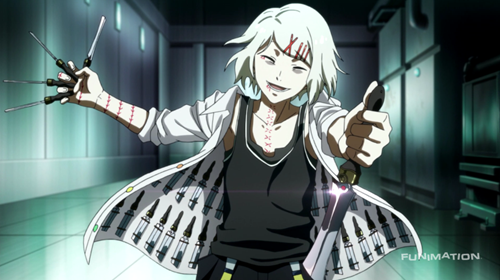
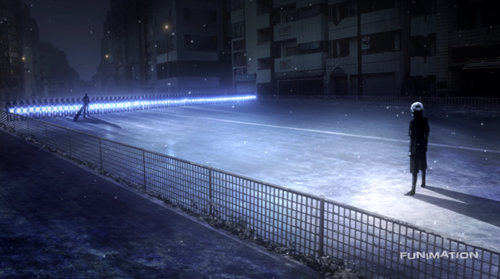
Like the cold winter battlefield setting the stage for
Kaneki's final trials, his initial descent into darkness is visually signed by
his hair turning white. White hair is an important visual cue attributable to
several characters in Tokyo Ghoul: it represents one who has used the power of
terrible trauma to harden themselves and transform into something beyond ghoul
or human. It is also a dangerous sign that character is doomed to suffering
and/or a tragic end. Kureo Mado is killed on what for him is a routine
assignment, never getting the chance to avenge the death of his wife at the
hands of The Owl. Juzo Suzuya is forever mentally damaged by his abusive
childhood and in the end loses the one man he ever saw as a true paternal
figure. When it doesn't spell pain, white hair also points to a life that could
be content yet spent alone cooped up within one's mind, as seen through
Anteiku's associate Yomo and CCG's top ranking Investigator Arima. Is Kaneki
doomed to a life of bitter solitude, to walk a path of inevitability where his
actions will only dole out pain to himself and those close to him? We don't
know, and Kaneki himself only becomes completely cognizant to the gravity of where
his choices have led him when he loses the final glimmer of light he didn't
realize he still had: his best friend, Hide.
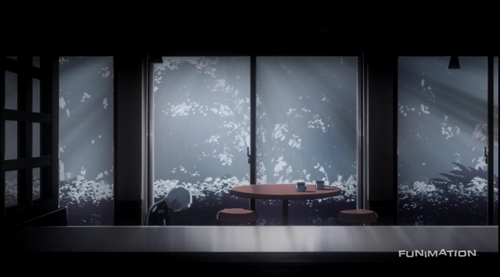
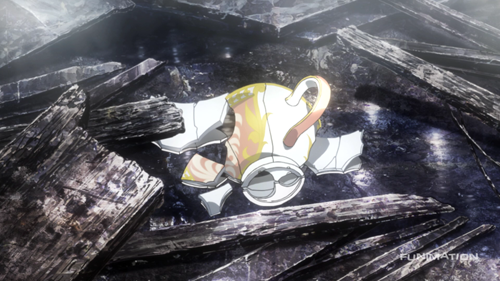
At the very end, Kaneki has lost everything. His humanity,
his connection to his friends, and finally, the one person who ever accepted
him as both a human and a ghoul. In this ultimatum, Kaneki realizes that Hide
has faced an ordeal of acceptance and loneliness that mirrors his own; forcing
himself into Kaneki's world only to realize he was unable to do anything on his
own, and is finally eaten by the dog-eat-dog world Kaneki couldn't bring change
to. The fear and isolation which acted as the catalyst for Kaneki's
transformation only lengthened the gap between his ambitions and what he truly
needed. Kaneki tried to change the world
to suit his own interests, but Hide only tried to save Kaneki. Hide was well
aware of the world's nature and knew all he could do was directly try to reach
out and connect with the person he cared about most, a lesson that Kaneki
learns via the harshest possible conclusion.
In the wake of Hide's selfless sacrifice, a new light
penetrates the bleak whiteness of the final battlefield's remnants. This light
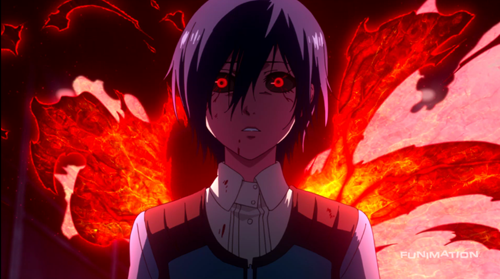
is personified in Touka's resolution; she has suffered loss, come to grips with
the cruelty of the world, and survived thanks to her personal arc learning to
rely on others. She and Hide are the brightest sources of light in Kaneki's
world, one snuffed out, the other taking hold of the future. Thematically, this
seems to be a sign that Kaneki, having reached the nadir of his descent, has
nowhere to go but up. But for the viewer, we're only left to ponder what this
light means for Kaneki. Will the light lead him to redemption and standing out,
or is it naught but a cruel reminder of that which is beyond his reach, dooming
him to vanish forever, forgotten into a white sea of souls trapped in a
senseless war. On this uncertainty is where the descent of Ken Kaneki comes to
a close, on a grim stamp, with a stray beam of hope, left to the unknown.
You can currently find all subbed episodes of Tokyo Ghoul (S1 + 2) plus all dubbed episodes of Season 2 streaming online at FUNimation (dubbed episodes are subscriber exclusive). The series has been licensed for home video release and the first season is due out on September 22, 2015.


You had me at "Cronenbergian."
ReplyDelete