
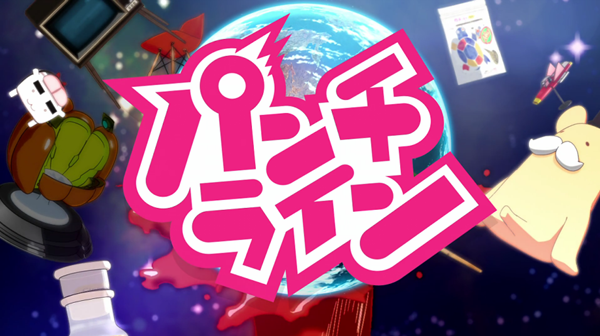
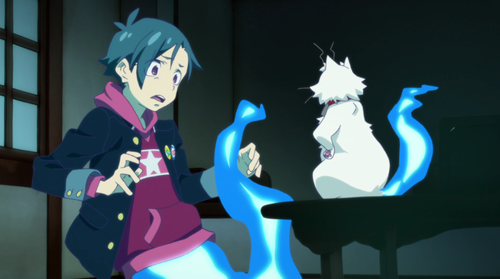
Yuta Iridatsu lives in the Korai boarding house with four other girls - pop star Mikatan, spiritual medium Rabura, hikikomori Ito, and nerdy inventor Meika. After getting caught up in a suspect busjacking during a trip to the city, a sequence of events occurs that results in Yuta being ejected from his body and becoming a ghost. Guided by mysterious cat spirit Chiranosuke, Yuta is instructed to uncover an ancient text residing somewhere in Korai House known as the Nandala Gandala, which supposedly holds the secret to his salvation. Oh, and if he sees girls' panties two times in a row, a meteor will blow up the planet. Happy hunting!
If you want the short version: the punch line is 'panties'.
Fuji
TV's noitaminA programming block once promised total dedication to redefining
the plane of animation - to bring brand new stories and collaborations to the discerning
critic's table. What was once indicative of - if not quality, originality - has
become practically indistinguishable from the remainder of the industry,
leaving the branding's purpose left to ponder. noitaminA is not a stamp of
recognition anymore, but rather reflective of a set of requirements. What makes
your story a shoe-in for the noitaminA block? Is it a wholly original plot
wherein characters are actively pursuing an unusual goal not regularly found in
shounen, light novel, or shoujo anime? Is it a slice-of-life for adults,
ranging down as far as seinen? Is the subject of your story something of niche
appeal, that the average fan might not know anything about? Is a character or
production name attached to your project of a well-known stature and thus needs
special treatment? These are all fair qualifications to nab you a spot in
noitaminA. In a nutshell, you just have to be unusual and off-beat but still
formulaic enough that it won't be a complete turn-off to anime's core audience.
The
range of converging talent goes the distance. On one end you've got Kids on the Slope and Terror in Resonance, two productions
reuniting director Shinichiro Watanabe and musician Yoko Kanno; both series
featuring gorgeous visual presentation and sound design but falling short of
the mark on story. On the other end, you've got Punch Line - a concept built from the ground-up by noitaminA for
noitaminA. I find it highly unlikely that Punch
Line was an idea churning through a writer's head for years and years -
this was conceptualized specifically for the block. And because this idea was
no-one's baby, the production was handed off to a cornucopia of random ass
talents. Animated by MAPPA, directed by the guy who did The Mystic Archives of Dantalian (does anyone remember THAT?), and
written by Kotaro Uchikoshi (arguably the name in this staff with the most
clout), a video game developer best known for creating the Zero Escape visual novel mystery games. You may recall the first
game by the title Nine Hours, Nine
Persons, Nine Doors. There's virtually no connective tissue between these
names, and the ultimate quality of this project betrays the missing links.
Speaking
of links, Punch Line is a
supernatural connect-the-dots mystery romp which hopes it will draw you in purely on its
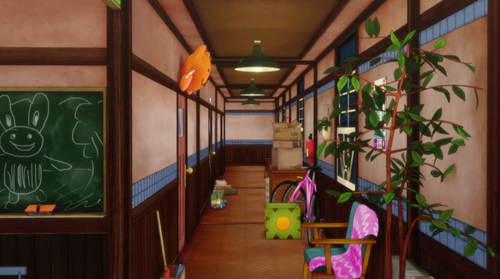
initial displays of disjointed absurdity; MAPPA's animation services that mindset well. The colors are bright and peppy, the visuals cluttered and detailed,
and the designs varied in the sense that it expects you to equate a character
to their outline and recognize them instantly. It's solidly designed, adopting
the kind of madcap surface sheen that solidified Gainax's catalogue in its
heyday. Indeed, Punch Line seems to be seeking a visual aesthetic not unlike Magical Shopping Arcade Abenobashi or,
dare I say it, FLCL, the holy grail
of tight literary randomosity. The story in place here also shares many curious mind-over-body
similarities to Masaaki Yuasa's animated film Mind Game. These are merely possible influences and not meant to
talk up the quality of Punch Line, no
sir. It's not even in the same time zone as those giants.
The
reasons Punch Line doesn't work are
numerous, but let me start with the most obvious culprit - the continuity.
There is no original concept or head storyboard director mentioned in the
series' credits (which is why I figured it's a creation by committee), but to
the credit of whoever possessed the major creative control of the show, they had
a lot of interesting ideas which they probably 'developed' after watching Mind Game. And so the first episode
assaults you with all of these ideas at once, piecemeal, leaving the viewer no
time to interpret. The bubbly self-proclaimed hero Strange Juice.
Transformations that can only be compared to DBZ's Super Saiyans (it's actually called Uber-fication, in a bit of an on-the-nose jab towards Nazi eugenics).
Spirits separated from their bodies. A perverted talking cat spirit. An ancient text
called the Nandala Gandala. The Qmay Group and Project W. The mysterious masked vigilante with the alias Kenji Miyazawa. The Earth decimated by a meteor, multiple times.
Individually, these concepts don't appear to have any connection to one
another, but in fact they are all part of a whole. A whole that is impossible
to understand until you have ventured further down the rabbit hole.

On a
rewatch, you may now understand all of the events taking place in the pilot
episode, but the writing remains decidedly not good. It is a story so dependent
on surprising reveals as part of a forward progression that the only way it can
work is if key moments of early episodes are deliberately hidden from the
viewer, so you have lengths of time completely missing only for the sake of
making us ask questions. Not for any artistic license - it's just world-building
for its own sake. The name Punch Line requires there to be an unseen
explanation tying all the threads together, a goal to which it leaps through
hoops to achieve, ignoring countless pillars of Good Storytelling 101. The
greatest malefactor of this technique is the talking cat, Chiranosuke. From the
very beginning, he knows 100% what is going on and what needs to be done. The success of Yuta's mission depends on
Chiranosuke keeping him informed of the numerous factors beset on him from all
sides, yet in the beginning, he reveals only the most archaic, cryptic notions
of the plot for Yuta to get started. It's in his best interest for Yuta to know
everything, but key information is kept from him, just so it will be kept from
us. Kind of a dick move, and a waste of time, especially once you learn that
Chiranosuke is actually attempting to foster the savior of all mankind.
Once you get around that hurdle, even after you learn so much, Punch Line doesn't even have enough time
to explain everything it sets up - some pieces given lots of screentime in the beginning end up meaning nothing later on - precisely because it wastes so much of its run
time. On what, you may ask? Bad comedy. Really really really bad comedy.
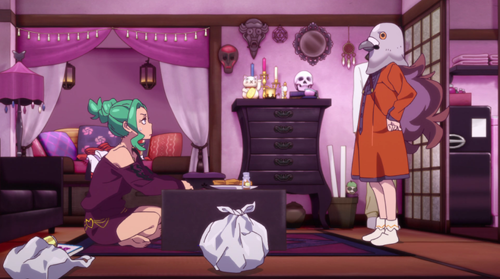
Punch Line is largely a comedy, probably
by nature of the fact that it's named for a comedic device. Its ilk of yuks
derives mostly from puns and verbal slapstick. The problem? The jokes are far
removed from whatever the plot is trying to convey (or purposefully not convey)
and run the gamut from not funny to groan-worthy. The writer can't seem to
decide whether they're penning a sketch comedy or a sitcom; elements of both
regularly appear within the same joke in the same scene in the same sentence. Like Family Guy's penchant for breaking the air with random, unfunny asides, Punch Line breaks through the atmosphere with dozens of left-field conversations meant to give characters' personalities texture but just reads like lazy monkey cheese. As someone who has seen enough Japanese humor to get it, I feel confident in
giving Punch Line's comedy a low score. It doesn't blend, it reveals even
more of the story's flaws, and doesn't tie into the
overarching plot in any way except to create pathos and audience appreciation for
the various girls of Korai House. The conceit of which is part of Yuta's
mission; purportedly, in order for him to save the world, his housemates must
all be great friends and work together alongside him.
Which is...a bit weird.
They live in a boarding house in the middle of nowhere with virtually no
neighbors and they see each other every day, and have lived together long
enough and peacefully enough to not want to set up shop elsewhere, and yet
they're NOT close enough friends already? This, again, leads into even more
comedy, as ghost Yuta goes about gallivanting a Steins;Gate plot device to solve all of the girls' problems while
also bringing them closer together, which results in hiiiilaaaaaaaarious ghost
antics, such as gaining the ability to possess Rabura's spiritually-attuned body (which leads to one of the most awkwardly drug-out jokes involving turtle feed and a Rafflesia). The more random and quirky the subject of each gag the better for this script, but the worse for my ability to enjoy it. As it is, Punch Line is an
unwieldy harangue of deformed narrative elements. Not quite a mystery, not quite a comedy, not quite
a story about friendship. Tries to be all three, and comes out not satisfying
the full needs of any in the hands of writers most likely not that emotionally conjoined
to the product. Like I said earlier, it all comes off like a cold written-by-committee
production, hiding its corporate stank with bright colors but
failing to clear the air of detachment. Whoever it may be, there's SOMEONE back there who was writing the hell out of this thing, but any vision they had is buried in all the corporate convolution.
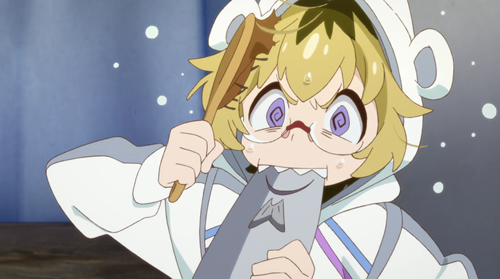
Actually,
make that four genres it fails to emulate. I've gone and done it, I've left
something out, I'm no better than the show itself; intentionally hiding key details until it becomes convenient to mention. I've neglected to talk about the very first thing I brought up in this review:
panties. Why is the punch line panties? Where was I going with that stray
thought? Don't get hung up on this quandary, as I wasn't going anywhere with
it. Neither was the show.
See, the
REAL reason that the show is called Punch
Line is because it acts as a pun via transliteration. The
title is romanized "pan-chi-ra-in". A "panchira" is a
colloquial term meaning a quick glance at a women's underwear. The pronunciation
also sounds a bit like "panty line". Did I forget to tell you? Punch Line is also a fanservice series -
the 4th and final hat it wears. Wonderful! On top of being a steaming pile of misplaced ambitions failing to represent multiple quadrants of storytelling, it also
features gratuitous panty shots. Moreover, panty shots are integral to the plot, by sheer
force; and by that I mean the conceit is brute forced where it doesn't belong.
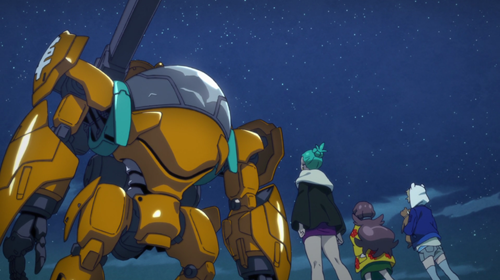
Yuta
cannot 'Uber-fy' unless his senses reach a fever pitch,
i.e. his head is engorged with blood. Naturally, the easiest way to get a guy
fired up in anime is to give him a nosebleed, and the easiest way to give him a
nosebleed is to stuff a pair of panties in his face. But be wary, young Yuta,
for if you gaze into the nefarious nethers a second time before your first high
has settled, disaster will strike! For reasons that only make sense later if
you connect logic trees sewn in different fields, a second burst of
panty-induced head trauma too soon will cause a meteor to destroy the
planet. When you discover why this is happening, you will realize creative
license was flagrantly abused to create a somewhat false cause and effect. Punch Line really doesn't care about
continuity - it will happily twist its own rules to create what it deems the
wackiest and most nebulous result. And of course, whatever happens will
inordinately concern panties. For no reason. Take the panties out, alter the cause of some later events, and the show is virtually the same. So why panties? Because why the fuck not.

*if you're disappointed I didn't include screenshots of any actual panties, please understand the point is that Punch Line's narrative would barely miss them; also I'm keeping this blog clean of filth, thank you*
You can currently find all subbed episodes of Punch Line streaming online at Crunchyroll. Sentai Filmworks has licensed the series with a currently undated home video release in the works.


No comments:
Post a Comment