
Hellsalem's Lot -
it's the eclectic epicenter for everything hip and happening this side of the
Beyond, a realm housing immeasurable varieties of creatures strictly non-human.
One day this other reality spilled out in the middle of New York City,
transforming it into a place where everyone and everything is weird and nothing
is normal. Except maybe human Leonardo Watch, the newest member of HSL's
unofficial crime fighting vigilante group 'Libra'. In this city, it's their job
to cull evildoers both human and not from the masses trying to enjoy their
Wonderful Beyond.
*minor event spoilers for Blood Blockade Battlefront are referenced in this review*
From the extensive mind of Trigun-father Yasuhiro Nightow
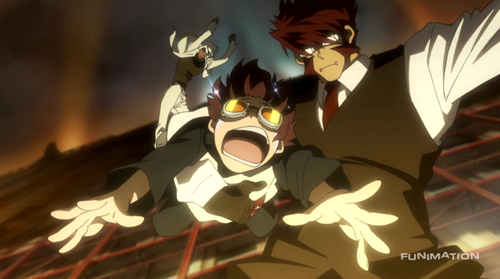
comes another story about ragtag vigilante justice and perhaps something more. Blood Blockade Battlefront chronicles
adventures in Hellsalem's Lot - the portentous new title for New York City
after a portal to an alternate reality opened in the center of town one long,
tumultuous day posthumously documented as The Great Collapse. Three years
later, the population has expanded to usher in the residence of all manner of
inhuman citizens once thought to be confined to fantasy. No, in HSL it's normal
for a human male to hold casual conversation with a 6-foot tall reptilian with
eyestalks and a vicious overbite, or for a gelatinous blob couple to run their own
sushi bar. The ultimate melting pot of all intelligent species imaginable is
created when humans and not mingle and cohabitate their cultures in one
giant dimension-gapped city, much like the urbanized cross-species economies
seen in Futurama or the New York City of the Men in Black
universe. HSL even has its own Ballchinians.
We see in BBB's
premise that Nightow has constructed an infinite story playground where he can
exercise his writing chops. Virtually anything can happen in Hellsalem's Lot
due to the logic of the alternate reality, the Beyond, never being fully rationalized. What's on the other side
of that dense fog, how big is the world these beings poured out from? We know
for certain that the Beyond is a world filled to the brim with ancient
apparitions and nefarious netherbeasts *ahem* beyond human comprehension. In
short it's a dangerous place, and the monsters waiting in the dark are of the
persuasion that probably don't want to get all chummy with their new spatial
neighbors. But more importantly there's no limitation on rules that govern the
denizens of the Beyond. When the Beyond opened up, a treasure trove of magic,
alchemy, spiritualism, demon arts - whatever fancy name you want to call it -
became 'real' and learn-able by humans. On the narrative level it's a convenient
excuse to have protagonists with a limitless range of superpowers. Specifics of
the story's supernatural laws are kept intentionally vague so that Nightow
never has to reign in any element of context - it's a story made to
purposefully be as batshit expansive as possible with an unending well of
content to draw from. So it's totally acceptable for there to be an elder race
of vampire lords, because Beyond. Of course a new multi-dimensional staged
version of Chess called Prosfair where pieces evolve and single games can take
days to complete has grown in popularity, because Beyond. Hellsalem's Lot is an
inter-dimensional haven where every fantastical whimsy in our culture has
likely and will likely become part of our tangible reality. It's a risky,
no-barriers style of world-building that in an unskilled writer's hands would
be hackneyed and unfocused.
But I'm specifically here talking about BBB's anime adaptation, and Nightow's not flying solo on this trip.
At the helm of this ship is director Rie Matsumoto, a relatively new
rising star who worked on Precure titles for awhile and then wowed the industry
with a stunning display in Kyousogiga (which I have to this day still not seen,
but the consensus from everyone I know is raucous approval). The success of
that title was enough to let her step out of Toei Animation's protective net
and lend her talents to this Yasuhiro Nightow-written, BONES-animated
production. Since the original manga is still in serialization, still being
produced, and is primarily a series of unrelated story arcs not accompanied by
an overarching narrative, Matsumoto was set with a daunting task. Rather than
adapt as far as was able in a single season, she decided to include a brand new
story and characters alongside the original fun and fancy free and draw it to a
conclusion, AND make it all cohesive, in this world where literally anything
can happen. As it turns out, her style of dense, symbolic plotting and
deep-seated, existential character drama was a perfect fit for Nightow's world.
What resulted from this match made in heaven was a tale pitting the mundane
against the bizarre; a secular story highlighting humanity's resilience and
simplicity in the face of overwhelming outward stigmata. But enough waxing,
let's actually talk about it.
The hellish playground of Hellsalem's Lot is presented
through the eyes of fledgling photographer Leonardo Watch. He's a pretty normal,
squirrely guy, but those eyes are anything but. See, when on a trip with his
parents and wheelchair bound sister to the outskirts of HSL, an elder
demon decided then would be the perfect time to invade our realm and scare some
shit up. Why did the beast choose to appear before Leo and his sister Michella?
Did something subconscious within them summon it forth? Was it the
manifestation of Leo's fears? No matter the reason, appear it did, enforcing a
deal to those graced with its emergence - one was to have their eyesight taken
from them, while the other would receive in return the All-Seeing Eyes of the
Gods, allowing them access to see the truths of the world. Without hesitation,
Michella offered up her eyes while Leo cowered like a chipmunk, unable to stop
the proceedings, and so was given the ultimate gift and curse.
BBB is framed
through a long, long letter Leo has written to Michella chronicling his adventures
in HSL. Since his sister is a cripple, and blind, Leo hopes to use his new eyes
to find something worth shooting for, see what she can no longer see, and make
a living in the Lot, the town of possibility and limitless dreams, for both
their sakes. Which, I imagine, was the ultimate goal in giving up her own sight
Michella had in mind to save her witless, sheltered brother from doing nothing
with his life. Sure enough, within only a couple days on arrival, Leo finds
himself swept up in a storm beyond his comfort zone, as he is discovered by the
dysfunctional crime fighting force Libra, who seem to think his All-Seeing Eyes
would be a most useful asset indeed. From there it's never a dull moment for
Leo as he brings his brand of timid normalcy to a table littered with
freaks, blood-starved demons, specters, stalwart heroes, egocentric
ne'er-do-wells, and a speedy little monkey named Sonic (how original).
Aesthetically, BBB
takes a lot of visual inspiration from my favorite series of 2014, Space Dandy, which is easy to explain as
both were directed by Shingo Natsume and both animated by Studio BONES. Through
their top quality work the urban jungle of HSL bursts to life, sporting
bustling crowds and magnanimous sets brimming with activity even in moments of
silence. It feels like a city you could get lost in for weeks trying to find
every little spot on the corner, and on every corner there's a new sight worth
seeing. And it only becomes more beautiful when the streets get soaked with the
carnage of a Libra-led exhibition of brutish justice. It's a bit baffling how
Matsumoto manages to blend so many styles of visual craft into one product and
keep it cohesive, but the moments when BBB's
overwhelming narrative application of mise
en scene breaks out into shounen brawls are executed with such
excellence you barely notice any tone has been shift. It somehow feels
completely natural to have prideful Klaus von Reinhertz and dick suck Zapp
Renfro announce their attacks and have the kanji flash excitedly on-screen.
Every frame of BBB brims with confidence and grace - from the vibrant
sight-seeing to the antediluvian Beyondian tech keeping the dimensional infrastructure in balance to Zapp's
elegant yet wild sword strikes to the mechanical mayhem wrought by the Queen of
Monomania Aligula on a one-sided booty call (just watch the show, it'll make
sense); every scenario is crazy, unique, and exudes a beauteous poise in its
artistry. BBB just misses out on
being my favorite show this year, but in measure of direction and animation
it's #1.
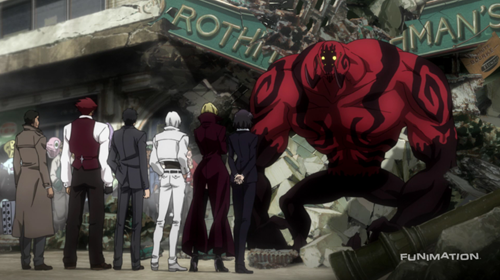
More than simply a collection of fun adventures, it's the
unique, memorable employees of Libra that elevate BBB's stories, and this world's cup overfloweth with them. The
comedic moments of this show are a treasure; Nightow writes his cast to the
beat of a Looney Tunes-esque camaraderie, which applies best to Libra's own
Daffy Duck: Zapp Renfro. There's nothing particularly deep about Zapp. He's a
dick and he shows his love for others by treating them like a dick. No
character besides the anime-original crew have much inner detail, but their
simple designs are so animated and poignant you can't help but adore them. As
of the first - and currently only - season, however, you might as well dub the
affair The Leo, Zapp, and Klaus Variety Show. Chain, Steven, Abrams, K.K.,
Brody + Hummer, and newest recruit Zed only get limited focus thanks to the
limited run of material.
Beyond its gorgeous presentation and cockamamie episodic
adventures, there lies a surprisingly poignant testament to the human spirit.
The relationship Leo shares with his sister is directly paralleled with an
anime-original sibling pair: White and Black, real names Mary and William
MacBeth. Mary MacBeth, now there's a loaded literary name. In these characters
are where all the cultured biblical and literary references come out to play,
and again, this is yet ANOTHER type of direction most works either own singularly
or don't bother with - Matsumoto doesn't just play with a full deck, she plays
multiple games at once (maybe she's a champion of Prosfair). It's tough to
maintain a through-line with all these writing modes in constant motion, so as
to mitigate, White and Black's narrative generally takes place outside the
scope or just on the fringe of whatever wacky hyjinks Libra is getting itself
into on any given day. Whereas Leo is silently haunted by the moral duty he
must bear at the expense of his sister's disability and his own weakness at
handling HSL's daily brand of insanity, White's haunting is literally as close
to her as any living soul could possibly be, with a cold, dead grip on her
heart. So demonized is she that she refers to herself as a ghost when she first
meets Leo - one who is not alive but still persists. You see, she and her
brother Black where also visited upon by an Ancient One on the day of the Great
Collapse, and neither exited the resulting Faustian deal unscathed.

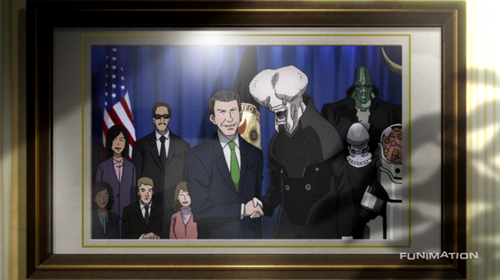
Evil comes in many forms and scales in the worlds of BBB. There's the common petty criminals
causing trouble in the streets. There's crime lords working in the shadows
collecting a pretty penny off HSL greed and love of bloodsport. There's the
elder vampire lords who live in the dankest depths of the Beyond and terrorize
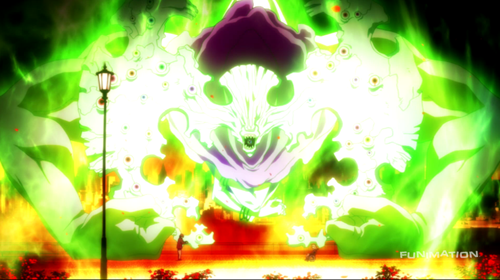
humanity for fun. There's the Ancient Ones, Lovecraftian-horrors approaching
the rank of gods who appear and perform in whatever manner they please
(sometimes in nonviolent manner, such as when Leo gets so hungry he has visions
of the Buddhist-adorned 'God of Chow'). And then there's the Thirteen Kings,
denizens of the underworld taken human form who revel in gluttonous squalor with glasses raised to the
unpredictable frivolity of Hellsalem's Lot. The moment the passage between
worlds was opened during the Great Collapse, chaos became the new norm, and
these patrons of despair who once only operated in darkness now had a outlet
wherein their passions blended with the local flavor. This was candy to (most
of) the Kings, and they made the skyline of Hellsalem's Lot their stepping
grounds. The one thing they can't stand? Normalcy. Actions that can be
predicted. And as Femt, the King of Depravity, proclaims upon one of his
gleeful romps falling to pieces at the hands of Libra's new blood, Leonardo
Watch is just too damn normal.
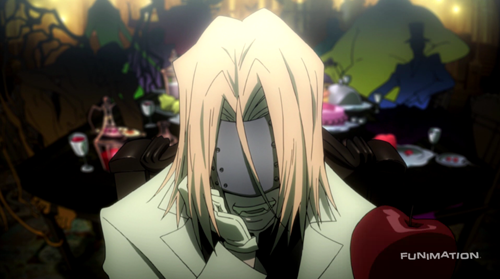
In this world of elder demons, blood-powered super humans,
elemental spectacles of ice and fire, armories of decked-out artillery, and
ESPers/casters keeping the stability of the worlds in check, the most powerful
of them all is the mettle of an individual soul. Leonardo Watch and Mary
MacBeth are indelible forces of power precisely because they are so boringly
predictable, because they perform as one would expect. Because despite all of
the extremities that beat them down and make them feel so small and helpless,
their hearts don't bend to the whim of random chance. Case after case, Leo is given an 'easy out'
to many difficult situations. Sometimes he can just wait it out until Klaus,
Zapp, or Zedd come to help him. Sometimes he can abandon a friend if it makes
his position in a conflict less stressful. But every time, he does 'the right
thing' often at greater risk to himself, and oftentimes it doesn't even amount
to much. White nicknames Leo her 'tortoise knight': he can't do much, but is
steadfast and unyielding at what he can when he finds the courage. He plays by
rules that were thought buried deep in the rubble of the Great Collapse but
actually exists deep in the heart of every man, woman and child - the power of
predictability that leads a human being to performing at the best of their ability
and doing what they think is right, even in the face of terrible odds.
This is a resonant testament to basic human resilience and
strength of heart that Matsumoto imparts in the midst of a catastrophically
rich battle with a demon who is probably Satan on All Hallows' Eve within the
debris of a splintered Hellsalem's Lot as Libra mows down hordes of zombies. I
really do not know how the hell she managed to do all that, but even she needed
a boost to complete her masterpiece. The final episode of BBB is a reiteration
of the very basic truth of human existence I described above, but the
presentation of that truth is so visually dense and lush that it required the
finale being delayed for several months and stretched to double the runtime.
Few series packed such an alarmingly epic capstone to its story like this one.


No comments:
Post a Comment