

Thousands of years
ago, Planet Kumaria was hit by a meteor and exploded. Fragments of the dying
star crashed into our Earth, and when it did, suddenly all of the bears started
acting strangely. They began to eat human girls! We couldn't have that, so
humanity built the Wall of Severance, separating humans from bears forever. But
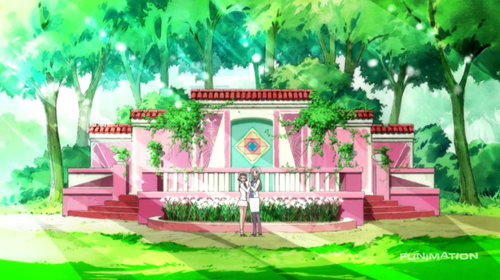
bears don't approve of human rules, because they're bears. Kureha Tsubaki, a
human girl (yuri), loves her classmate Sumika, also a human girl (yuri). Tragedy strikes at the heart of their unapproved love when Ginko Yurishiro and Lulu Yurigasaki, two bears,
infiltrate Kureha's school to eat 'invisible' girls. And when yuri meets
bear, a storm will brew.
*complete spoilers for Yuri Kuma Arashi are referenced in this review - the section where the spoilers begin is emphasized in the text*
In the past three years that I have been churning out anime
reviews, there have been two days which I have been anticipating but avoiding
out of fear that my lack of talent will sully the integrity of their subjects.
One is when I finally review my favorite anime of all time, Fullmetal Alchemist. I envision a day
when I release an extravaganza of an essay comparing and contrasting FMA '03 with FMA: Brotherhood and sharing what I take as a critic from
Hiromu Arakawa's stories. That discussion is terrifying to me, but I know I
will tackle it someday. The second is what is happening today, and it's got me in even greater dread: it's the day I talk
about Kunihiko Ikuhara. This is akin to analyzing Hayao Miyazaki, Mamoru Oshii,
or Satoshi Kon. I scarcely know how to begin.
You may know Ikuhara
as a beloved active feminist who provided his discerning ideals to several
seasons of the Sailor Moon anime. You
may know him as the esteemed auteur who directed the transcendentalist,
progressive thinkpiece manifesto Revolutionary
Girl Utena, lauded to be one of the greatest anime made of all time. You
may know him as the comeback guy who directed the generationally entrenched
urban fable Mawaru Penguindrum, a
dense and complicated elegy to the whims of a damned society and my personal
favorite of his catalogue. You may simple know him as a story-telling genius, a
man capable of packaging whimsy, gravitas, fancy, horror, tragedy, and the
downright wacky into a single narrative firework creating a melodious
explosion of beauty and depth, and you would be right on all accounts. To bang
a gong for this unparalleled talent is unspeakably daunting. But I'll try as I
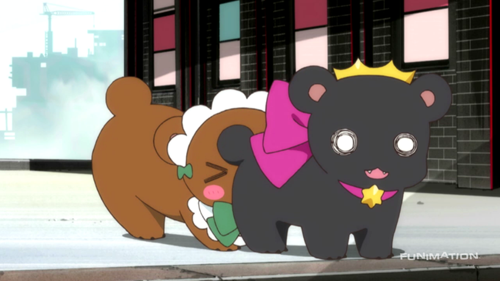
dive into his third completely original animated epic: Yuri Kuma Arashi, a tale about girls who love girls, bears who love
bears, and bears who love girls. Among other things.
Though the gaps between his campaigns are long - Utena came out in 1997, and his next
affair, Penguindrum, was 2011,
FOURTEEN YEARS apart - Ikuhara has lost none of his touch as a director,
writer, and designer. My ingestion of his portfolio is a little skewed; I saw Penguindrum first, then YKA, THEN I went back and finally saw Utena in its entirety (including the
movie). The signs of his talent are all there and deftly carry over that
14-year canyon as if it were only a few days. Curiously, his projects have been
getting shorter and shorter. 39 episodes
and a movie for Utena, 24 episodes
for Penguindrum, and now 12 episodes
for YKA. I'm unsure if this is
industry agents challenging the position of a classic auteur in today's
strictly fan-lauding business, or if maybe Ikuni just doesn't want to write
long stories anymore.
For what it's worth, Yuri
Kuma Arashi is a very good anime. As a Kunihiko Ikuhara joint, it's
probably the most focused of all his projects, exploring multiple angles
conjoining at a single topic rather than juggling many topics at the same time
as Utena and Penguindrum do. One of my favorite designs of Ikuhara's work is how
the aesthetic of each takes on a unique inspiration complementary to the
narrative's surface direction. Generally he loves to orchestrate scenes as if
they are pieces of a stage play - this can be seen throughout all his stuff. YKA's compact size allows it to have
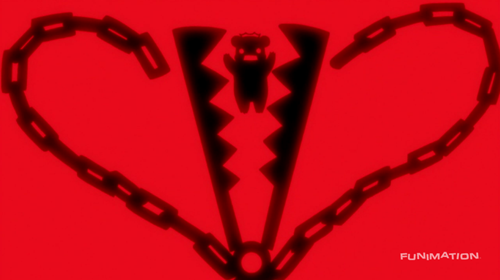
even more nuance, and a large portion of its scenes emulate cheesy horror
flicks. At a surface level, Ginko and Lulu are effectively invaders from
another world, so the music and lighting often treats them like aliens from a
bad sci-fi b-movie - it's kind of brilliant. High contrast, high school murder
and cult conspiracy is definitely the surface definition Ikuni means to
transcribe YKA in; purportedly it
takes a lot of art direction influence from Italian horror cult film Suspiria, wherein a seemingly
prestigious academy hides dark designs of the damned down its halls. Of course YKA isn't actually about a coven
sacrificing girls to their ethereal dark master (I mean, not ENTIRELY) - that's
just Ikuni exercising his knowledge of cinematic history for the purpose of
art, and he's really good at twisting another film's aesthetic to his own
purpose but not completely erasing the original meaning of those designs.
If there's any immediate negative I could find in YKA's
surface detail, it's that the short length occasionally weakens the versatility
of its characters. As the most focused and shortest of his stories, it's also
the most directly mouthpiece-y - insofar as several characters only exist to
represent a single idea or message and have no agency or life outside of that.
It's a short runtime, so critical events and themes are brought forward almost
rapid fire with little time to breathe.
Ikuni's a super talented guy, so he can balance the speed and delivery
of his allegories rather well, but nevertheless, YKA is stuffed tight like a
can of sardines and it does threaten to burst. This is less a criticism and
more an observation at the restraints of the project. A story is still a story
and it's nice for characters of a story to be fully fleshed out and not merely
exist to fulfill a narrative need.
Now, this discussion is going to break off
into tackling individual themes of YKA
and covering what I think they mean in the show's and real world context - this
is a level of discourse I don't normally take but I feel is befitting Ikuhara's
reputation. It's going to be 100% spoiler heavy from here on, so I hope I may have convinced
you to go watch the show before you continue reading (you can find the whole thing at FUNimation's website). Before we do that, I have a confession to
make. You may or may not be aware that I identify as a white, heterosexual
male. This matters because I have invisible privilege on all three counts that
I am decent enough a person to recognize and not take advantage of. I'm not
saying this so I'll be praised for not abusing said privilege - that's like
being given a gold medal for knowing how to breathe. I'm saying this because YKA is a story all about a subject Ikuhara has famously treated
with great respect: lesbianism, and I mean REAL lesbianism, not the idyllic
flights of fancy found in modern anime crafted to service a man's perversions.
This is the real, big deal, and YKA
is whole-hog nothing-but-this-one-big-deal. Being a straight man discussing a
story about modern homosexuality as experienced by women and girls, in a way
that shines a beacon on some VERY touchy subjects, I am well aware how out of
my league I am talking about it, how unqualified I am both as an intellectual
and as a human being to pretend I know anything about it. This is a world
entirely foreign to my earthly experience, but I love Ikuhara, and I love the
way he creates magnificent fantasy worlds that reflect on harsh truths of our
society, so I want to talk about what he's doing here. Because of what I am, I
completely understand if you don't want to read any of this from me. If you do
continue forward, I think you for approving me. So let's commence the trial.
The Wall of Severance
What is a girl? What is a bear? Let's think about it in
terms of an idealized worldview. Girls are mammals who grow older and procreate
with boys to bear children, and the cycle continues. Bears are mammals who grow
older and procreate with other bears to bear cubs, and the cycle continues. By
nature, these two species must exist separately and are thus incompatible.
Right? But what if some bears want to associate with girls, and what if some girls
want to associate with bears? Can't they do that? What's so wrong with that?
"We loved you from the beginning, and we hated you as
well". This double standard proclaimed by bear Ginko Yurishiro and acting
as our introduction to her and all of bear-kind describes diverging progressive
and regressive worldviews that are at war in YKA. "We loved you", we
being the true individual seeking love. "We hated you", we being the interpretation of natural
law forged by human hands. Bears exist in a state of impossibility - their
nature is a complete contradiction. In this analogy, Ikuhara is representing
homosexuals, lesbians, as bears - as creatures that the world chooses not to
see, that the world cannot be allowed to see because they can't BE seen. After
all, homosexuals are one of many subsets of humanity that those on the top of
the social food chain would prefer didn't exist, treated as hideous paradoxes
of a self-appointed norm. Likewise, the clarity of a bear's actions within the
show is dictated by a third party. The natural law of bears is to eat girls,
but what it means to 'eat' is subjective. Sometimes it means to literally eat,
sometimes it implies sexual empowerment, and sometimes it's an expression of
honest love. The bears' use of the word changes given the situation, and due to
its ambiguity the action of eating is always off-screen or obfuscated. As a
writer, Ikuhara loves duality, and in this show he utilizes it by making many
elements follow a visual yin-yang relationship: opposing but in need of the
other to be complete. This is made most obvious by symbols of a girl and bear
forming a literal yin-yang shape as the seal leading into Severance Court (the
symbols are also 'severed' apart as you enter 'severance' court).
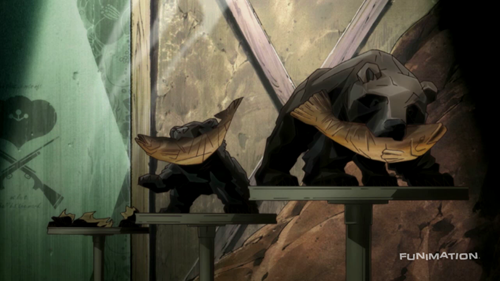
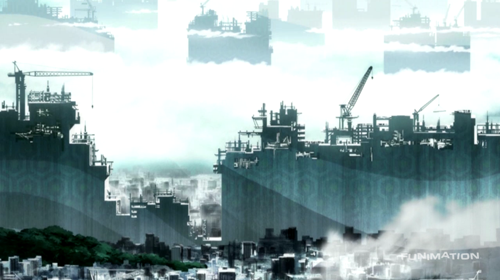
To the end of complete separation from those they don't want
to associate with, humanity builds the Wall of Severance, just like humans are
always forging invisible walls between themselves and what they determine to be
'different'. The Wall is in a never-ending state of construction, negating the
history's claim that we already "built" it. No visible progress is
made through the course of the series , as it is human nature to always find a
new outsider to compare itself too, and to again build a wall between them. This
is a reality I'm all too familiar with, as someone who personally believes the
insistence of labeling autistic children only serves to create social rifts
between people on and off the spectrum, for example. It is the endless drive of
privileged humans to stratify ourselves until we can be contained in our own
personal boxes, shut out from all others.
In the city where YKA
takes place, only human girls exist. Other than the bears that sneak across the
Wall, no animals other than humans are present in any given scene, and no men
either. The central conflict of YKA
concerns stratifying humans and bears, but the conditions of the residency make
you wonder what other stratification have already occurred. Is there another
wall somewhere bordering off all of the human men? There are one or two
instances that negate this idea, but it's interesting to ponder what other
paradoxes the human race of YKA has
already sectioned off from their reality.
The Invisible Storm
While the legacy of hate crimes spurned by homophobia in the
United States is one usually loud and violent, from what I have heard, the same
legacy takes a somewhat different approach in Japan - one of silent, abusive
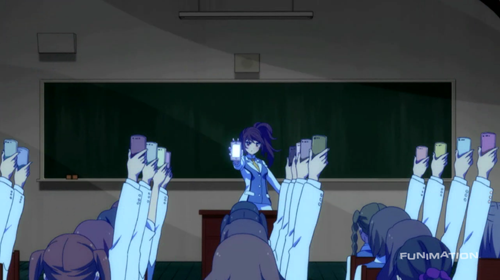
ignorance. This is the approach Ikuhara displays within Arashigaoka High
School. Students Kureha and Sumika are in love, and display their affections openly
in public; they eat lunch together, tend the gardens together, and spend time
at each others' houses. But as students, there is a certain expectation
required of them. Arashigaoka's student body is dehumanized by way of
comparison to cattle, processed beasts who must give way to 'nature' and
protect themselves as a group, to do what's best for the herd. What's best for
the herd is autonomous purity, freedom from sin. Kureha's same-sex love is, by
'nature', forbidden, and goes against the flow of the herd. In retaliation for
disrupting the peace of oblivious, natural law, the other students exclude
Kureha and anyone who gets close to her, subjecting them to cold, social
isolation. That body which actively demonizes individuals harboring abnormal
predilections is the Invisible Storm.
Girls who harbor feelings that differ from that of the herd
become lost in the passive-aggressive might of the storm, tumbling through to
find something that will make them feel whole amidst a hurricane of slander,
cruelty, and non-acceptance. This is a battle of silent persecution that
lesbians, non-whites, and trans-women face every day of their lives, which
people who are deemed 'normal' are unable to see - it is invisible. I may be
aware of these prejudices, but in my immediate daily life it isn't a thing I
can see, because people treat me in a certain way when they know my gender and
pigment of melanin. There's a real power in the idea of something which is impossible
to see yet capable of intense emotional and physical damage. YKA's pattern motifs ascribed to
Arashigaoka capitalize on the visual power of exclusion, utilizing breaks in
symmetry to represent gaps in the herd.
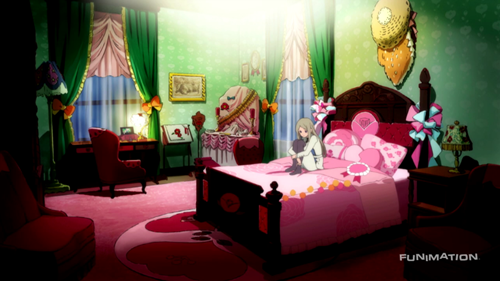
Though the result of exclusion is insular, the ACT of
exclusion is treated as a lavish event. The student body holds regular
Exclusion Ceremonies where the goal is to "Search Evil" i.e. select
via electoral process the next evil to be excluded. Ikuhara highlights the
needless pomp and circumstance of these votes by the result being exactly the
same every single time: Kureha Tsubaki. Exclusion Ceremonies are formalities
meant to make the process of exclusion somehow seem fair, but the reality is
that no-one is voting as an individual. It's not a majority vote, but a test of
homogeneity. To show that they are synonymous with the herd, every girl must
vote for a predetermined roster of 'excluded ones' by order of immediate import
or they might risk exclusion themselves. These modernized witch hunts are both
a show of power toward the victim and a challenge to the remainder of the
student body to remain loyal.
Yuri Approved + Men
As stated earlier, the world of YKA is one where only women seem to exist; in fact there are only
five determinable male characters in the cast. The blanket reason for this
obviously being that Ikuhara has a very specific point to make, and that is on
how women are treated by society, so to do this he removes the other gender as
active participants from the equation because we're not directly talking about
them. However the inclusion of those select few males offers a lot to say as
well.
The word "yuri" has several meanings. In the
context of YKA, it is the signifier
of a human girl. For us, it is a type of flower, and also the Japanese word for
'lesbian romance'. Within anime culture, yuri is a sacred topic synonymous with
pure, unadulterated feminine youth and love presented for the benefit
of...well, man. Yuri anime for fujoshi surely exist, but most of the time the
target audience, like that of moe, is for men. The concept of 'yuri' when
interpreted by man is treated as criminal, taboo material glorified precisely
because of it being an untouchable sacred ground. This is similar to the
popular otaku wet dream of getting romantically involved with your little sister.
Like the way bears are defined in this world, a 'yuri' exists in a state of
contradiction: it is something desirable and yet blasphemed. Ikuhara
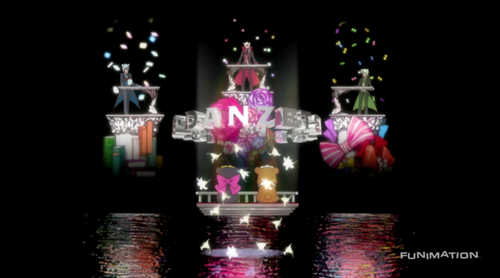
immortalizes the concept of "yuri for the benefit of man" via the
Judgmens.
The Judgmens are bears....or maybe they're humans. But
they're definitely men (Judgement
Men.....get it?). They're something between bear and human, and they
seemingly out of thin air appear, not unlike the Survival Strategy sequence from
Penguindrum, to conduct Severance
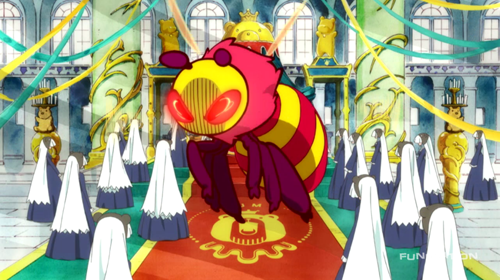
Court at tense junctures where girls and bears meet. Their sessions begin by
calling up girls who are excluded and asking them, "Is your love the real
thing?" Speaking as constructs of the Wall of Severance, they issue a
challenge for the girls to prove their love is real, so that their love may be
approved. In Severance Court, humans or bears face judgment for their worldly
crimes from the three Judgmens: Life Cool, Life Beauty, and Life Sexy.

As with other repeated events of fanfare taking place in YKA, Severance Court is a formality
which reveals the truth of a woman's right to her own sexuality. It's important
to note that when Ikuhara first announced this series, he said he wanted to do
an 'ecchi' show, the kind that you can get oppai mousepads made for or endorse
scandalous spreads in Megami Magazine for. But the caveat to this wish was that
he would deliver "an ecchi show unlike anything you've ever seen". So
going into YKA, it's clear that
Ikuhara is playing around with ecchi elements in ways both full of service and
deconstruction. There're a lot of risqué gaffes on food and public indecency,
but visually it's pretty tame and can't be called true blue fanservice. That
is, until Severance Court comes to a close.
"Will you be invisible, or will you eat humans?"
The three male figures ask this question to Ginko and Lulu as defendant bears,
mirroring a patriarchal enforcement where a woman's choice for love is not one
she is allowed to make on her own. Once their love, their 'yuri', is approved
by a man, suddenly the fanservice cranks up several notches and enters the
realm of pandering. The bears in turn undergo magical yuri/bear transformations
as the camera spins around them at tantalizing angles, winking and undulating
with complete awareness of an unseen viewer watching them, all while Ave Maria plays as backing: the idyllic,
holy purity of lesbianism presented at the behest of a male audience. Ginko,
with Lulu's help, then expresses her desire "to eat" Kureha, culminating
in one of the most blatant visual representations of lesbian sex ever put to
screen.
This sequence has become infamous as the make or break scene
of the show. Many decided that the fanservice was incongruous and antithetical
to Ikuhara's oeuvre, but I would disagree. The fact that magical girl
transformations are featured in all his works aside, I'd argue that his
trademark style of sequence repetition adds context to his overall message
here. The conceit of the Yuri Trials is actually much greater than simply this
one moment of pandering, but as far as the pandering is concerned, I find it
entirely the point that the moment betrays the shame of its female characters. It is a direct commentary on the nebulous
design of yuri crafted for men. It's gaudy, meaningless, and tells you nothing
of a woman's true worth; but none of that matters, because according to man, it
is sexy. Sha-ba-da-doo.
Every other time a male appears in the series, it is for the
purpose of highlighting some truth about a woman's role and treatment in
society in relation to - and often in the shadow of - men. In Lulu's backstory
we meet her baby brother Milne. Though Lulu is the first-born and rightful heir
to her kingdom, Milne succeeds her birthright the moment he is born on account
of being male; this is gender essentialism and entitlement, that there is a
place for men and a place for women which cannot be crossed. In Yuriika's
backstory we meet an unnamed man only referred to as 'Him', who cares for
Yuriika as his 'precious thing' before deciding he doesn't need her anymore and
tosses her in the garbage. "He" represents the frivolous libido of
the male beast (although, the androgynous design of 'Him' gives the impression
that this allegory applies to both genders) and the sin of coveting, that a woman
is something to be treasured and pampered - locked away in a box from prying
eyes - until you are tired of your current treasure and want a new one.
Lady Kumaria +
Religion
Religion is a powerful blanket under which to indoctrinate
followers to a cause or belief, for intentions both good and ill. In the world
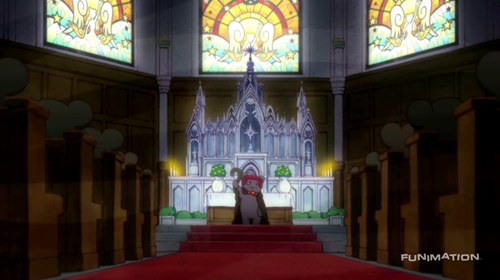
of the bears, Ginko was left as a newborn cub lying on the steps of the Church
of Lady Kumaria - the patron goddess of all bear-kind - and was taken in. It is
no mistake that Lady Kumaria, and Planet Kumaria for that matter, allude to the
actual biblical name Maria (which also covers the usage of Ave Maria). The
bears are strongly informed by teachings of Christianity and preach its word to gather their sleuth under one cloth.
In the name of their holy mother with whom approval is sought, the saint Lady
Kumaster gathers 'unwanted bears' like Ginko to go to war with humanity - Ginko
is manipulated by the church into believing Kumaria is the only being who truly
loves her, and that the way to vie her approval is to eat lots of humans. People
who have already been stripped down to their core can be convinced to do
terrible things under the guise of religious fellowship.
Another religion exists within the walls of Arashigaoka High
School - one which silently instructs the flow of the Invisible Storm through metaphorical suggestive hypnosis. The school itself - in the most direct narrative sisterhood with Suspiria - is characterized as a sanctimonious
sanctuary for women which traps its students into the mindset that their collective contribution
to their environment is more valuable than their individual worth. There is a
global normalization at work that a woman is a necessary part of social
settings and should be seen AND be expected to behave in respect to the rest of
the crowd; but outside that context, she is powerless. Student body gatherings
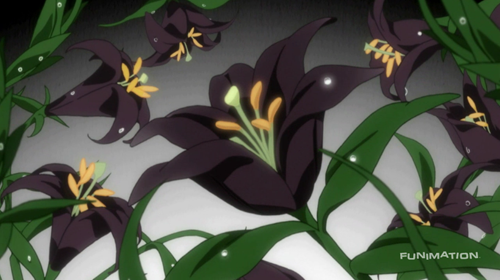
at Arashigaoka directly resemble witch covens; the students sit transfixed in
darkness as the illusive wall pattern of lilies turning into doves illuminates
their faces. A lily (a yuri/girl) becomes a dove (biblical symbol of peace) -
it becomes a child of God. In YKA,
the power of a holy manifestation is not discounted, but is revealed to
castrate the population of their agency to their material lives when funneled
through human hands and organized religion. Ok, so that's an angle stories have
been touching on for decades, but it's important in this one.
The Trial of the
Promise Kiss

To covet your love is to treasure it indirectly. Human
beings are constantly creating impure, external contexts of their love - anime
that idolizes women as objects of sexual desire is but one of these outlets.
The girls of YKA face literal and
figurative trials against the sins of harmful love: obsession, desire,
envy, and pride. The treatment of
the Severance Court's defendants as "criminal-bears" reveals a new
meaning for Ginko's introductory adage. The Judgmens/the patriarchy
"love" women within idolized constructs, but they also
"hate" women who fail to live up to their unreasonable standards;
they have committed the crime of being impure. This is why in their verdicts the
girls are always forced to choose between two scenarios. Of course Ikuhara is
nothing if not a master of multi-sided symbolism, so the crimes the girls are
accused of are both indictments from a male power but also real flaws that
humanize them.
In the lore of YKA, 'love' and 'kisses' are both expressions
of affection with different connotations. In Lulu's trial to become a human for
Ginko's sake, she is instructed to either "give up on love" or
"give up on kisses". 'Kisses' refers to her brother Milne, who was
determined to appease his big sister and receive a kiss from her. 'Love', as
mentioned earlier, refers to the relationships bears share with humans and the
various ways they express their love, via eating or predatory admiration or
otherwise. A mutual kiss is - in the YKA dictionary - much more intimate than the broader, poorly-defined
definition of love. Many incarnations of
'love' are selfish, harmful and deceitful, but a 'kiss' is free of that
ambiguity; it's pure. In Lulu's case, a kiss between her and Milne would
symbolically bypass the strict laws of their kingdom which makes them
competitors in pursuit of the throne. It's a symbol of their familial love free
of society's spiteful attitudes of essentialism. Ergo, the path to salvation is a
kiss, a private symbol of love more true than the ways the actual meaning of
the word can be perverted publicly. To admit that something so universally
accepted as a force of good as 'love' can also take on maligned purpose is
pretty ballsy - to me, it's one of the most controversial messages YKA has to share. But it's true. The
intention behind a declaration of love, in certain settings, can be quite
dangerous.
Speaking of everyone's favorite oh-so-clever bear, Lulu
Yurigasaki - the culmination of her trials conjoined with Ginko's is pretty
heartbreaking and one I found the most powerful. Lulu refused to accept her younger brother as the future king,
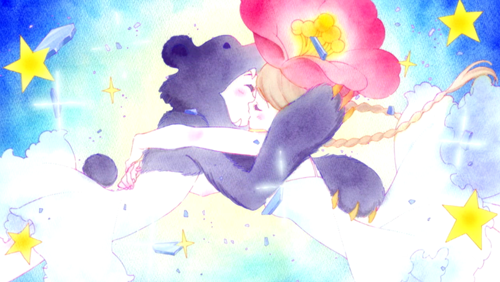
and for her defiance she was shamed by losing her ability to bestow him love as a sister. In atonement, she dedicated her life to helping Ginko claim a kiss
with Kureha, asking for nothing in return. The kiss that Ginko seeks is a
Promise Kiss - a promise between two girls who were once true friends (true
friendship is another synonym for love in this show) to one day become true
friends again. Ginko's trial was one of selfish, personal gain, but Lulu became
a martyr by acting as a vehicle to foster the trials of others. She took the
brunt of the repercussions women face standing up for their rights on her back,
beaten and rejected but forever
dedicated to seeking enlightenment despite it being impossible for herself to
obtain it. Ikuhara loves his allusions to biblical entities, too, and I think
Lulu isn't far off from emulating Bear Jesus.
The Door to
Friendship + The End
As chronicled in Kureha's mother's storybook The Moon Girl
and The Forest Girl, a giant mirror resides between two worlds. The only way to
make it to the other side and meet your true love is to smash the
"you" present in the mirror - to break society's conception of you
and your own faults. Only then can your "true self" breach the wall. The
crime which marks Ginko a criminal bear is that of envy - she is jealous of
anyone else who Kureha loves and wants to be her one and only (which isn't
unreasonable; recall that she was raised to believe that only a single person
could ever love her). In her criminal trial, Ginko is able to smash herself
once she overcomes her primal desires that boxed Kureha's love in her heart - she
was driven to covet just as predatorily as the other yuri bears encountered
throughout the series. In a twist, Ginko mirror is then mirrored by Kureha's
mirror. In the past, after Kureha faces publicized persecution for daring to
associate with a bear, Ginko pleads her case with the Judgmens to turn her a
human. But Kureha initiates her own
trial at the same time and makes the exact same wish: to make Ginko a human. Kureha
had actually been labeled a criminal years before Ginko: her crime was of
pride, because she made a wish on Ginko's behalf without her permission. In the
present, as the Invisible Storm prepares to eliminate Ginko in defiance of girl-bear relations, Kureha,
with memory of her actions fully restored, confesses her sins and makes one
final request; not to the Judgmens but to Lady Kumaria herself: to become a
bear.
This was a key moral I had been missing which put much of
the story's progression into satisfying context. To love someone is to accept them into your
heart, every single facet of their being - to approve them. I finally
understood - transforming into humans was Ginko and Lulu's way of showing their
love for Kureha. By becoming what she is they accept what she is. So in turn it
makes perfect sense that for Kureha to fully accept Ginko's love, she must
become a bear. It then becomes clear that the bear-girl transformations granted
by the Judgmens are not merely sexualized designs for a male audience, but the
embodiment of their true selves, an
existence both human and bear and yet neither. As a symbolic force, I think
this puts the Judgmens in a much more forgiving light as arbiters of positive
change. Could this also be Ikuhara's way of reminding us that not all men are
monsters who use women for their own selfish wants? Maybe. But more
importantly, though they may have good intentions, the Judgmens are unable to
grant Kureha's final wish; i.e. contrary to their role as men, it is not in a
man's jurisdiction to choose a woman's role for her.
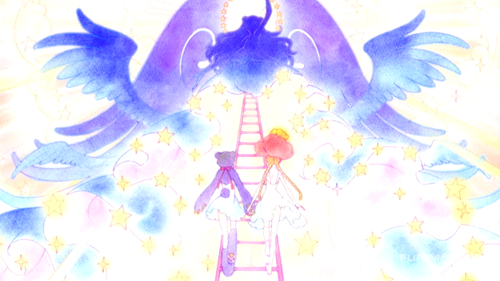
That is the way of the idealized world where Ginko and
Kureha, after finally sharing their Promise Kiss and under the gentle wing of Lady
Kumaria's guidance, have ascended beyond our backwards, sexist ways. You could
say Ikuhara's capstone calling card is to have his protagonists break free of a
cruel, never-ending cycle into an uncertain, yet beautiful eternity out of our
worlds' phase. There are only personal victories in his stories - the world
continues on unhindered as it always had, and just a glimmer of recognition, a
little drop of positive change, is left in the wake of every emergence from the world's cycle. There's an inherent cynicism to this ultimatum: girls can find true happiness in their love when their consciences move beyond the world's conception of it, when they stop letting the world herd them back in line, but they can't change the way the world views them. Individuals have the power to transcend, but people as a collective are fated to their heinous prejudice. Still, there's hope. The final scene of Yuri Kuma Arashi tells us that the boldness to be true to yourself and not just follow the patterns of the herd can inspire others who
may feel invisible, who may feel unwanted, and who may feel they don't fit into
society's norms, to step forward and defy the world that tries to define them to what makes them feel comfortable; fostering positive growth one yuri couple at a time.
You can currently find all subbed and dubbed episodes of Yuri Kuma Arashi streaming online at FUNimation, but hopefully you already knew that as I suggested you watch the show in full before getting this far. No home video release in the U.S. has been announced at this time.


No comments:
Post a Comment