
Good morning folks, thanks for checking in early! Today marks the third day of the 2014 Anime Retrospective, and due to my botched scheduling, there will be TWO, count 'em, TWO reviews coming at you on this fine New Year's Eve. The first will be the fantasy epic with visions of Hollywood in its eyes, Rage of Bahamut: Genesis. This evening will feature a show which I have a no doubt highly contested opinion of, Mahouka (The Irregular at Magic High School). I'm saving the crap for when more people are awake because I honestly believe that review is the most entertaining out of the bunch. Lest that be said, I do not intend to pull attention from Bahamut, as that is one I hold dear to my heart and wish to share. Scroll on down to see my thoughts!
Mild spoilers for the culmination of certain characters' arcs and relationships exist in this review, so be wary!
Mistarcia is a land
where humans, gods, and demons coexist. They have lived in tempered peace for
2,000 years since rallying their powers to seal the terrible elder dragon,
Bahamut, to prevent the world's destruction. Far from tales of mythical beasts
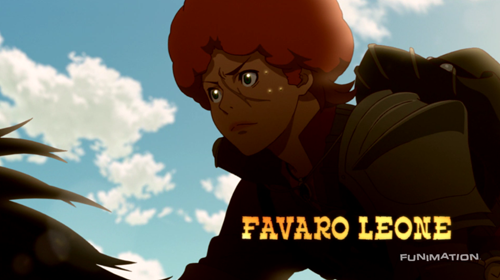
and and ancient prophecies, silver-tongued bounty hunter Favaro Leone travels the
globe looking for a quick buck and an easy time. But his luck is doomed to falter when he
encounters a young woman seeking safe travel to the mysterious town of Helheim.
Rage of Bahamut:
Genesis is an odd duck as far as adaptations go. What do you do when you've
got a popular card game and you're asked to make an anime out of it? Most would
follow in Yu-Gi-Oh!'s footsteps (which ironically is backwards since the YGO
card game came about after it became the staple feature of the manga),
depicting teenagers battling with cards in duels that are 'more than just a
game'. These days, many anime are created for the express purpose of later
making further profit off a card game, such as Fantasista Doll and WIXOSS.
Cards are a compact, handy concept and people love to collect cards - it's a
win/win situation. So what would Keiichi Sato do, when approached with Rage of Bahamut?
Keiichi Sato may best be known as the director of Tiger & Bunny and original concept
creator for The Big O. Primarily a
mecha designer, he is a self-professed nostalgia lover which knowledgably seeps
into his production credits. His work can very easily be placed into a
particular time period and genre just at surface level. The Big O invokes an anime twist on Batman: The Animated Series and early-90s action drama. Tiger & Bunny covers superhero
serials and works the very idea of nostalgia into the plot; a world where
superheroes have become processed and monetized yet protagonist Kotetsu longs
for a time when 'real' heroes were needed. His concepts seem to be based
heavily on 'super heroes' as depicted by the age of their origin, not
necessarily the classic, stalwart heroes we envision. For instance, the heroes
of westerns aren't exactly the most sympathetic or approachable individuals.
They're often loners who operate on their own code of justice, they may even be
crass and rude anti-heroes, but in the end, they still get the job done. With Rage of Bahamut: Genesis, Sato got the
chance to expand his oeuvre to this type of character and setting.
Assuming most of Sato's direction is influenced by his
personal nostalgia, I can only assume he has strong feelings about Hollywood
westerns and fantasy adventures, as Bahamut
is overflowing with cinematic pizzazz unusual for an Eastern production. The
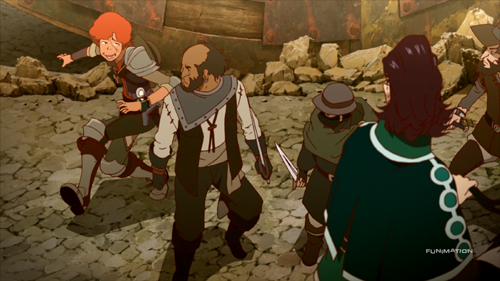
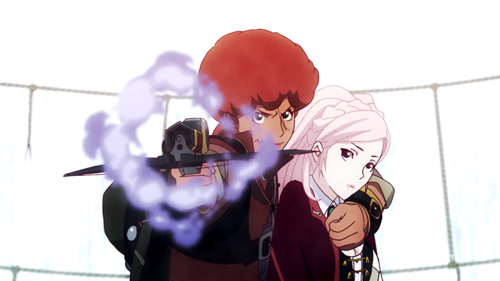
series opens not unlike we were watching a scene from The Princess Bride, as bounty hunters Favaro and Kaisar give chase
on horseback, gallivanting over rooftops and bridges, flashy on-screen text
revealing their names for the audience. There's an obvious blend of Tarantino
in the mix as well for comedic elements, with just the slightest touch of his
eclectic irreverence spicing up the rivals' banter. Sato assaults our senses on a grand scale,
taking a fantasy card game and actually adapting a story from within the
universe of the game, not just making a show about cards. Instead we got a
swashbuckling fantasy epic pitting a sleazy, good-for-nothing anti-hero against
the fate of the entire world. More of that, please.
Bahamut is a
simple Hollywood-fare story about saving the world from prophecy-foretold destruction
that saves itself from total homogeneity by its karmic cast of characters.
Favaro is a snarky rascal only looking out for his own hide, shadowed by his
old friend Kaisar, a goody-goody moral compass in thought, word, and deed. Upon
meeting Amira, the strange girl who fell from the heavens and seeks passage to
Helheim, Favaro and Kaisar are strung along from one locale to the next, meeting
gods and demons and learning the truth of their families' sordid pasts,
eventually coming together to tackle Amira's fate. This is not a story where
the protagonists necessarily change, but rather meet at a common ground of
understanding and work around their differences - because the story at work
isn't REALLY theirs though the viewer generally follows Favaro's perception of events. They just got caught up in another, bigger story and are
being flung around like marionettes. The presence of Amira and Rita the undead
zombie girl (yes really), help mediate that conclusion.
That isn't to say I
find the female characters of Bahamut
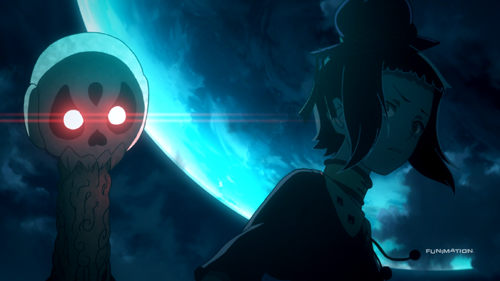
tied down to a man's whims - they are anything but. Rita is a completely
independent factor who merely tags along because she finds Kaisar's group
interesting. Amira, more than anything, just wants to see her mother again.
However, we see through the female characters perhaps too much embellishment of
Sato's Hollywood bender; the negatives of this approach which combat the narrative
against their strengths. Though she is independent, Rita has no goals of her
own - she just becomes a member of the team and helps out, but to what end? We
don't really know. The people's holy knight, Jeanne d'Arc (bet you can't guess who she's based on), portrayed as an
unflappable fortress of patience and good will, is stripped of everything and
broken into madness merely to demonstrate one of the villain's abilities; it
feels a shallow conclusion for her character.
Too often in Hollywood, woman are relegated into roles that blatantly service
a plot-point or trope, and Bahamut unfortunately falls into this
trap with Jeanne and ESPECIALLY with Amira.
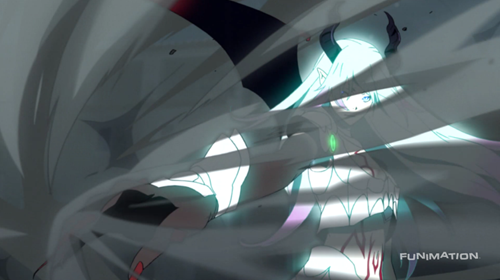
The character of Amira is a perplexing one from a conceptual
standpoint. She's at once both sympathetic and likable but also kind of
confusingly designed in a way that feels manipulative. Like you weren't sure
what role the writers wanted her to play in the story on an emotional level.
Firstly, this IS Amira's story - everything that happens comes about from her
actions. She is literally and conceptually a tool for the revival of Bahamut; a
key locked inside a demure girl who just wants to be reunited with her family
and make peace. But it's in Amira's personality and portrayal that her purpose
as a character (outside being a focal point for the story) gets confused.
Before we knew much about her, she was presented like a silent, somewhat
absentminded femme fatale: shot in a way not totally objectifying but clearly
made to allow us to be admirable of her body. The charm of her character was in
the stark difference between her childish introvert side and badass action side, but on both sides equally devoted to her mission -
she's beautiful, straight as an arrow, and can kick your butt. What's not to like,
right? We find out more about her later, and without spoiling as best I can, we
discover that her appearance doesn't quite match her age.........explaining her
child-like naivety. Emphasis on 'child-like'. She acts like a child because she
is literally a child inside an adult woman's body. This character that we had
been given several curvaceous views of prior to this revelation.
Uhhhhhhhhhhhhhhhmmmmm.
I'm not AGAINST this type of characterization - a young mind
inside a matured body can be handled well, but Bahamut only takes the most predictable, silver screen route.
Favaro and Amira develop a relationship by the end of the series that feels
like brother/sister, so it stings of betrayal when their final scene together
ends in a kiss, because every climactic fantasy adventure in Hollywood must end
with a kiss. It's like if at the end of Pacific
Rim, Raleigh and Mako had kissed on the lifeboat. The whole movie built up romantic tension
between them, and yet it ended on merely the notion of "glad to be alive
here with you", not "I love you"; it was a highly progressive
route to take and one I was happy to see, for once not enforcing a romance and
only leaving it up to interpretation. This narrative basically forces Amira
to mature physically and mentally beyond her years in order to create a
sympathetic, likable character who could also satisfy the needs of
rote Hollywood romance. It may be a visually satisfying bon voyage from their relationship (and their relationship is my favorite aspect of the story) to have an on-screen smooch - it is a high emotion kind of
moment that fits the tone of the final episode - but factually it doesn't feel right. She's a character I
like......but oddly manipulative in her conception. Like, I dunno, I understand
why her existence was one of constant pain and suffering, but to force a traditional romantic ending was too much for me. You feel bad for her more as a creation of
the production staff than as a character in the story.
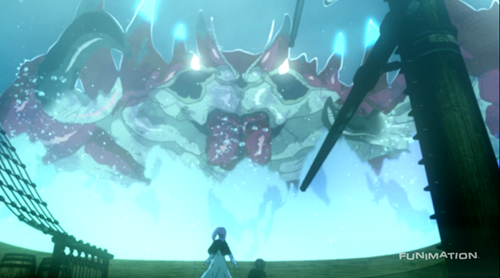
I harped on that quite a bit, but I honestly don't think
Amira is a bad character. She's manipulated at the expense of the direction and
as such lives a sad, terminally short life, but there's nothing explicitly
toxic about her and she's absolutely still someone you root for. Everyone in Bahamut is. It's a full-blown
extravaganza of one of my favorite types of stories: when multiple factions in
a stratified, complex world come together to fight a simple, common enemy. The
type of story with twists and turns and clever, gratifying pay-offs that tease
and excite; a story that favors non-conventional characterization (even Amira's
is technically non-conventional) to deliver a fresh flavor to mythical lore that
has been retread over and over and over again. It's a story that speaks 100% to
lovers of the anti-hero daring-do wiles of Western cinema, and really to no-one
else.
This is one of the least 'anime' anime you can find; there's
nary a drop of otaku conventions or Japanese culture to be found. Scenes are
shot in ways that emphasize location as a valued part of the story - even the
episode titles are often marked by the city the characters' are currently in.
Traditional anime story-telling is very insular and tends to focus on the
individual character as the #1 construct of the story. They are the draw - the world
exists around them, in spite of them, as commonly the setting of an anime has
little bearing on the story's ultimate conclusion, because it is reliant on the
characters. In contrast, Western story-telling relies heavily on context and
setting; worlds that characters exist IN. Bahamut
introduces a world where many characters exist, but don't always take
center-stage, because the setting is the star player. Fans of traditional anime
look for stories with characters that they can latch onto, whether it be a
character they relate to or just a cute/hot girl they want to draw fanart of.
They are less concerned with the world the characters exist in, which is why I
think Rage of Bahamut: Genesis will
not be a very popular 'anime', at least not on its home shores.
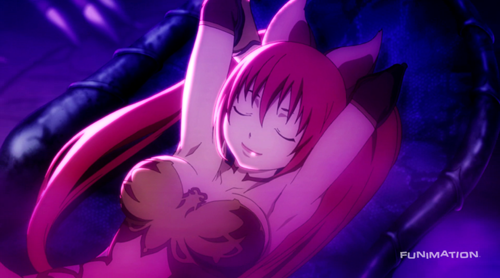
A prime example of this disconnect between Bahamut as a Japanese anime and as a
Western-styled animation can be seen in the character Cerberus. She's probably
the most traditional anime 'thing' in all of Bahamut. She's a demon, a representation of the same Cerberus of
Greek legend, but instead of having three heads, she's imagined in a lithe,
loli's body with independently sentient dog heads for hands. Were
this a regular anime, I guarantee Cerberus would be getting all the screentime
because she's a cute girl with a funny visual quirk. It's like Kantai Collection - it's a genius
concept made specifically for otaku. But here, Cerberus gets virtually nothing
to do but occasionally mug for the camera; no character arc, no fight scene, no
nothing. There are several characters like this in Bahamut who come and go with little warning, or whose screentime is
directly proportionate to the needs of the story, not the wants of an audience.
This is not the type of character usage otaku want to see. They want characters
they like to appear on-screen a lot and do anything, not only operate as a
function of the world and story they exist in. Bahamut does not satisfy that mindset.
What Bahamut does
satisfy is my desire for an entertaining story filled with entertaining
characters directed through the lens of big budget cinema. But before I end the
review, I have to ask - does Bahamut
satisfy fans of the original card game? It is an adaptation, after all - is it
a GOOD adaptation? That's hard to say, as there isn't a concrete narrative in
the original Rage of Bahamut card
game to adapt. It's a fantasy game with fantasy instances and fantasy monsters
to fight - there are only mini-stories acting as player events to win riches
(more cards). But based on what I've heard, the anime does provide forms of
fanservice to those who just so happen to have played the card game. All of the
character designs come from existing cards, so, congratulations, nameless
bounty hunter guy, you are now Kaisar! One cute scene in Episode 2 has Favaro
picking out clothes for Amira. The varying outfits she tries on in
humorous quick-cuts are all based off player class designs from the game, so
that's a nice touch. It's primarily aesthetic details that carry over from card
game to anime. But honestly I don't see much point in figuring out if Bahamut is a good adaptation - it's good
enough that it doesn't need to be considered an adaptation.
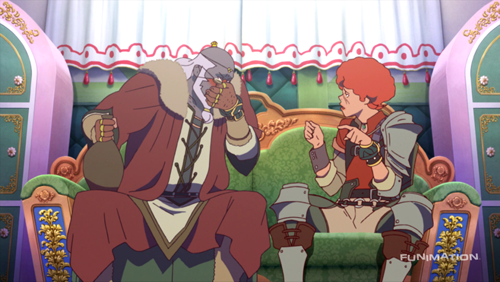
You can currently find all subbed episodes of Rage of Bahamut: Genesis streaming online courtesy of FUNimation. A home video release has not been announced at this time.


No comments:
Post a Comment