
Welcome to the second day of the 2014 Retrospective! Today we're going to take a look at a mecha series known as Captain Earth, a show for me which represents the dulling state of sci-fi anime in light of other, highly more progressive works in recent years. Read on, but be wary, for sort-of spoilers exist in this review. I say sort-of because most of the information here is required knowledge for even beginning to understand what's going on in Captain Earth. Yes, it's that kind of show. Enjoy! Try to keep your head straight as you process the absurd amount of proper nouns!
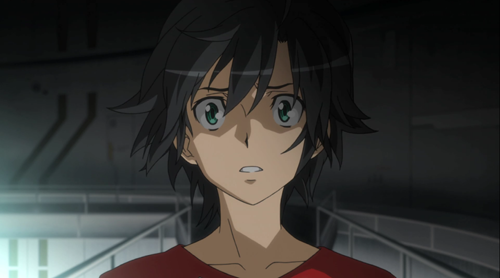
Daichi Manatsu left
Tanegashima years ago after his father died in a 'routine' space flight
incident. He returns when the memory of an old friend, a boy named Teppei who
could create a circular rainbow in his hand, appears in the sky. Daichi sneaks
into the old facility where they used to play and discovers a mysterious child
and an elevator. Through mysterious portents, Daichi comes into possession of a
gun called the 'Livlaster', a weapon and key which utilizes mystical Orgone
energy needed to pilot a massive robot known as the Earth Engine Impacter,
owned by GLOBE, an Earth-based defense force in operation to prevent attacks
from an invading alien race called the Kill-T Gang, beings from Uranus who seek
to drain all of Earth's life force to further their own perpetuity. Now Daichi
must......do something......to stop them...
Sorry, I...I had a brain fart at the end there. Welcome to Captain Earth: IT'S REALLY CONFUSING AND
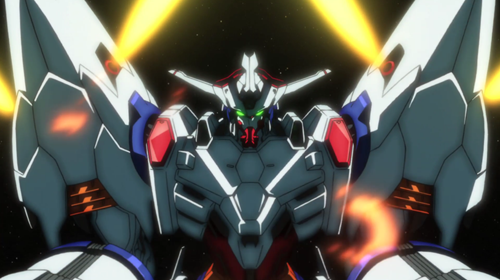
HAS TOO MANY PROPER NOUNS TO REMEMBER! Captain
Earth is brought to us by Studio Bones, famed Star Driver director Takuya Igurashi, and well-known screenwriter
Yoji Enokido (unfortunately, Captain
Earth does not feature as much cinematic flair as his work on Utena, Ouran Host Club, and Star
Driver displays). With such an accomplished production team at the helm, Captain Earth must have been a real
smash hit, huh? Ehhhhhhhhhhhh, let's talk about it.
One could call this a sister series to Star Driver, an homage to Eureka
Seven, a love letter to extravagant mecha anime - one could call it many
things. Whatever it is, it was hyped all over Japan as the next big thing. Star
Driver was introduced as 'the next big mecha series' that wasn't Gundam or
Studio Gainax, and it failed spectacularly. Now the exact same team is back up
to bat with a new pinch hitter: Captain
Earth. Star Driver met a certain
checklist of features on its quest to be the best new mecha ever, so let's go
through them all to make sure Captain
Earth is proper material to achieve the same goal.
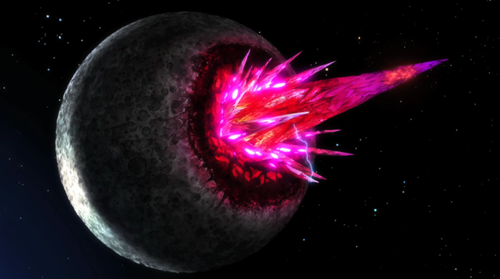
Do we have "an incredibly long list of characters, factions, and motivations impossible to keep
track of"? Yes, we do! Daichi Manatsu becomes a member of GLOBE as the
pilot for the Earth Engine Impacter because he possesses a Livlaster. He is the
captain of the Midsummer's Knights, along with Teppei Arashi, a defunct Kill-T
Gang, Hana Mutou, a failed living harvester of Orgone energy, her pet squirrel
Pitz, who can predict convergences of Orgone energy, and Akari Yomatsu, a
self-proclaimed 'magical girl' hacker and daughter to the Head of GLOBE's
Tanegashima Base. They are members of GLOBE, the Earth defense force against
the Kill-T Gang invasion, which is divided into several bases of operations
including the Tanegashima Space Center land base and the orbiting ship Tenkaido
which intercepts Kill-T Gang energy signatures. GLOBE represents just one of
mankind's responses to the alien threat, the "Intercept Faction",
relying on giant robot Impacters to battle the Kill-T Gang before they can
reach Earth. Other factions are at odds with GLOBE's approach, such as the
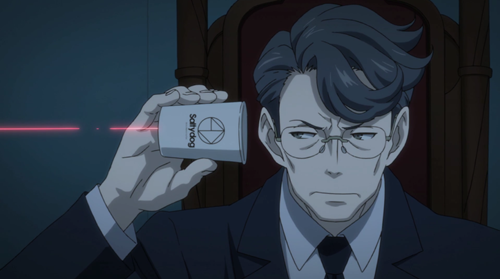
organization Salty Dog's "Ark Faction" which has placed its bets on
the Kivotos Plan which relies on safely harboring select humans on a ship to
escape the planet, leaving the rest to be devoured by the Kill-T Gang. The
Kill-T Gang themselves operate in human form on Earth under the protection of
Macbeth Enterprises which provides them with offensive mecha used for their
orbital invasions, run by corrupt CEO Masaki Kube who believes he is privy to a
specialized artificial intelligence known as PUCK which gives him control over
the Kill-T Gang but really PUCK is on their side and...and......and...all of
that stuff. It may sound like I've divulged way more specifics than an
introductory review requires, but all of this is pretty much BASE information
you learn in the first few episodes, necessary to have any idea what the fuck's
going on. This is the kind of show where you need a manual on entry just to
keep everything straight in your head.
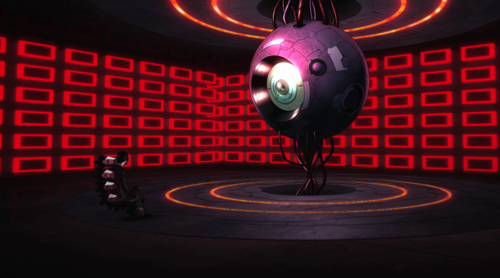
Do we have "confusing episodic plot structure and terminology"?
Yes, we do! Let me explain what the Kill-T Gang really are. The first two
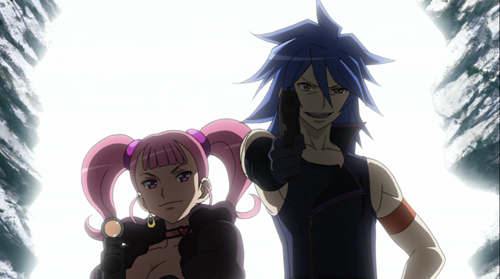
Kill-T Gang we meet are Amarok and Malkin, a couple of Team Rocket-esque
schemers with grand designs for stealing all of Earth's life energy. In
actuality, what their species is called (like, their equivalent of the word
'human') are Planetary Gears. The core of their essence is contained in small
cubes known as Ego Blocks which are stored on their mothership, the Auberon,
which orbits Uranus. The Planetary Gears' genetically-altered human bodies are
known as Designer Children - these forms allow them to exist on Earth. But they
cannot steal life energy in this way. To do THAT, they must gather enough
Orgone energy (I.E., what Hana was originally created for), and once they have
enough, they can create a spatial reaction by piloting their Machine Goodfellow
robots which summons their Ego Block outside Earth's orbit and creates the true
terrible form of a Planetary Gear: a Kill-T Gang. In this form, their very
proximity can absorb life energy, thus a single Kill-T Gang making it into
Earth's atmosphere would spell doom for humanity, hence why the deployment of
giant robots like the Earth Engine Impacter is necessary. That is the entire
process going on behind the scenes for a SINGLE Kill-T Gang to attack Earth,
I.E., a single episode. Yikes.
Do we have "self-indulgent double entendres meant to
represent the human condition"? Yes, we do! Yoji Enokido is obsessed with
flamboyance and the virginity of youth, displaying this via visual and spoken
sexual metaphors. And what greater glee can there be but to hide the primal
language of love inside science fiction drama, a genre to which sullied
adolescence is its bread and butter. Daichi is a teenager, and so of course
this must be a coming-of-age tale. To represent this, let's characterize the
bad guys as the height of sexual promiscuity and the giant robots as the
metaphorical deflowering of youth. The term "kiltgang" is German; it
stands for the act of a man meeting in secret with a woman he loves, out of
wedlock, and uniting in heretical sexual congress. So the Kill-T Gang represent
a desecration of religious adulthood, a path to sin. This is further visualized
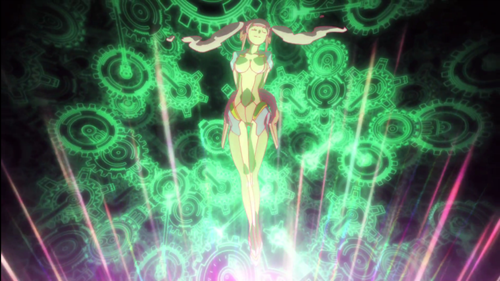
when a Kill-T Gang merges into its true form. Within the space of their ego
block, a humanoid representation of the Planetary Gear is still visible for the
audience; here, they are naked with more accentuated curves and features,
moaning in pleasure at the sensation of being 'complete'. Whereas in Star
Driver, Takuto's ascension into Tauburn was emphasized by its beauty and
perfection, symbolizing his carefree spirit, Captain Earth's robot Impacters
are hulking monstrosities that must be docked at multiple stages of Tenkaido
Road to achieve full mobilization. This process doesn't sound sexual, but the
way it's shot gives the impression of a small object penetrating into the
bottom of a larger object multiple times. I take this to represent piloting
Earth Engine as a visual deflowering of Daichi's budding adolescence. Also I
may just be a prude and am conditioned to seeing objects ascending into
metaphorical anuses. None of this means much aside from a weak ploy at giving
context to fanservice elements - standard otaku fare symbolism.
As you can see, there is world-building galore in Captain
Earth, bursting from the seams. So much world-building in fact that there is
little room for any other features. This brings me to my total evaluation of
Captain Earth. It's......average. I found myself halfway through the show,
keeping notes of character names and factions and the number of enemy units
when I came to the realization I didn't care one bit about any character. In
its effort to be a complex world with complex rules and complex history, this
show utterly fails to make a world inhabited by complex people. And that's
entirely for lack of even attempting to create empathy.
There are no personalities anywhere in Captain Earth. All
characters are humanoid husks piloted by specters of space dramas past. Take
Daichi Manatsu. He's a......boy, who......has......a boomerang.....and he likes
to......eat watermelon...? If you're like me, you'll have a very hard time
describing a character by any measure but the things they've done or had done
to them. I can tell you all about how Hana Mutou was a bio-weapon connected to
a submerged space ship called the Blume and how she was trapped in stasis for
years until Daichi's voice awoke her, but I'll be damned if I could tell you
what kind of person she is. She has large breasts, because the plot told her to
and I guess that's where she stores all that Orgone energy. The two fall in
love later on, again, because the plot deemed it necessary for there to be a
romance. Teppei and Akari fall in love too, because there was no-one left in
the Midsummer's Knights to fall in love with so I guess they're stuck with each
other. Their romantic fates were assigned to them on a waiver as they walked
through the front door.
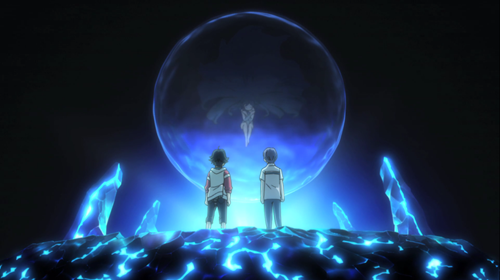
Contrary to my cynicism, the basis for intuitive character
dynamics was laid out beautifully on paper. Every member of the Midsummer's
Knights holds a clearly defined relationship with each other member. Daichi and
Teppei are old friends who loved to tease each other (in a very bro-ish
fashion) and play a game where they'd relinquish ownership of a blue amulet
every time the other manages to surprise them, a tradition which they continue
in Globe. Hana and Akari grow a sisterly bond via their shared relationship
with Akari's mother, who chooses to act as Hana's unofficial surrogate mom.
Daichi and Akari are the two human members of the Knights and help each other
out in battle - Akari is the one who helps Daichi control Earth Engine
during his first sortie. Hana and Teppei
are the non-human members and they also share a bond on the battlefield - Hana
specifically uses her Orgone energy to give shape to Teppei's latent Kill-T
Gang powers. And as mentioned above, Daichi/Hana and Teppei/Akari come together
romantically. This is all well and good until you realize two things in
execution: 1) the distributed relationships are drastically similar for both
sides (friend, battle, lover) like a bulleted list, and 2) there's next to no uniqueness.
Why exactly do Hana and Akari see in each other as friends? What does Hana see
in Daichi romantically? Planetary Gears and those with singularities possess
the ability to Vulcan mind-meld with others through a kiss, and this acts as a
very convenient device to hide the particulars of Hana's love for Daichi behind
more world-building! These are simple elaborations which are barely expanded on.
Not to mention the battle connections get thrown out of whack once Teppei and
Hana receive their own Impacters, more weightless plot embellishment to add to
the Wiki page. The relationships are as robotically organized as the overly-complex
plot and only exist to be talking points, gussied-up plot synopses for
superficial discussion among elite fans.
But what about all that world-building, surely it's enough
to carry the show on its own? The world-building is the reason Captain Earth is elevated to the level
of average and not plain ol' mediocrity. But it is not as inventive as, say,
Log Horizon's, which I shall elaborate on in that future review. Captain Earth just doesn't give us
anything new or interesting enough twists to warrant recycling. It feels less
like a celebration of giant robot anime and more the algebraic formula for its
continued stagnation. Classic key scenarios are played out here in joyless
visual acuity: invaders from another world, love between a human and non-human,
an artificial intelligence that can lie, existential shared dreams of normalcy
just before the final episode. I've seen all of this before done better.
Namely, by the Eureka Seven series. Captain Earth is missing a key component
from its formula: the human element, which it desperately needs, as the ideas
behind the show are not strong enough to stand on its own legs as an abstract
piece. Without it, the various high-tech set pieces are mere baubles - playthings
of the inexperienced adorned with pretty lights and sounds.
What we have here is a textbook example of young adult
franchise-ism. Though not a franchise by definition of its episode/season
count, it bears the same tendencies of American cartoons that place internet
fan culture above its own quality. These are cartoons like Legend of Korra and RWBY. These shows prioritize world dynamics above all
else, spending endless lengths of screentime on lore, laws, and elaborate
machinations. This approach appears to enrich a story at first, but eventually
it becomes so enriched that it is indistinguishable from standard operating
procedure; shined so hard that the sheen blocks out minute features. The
characters in these shows are written into relationships by flimsy proximity
and are fueled based on fan reactions, not author intent or natural impulse.
Have these two characters exchanged more than one line of dialogue?
Congratulations - they may now be shipped! This is the exact sensation I get from
watching Captain Earth. Its
world-building conflates with its narrative to the point that the entire story
feels like you're watching the literal video transcription of a Wikipedia
entry. Its characters develop romantic relationships only so viewers can be
titillated by romantic relationships, leaving out any realistic human
progression. It is a show about robots written by robots, trying to understand
our complicated hu-man emotions but failing to grasp that complexity beyond an
observable level.
You can currently find all subbed episodes of Captain Earth streaming online at Crunchyroll. Sentai Filmworks has licensed the full series for a currently unspecified home video release.


No comments:
Post a Comment