


You push your way through the dusty tomb, coming to a clearing where a formation of leveraged blocks protrude from a nearby wall. Compressing the button to your right reveals on several of the blocks these letters arranged as follows:
P I IS OIN
TO OT ON
On your left is a keypad of numbers. Thinking analytically, you surely realize these numbers can correspond to letters of the alphabet. Quickly noting several of the numbers can be rearranged such that all rows amount to the same summation, you find the dim light entering from a minuscule rift in the ceiling illuminates one row of five numbers. Converting the revealed digits to their place in the alphabet, you are able to place your findings and decipher the message on the wall to reveal:
PACHI IS GOING
TO OTAKON
YES, I am going to Otakon, and NO, I don't know if that puzzle I just lazily transcribed works! :D Tonight, you guys get a review. I wanted to get one more in quick because in just a couple days I will be heading up north to Baltimore for my third time attending annual Otakon. If you happen to be there yourself, dear reader, and wish to say hi, nothing would please me more! An easy way to spot me is that I always carry my Penguindrum #2 Penguin with me even when not cosplaying. On Saturday and Saturday only, I will be cosplaying as Shouma Takakura from Penguindrum all day. If there are multiple Shoumas, just look for the husky one - that's me.
Anyway, if you know anything about recent anime you MIGHT have guessed what tonight's review is about. Yes, it's the puzzle-solving adventure Phi-Brain: Puzzle of God! I hope you enjoy, and I hope to see you at Otakon! ^_^
Anyway, if you know anything about recent anime you MIGHT have guessed what tonight's review is about. Yes, it's the puzzle-solving adventure Phi-Brain: Puzzle of God! I hope you enjoy, and I hope to see you at Otakon! ^_^

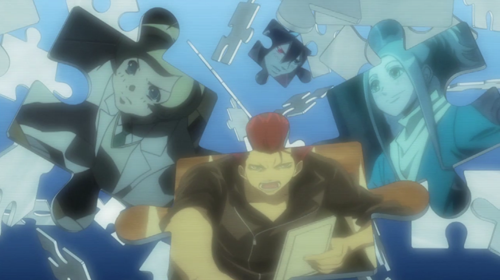
Something's not quite right in my art for this review: Nonoha is solving all the puzzles while Kaito's leering for the camera. How peculiar. This was a drawing that I didn't really feel came together until I started coloring it. The intricate folds of Gammon's leather suit, the musty, grime-y wall, the glow of the puzzle pieces as they are inserted into place, the dimly lit phi symbols above; this one's got a lot of neat, atmospheric parts I couldn't realize until I started coloring. I like it a lot.
For Kaito Daimon, solving puzzles is more than just a hobby - it's a way of life. The puzzles speak to him, revealing the heart of those who made them. Some are made with good intentions to be enjoyed by all, while others are made for evil purposes. When Kaito discovers one of these "Puzzle of Fools" and attempts to solve it, a mysterious armband called The Armlet of Orpheus bonds itself with him, granting his mind the ability to exceed normal thought processing capabilities. Those who are chosen by the armlet are known as the Phi-Brain Children and are sought by the notorious P.O.G organization of puzzle givers. Now targeted by the P.O.G., Kaito and his childhood friend Nonoha find themselves risking their lives in the thick of a global conspiracy and a quest to solve the most dangerous puzzles in the world, leading to the unfathomable Puzzle of God which can grant its solver untold power. Fortunately for Kaito, there's no puzzle he can't solve. It's puzzle time!
Hey kids, remember Yu-Gi-Oh?
Of course you do. Remember turning on the TV Saturday morning to catch Yugi and
his crew participate in duels? Remember the giant monsters that emerged from
the cards to do battle, such as the Summoned Skull and Blue Eyes White Dragon?
Remember the extremely hokey dub courtesy of 4Kids Entertainment, with constant
dialogue additions and omissions, over-the-top acting, primetime video edits,
and bastardized script? Remember that Yu-Gi-Oh
is actually a good anime?
You might not, if your only exposure to it was the severely
tampered with American broadcast. You probably liked it as a kid, but now that
you've grown up you look back and sneer in bemusement. Well, look beyond the
critical veil and you'll find Yu-Gi-Oh
is a solid children's series with well-managed core concepts and lessons to
teach. It's got entertainment value for adults as well; age-limitless values
and a propensity to get considerably dark and edgy. Not that you'd be
COMPLETELY aware via the edited dub, but even then you've got characters being
banished to "a realm of infinite shadows". That's dark shit for a
kid, even when dumbed down. Many of the foreign cartoons ported over in the
90s/2000s and slapped onto Kids WB or Fox Kids were rightfully poor programming
and a little Westernization did not improve them. Digimon is not poor programming, One Piece is not poor programming, and Yu-Gi-Oh is certainly not poor programming. Its primarily aimed at
kids, but it's got a lot of heart and sense of fun and creativity (despite the
fact both the anime AND manga became only about Duel Monsters, whereas the
original story was all types of games, hence 'King of Games') under its hood.
After Yu-Gi-Oh
exploded with popularity both in the East and West, a trend began: the game
made real. Duel Masters, Beyblade, Bakugan - suddenly anime about card games or some kind of
children's game became all the rage. Even Digimon,
in its third season*, retconned the entire first two seasons into a card game,
that's how trendy it was. These followed similar formulas: everyone in town is hooked
on a particular kids' game (usually a card game), and one particular whiz at
the game and his posse stumble across a magical entity that makes the game
"more than just a game", turning the fun games into bouts of survival. These shows and their
predecessors were all trying to ape off Yu-Gi-Oh's
runaway global success, but they always fell just short of the mark. Why? My
theory is that, while they were utilizing assets of Yu-Gi-Oh, they weren't utilizing the heart of the show; the brass
tacks of what made it good, not just copy/pasting ideas. They were wannabes,
not worthy enough to be called successors, only ripoffs. But in 2010, an
original series came along to take its place as possibly the first worthy
successor to Yu-Gi-Oh. That series
was today's review, Phi-Brain: Puzzle of
God.
*I should note that even though I
mentioned Digimon above, its third season is absolutely not a 'Yu-Gi-Oh
rip-off'; it's an outstanding show with a plethora of unique strengths and
weaknesses; I only listed it for the connecting thread of card games
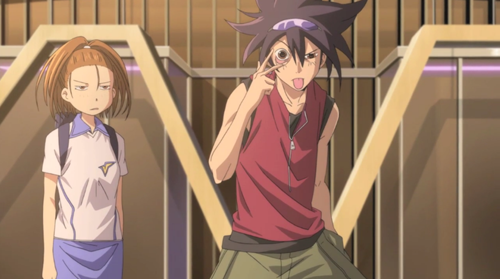
What instantly stands out about Phi-Brain is its distinctive cast. You've got the aloof,
big-hearted lead, Kaito Daimon, as the stand-in for Yugi Muto, complete with
perfectly maintained spiky hair that would realistically take hours to style.
Traditionally, the Yugi-esque protagonist is short, whereas Kaito is tall and
lanky like a CLAMP character; proportions which contemplate the splayed hair
rather than draw unneeded attention to it. Athletically-inclined childhood friend Nonoha
Itou is the conceptual straight-man to Kaito and his posse of unusual "named
geniuses" but a presence to be reckoned with in her own right, often
pulling her friends into line with reason. Rude and crude Gammon Sakanoue talks
and dresses tough, but is often relegated as the bumbling fool of the group; deep
down he's just a big softie and shares more in common with Kaito than he'd care
to admit. Cubik Galois, the timid yet spunky nerd, always wears a lab coat and
finds any excuse to show off his inventions, regularly culminating in tracking
devices that allow everyone to monitor puzzle battles from afar and collect
data on their opponents. And finally there's Ana Gram, a wide-eyed, off-kilter
wallflower who vocalizes his innermost thoughts and loves to paint; also a boy
who looks, dresses, and acts 100% like a girl (to the point that it's rather
puzzling why they didn't just make him a girl). Each member of the cast is
immediately unique in looks and personality. I heard long ago that a test of
good character design was that you should be able to recognize a character by silhouette alone; Phi-Brain passes that test with flying
colors.

So what makes Phi-Brain stand out from the multitude of Yu-Gi-Oh's spawned imitators? The
immediate culprit is its all-important series McGuffin: puzzles. Right out the
gate I considered this a cracker jack concept far more meaningful than a simple
game. Puzzles are a better tool for engaging children because they can be fun,
and they stimulate the mind. A card game will allow you to learn and excel
within a particular rule set, but it's not challenging your mind cognitively. I
always find myself having to suspend my disbelief to accept a world that has
adopted a children's game as its global pasttime played by both kids and
adults, like card games or even Gunpla battles in Gundam Build Fighters. "The main characters need opponents and
a tournament to participate in" seem to be the only reasons for making a
world revolve around a game. On the contrary, I can absolutely accept a world
where everyone is obsessed with puzzles (it's not as overt in Phi-Brain, anyway), because all ages can
take something away from puzzles which benefits mental growth. It's not just an
otaku's representation of 'passion'; there's real educational merit in solving
puzzles.
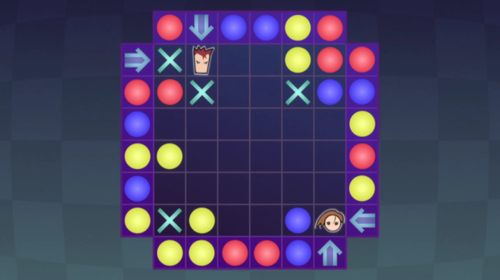
Furthermore, the concept of puzzles is one not monetized by
the series' production company. When you look at Beyblade or Bakugan, you
know right away the #1 reason they exist: to sell toys. Phi-Brain does not, but the funny thing is, IT SHOULD HAVE. In
fact, practically zero merchandise exists for this show, and it's more than a
little weird. It's admirable that Sunrise created a series that could be
mentally educational to children without the subtext of purchasing an ancillary
product that they would enjoy more; like, all of the value of Phi-Brain is contained in the program,
there's no credo to the kids to buy puzzle books or you're not getting the full
experience or anything like that. However, merchandise would've been great
because it's puzzles. As I mentioned above, they are fun, valuable tools for
cognitive learning. The sad self-fulfilling prophecy of Phi-Brain is that we live in a digital age where puzzles are an
archaic activity. Kids don't want to sit down and think, they want
entertainment fast and they want it now, with as little brain activity required
as possible. Hell, lots of adults want it that way, too. So it's no wonder
Sunrise didn't market puzzle activity books with the show's branding - they
wouldn't have sold. But honestly I wish the studio had taken a chance. They
could've thrown caution to the wind and attempted to start a puzzle revolution.
Bring marketing power back into a dying form of learning, but alas.
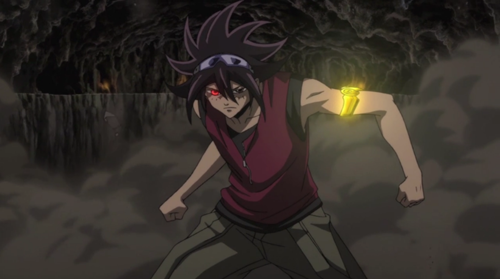
This stigma unfortunately affected the content of the show.
For a series about puzzles, you see, it doesn't do as much as you'd like in
showing you how those puzzles are solved. Much time is spent explaining each
puzzle's intricate structure and allowable rules, but more often than not, the
'solution' is obscured by Kaito's armlet powers waking and finding the answer
for him - an anime-centric device to show off the protagonist's skills which
creates a wall between the content and the viewer, something a show about
solving puzzles should never do. The whole point of the show is to teach you
the joy of puzzles and solving them, so why would you, y'know, not show how to
solve them? I mentioned earlier that puzzles was a great concept - I never said
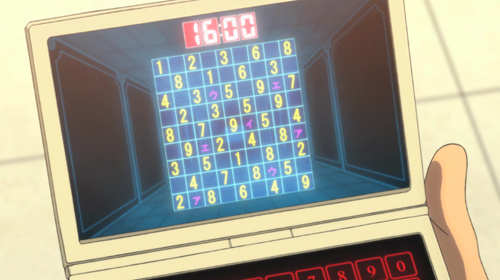
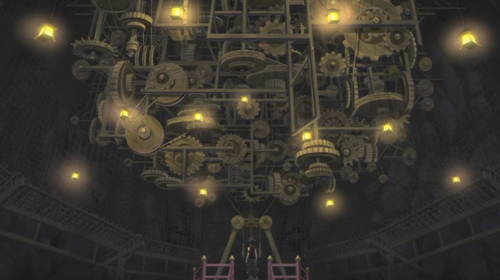
they executed it well. What they do get right is the variety of puzzles. You'll find all kinds in this bucket: sudoku, mazes, logic puzzles, tile pushers, labyrinths, encryption, matching, memory, and many more. All of these are represented in small scale and impossibly large P.O.G. delivered 'Philosopher's Puzzles' and 'Puzzles of Fools' scale, the latter of which often coerce the protagonists themselves in as key set pieces.
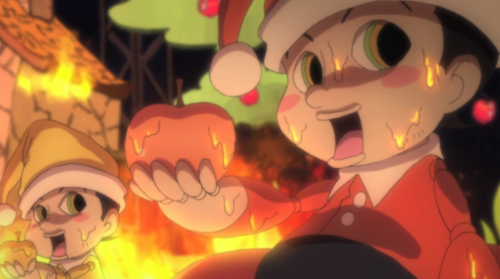
Like Yu-Gi-Oh, Phi-Brain takes the "tour of moral
atrocities" approach to story-telling. Through its wide regular and
incidental cast, it explores many themes: abandonment, neglect, obsession,
parent death, egomania, inadequacy, jealousy, isolation, childhood trauma,
self-loathing, over-dependence, and of course, mental breakdown/insanity; never
to the point where these overtake the show's primary modus operandi:
friendship, creativity, and fun. Kaito Daimon's goal is to be able to share and
enjoy puzzles with everyone. Using his sixth sense to 'feel' the heart of
puzzles, he fulfils good puzzles and frees evil ones, seeking out the good in
his friends and foes alike. As he was once taught, no puzzle is truly evil
- only the heart of the one who made it.
Phi-Brain envisions a world where people from all walks of life are bound by a
shared love. Here, puzzles are a doorway to the soul because they represent the
inner-workings of the giver and solver's true selves.
In a nutshell, the themes of the story are exactly like
every other 'the game becomes real' show for kids ever made and I've just been
coming up with fancy ways to say, "The lesson is friendship and puzzles
friendship make the world go 'round because metaphor for love friendship".
Replace 'puzzles' with 'card games', 'Gunpla', whatever you like - these shows tend to have a similar agenda. Take a game for children and make it dangerous, exploring histrionics of human relationships and the soul as you go. I find Phi-Brain to be one of the more intriguing entries of this genre primarily at picking a pasttime that could believably be enjoyed by all ages and that had never (to my knowledge) been done before.
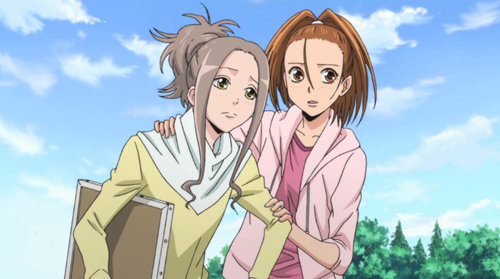
If we replace 'puzzle' with anything else, is the story of Phi-Brain unique or particularly interesting? Not really. It's a soul-searching tale of discovering yourself and to use what you've got instead of seeking what you lack. Tone casually shifts between happy-go-lucky and melodrama, as again is typical of these shows. What fascinates me most about 'the game becomes real' anime is they don't tend to fit into traditional genre types. Rather than picking one thematic tone, they choose to explore all of them; never to the point of being fully realized, mind you. More like baby's first thematic extravaganza. Despite this, Phi-Brain works for me because it's the first of its type in decades that's really owned up to that style Yu-Gi-Oh gave rise to without compromising its material to the overt marketing proclivities YGO also gave rise to. I also appreciate it for not trying to be too much of anything in any particular dramatic direction - it's just enough of everything to be fun without being overstuffed or insubstantial. You just have to accept the fact that its content is by definition aspiring to be no greater than Saturday morning middle-ground, otherwise you may consider yourself too old for it.
Phi-Brain is far from a perfect creation. It's a moderately long
show (~75 episodes), as the type usually is; Sunrise placed their C staff on this project,
resulting in mostly competent animation but frequent off-model messes; and as
I said above, the novel concept of puzzles isn't explored fully to the benefit
of the viewer. But even so, Phi-Brain is an equally original and
classically-styled series painted with a hip, modern brush. It is in no way a
replacement for Yu-Gi-Oh, but I'd say it'll serve nicely as a qualified primer to the
genre to introduce kids to some memorable characters, world-spanning
adventures, and a chance to dive into their own mind to solve puzzles.
You can currently find all subbed episodes of Phi-Brain streaming online courtesy of Crunchyroll. The first two seasons are currently available for domestic purchase from Sentai Filmworks.

This is good. It´s very rare to find a review of Phi Brain, and a good one at that. Amazing points, one and all. Not a perfect series, but very entertaining.
ReplyDelete