


A very late, late evening to all of you! I seem to have lost my way and unfortunately haven't provided any updates in awhile; well I'm fixing that tonight. Sit back and pop yourself some popcorn, 'cuz tonight's review is a long one. Follow the jump below to read my thoughts on the recently completed Studio Trigger action extravaganza Kill la Kill, one of my favorite series of the past year! Hope you enjoy!
P.S. I realize my Review page has been an organizational mess forever, so I tweaked it a bit so it's a little neater. Still not anywhere close to how I want it to appear, but at least I'm not ignoring the blog's cleanliness!

I don't mention this in the review, but one of my favorite aspects of Kill la Kill was how several characters exhibited their own unique visual motifs, such as lighting and backdrop. For this drawing I decided to take my three favorite characters from the show (Satsuki, Mako, and Mikisugi) and make their unique lighting clash. Making the lighting work around each character but also blend into the remainder of the drawing in after-effects was really hard yet enriching experience. It's a lot harder to draw Mako's "HAAAA-LLE-LU-JAH~" arm pose than you might think. Also I apologize if you take offense to radiating penguin nipples.
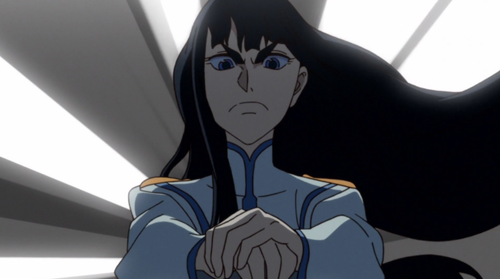
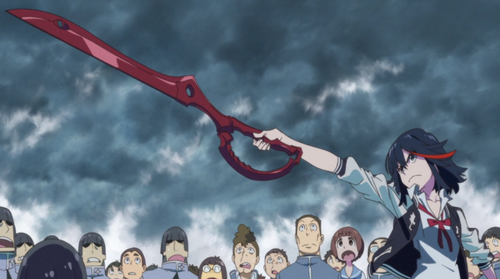
Honnouji Academy is more than just another high school - its foundation lies at the pinnacle of Tokyo Bay as a beacon of oppression, where iron-fisted student council president Satsuki Kiryuin and her cadre of elite soldiers reign supreme. Using tailor-made Goku uniforms embedded with "Life Fibers", the elite of Honnouji subjugate all beneath their feet. Enter wandering transfer student Ryuko Matoi, a girl on a mission to seek out her father's killer, armed with only half of her late parent's Scissor Blade as a clue. When these two meet, a bloody warfare begins.
We've finally hit my 20th anime review, and only now have I
gotten an opportunity to talk about the towering juggernaut of animated mass
appeal, Gainax. If you know anything
about your anime history (and you should, this is culturally important stuff),
you probably have heard of Daicon IV, the short film produced by a young Gainax
still in university (then known as Daicon Film) for the 1983 annual Japanese SF
Convention. One could cite this as one of several starting points for the otaku
boom of the past 35 years in Japanese culture. While Daicon Film was still
growing, they displayed heart, passion, and a berth of talented young minds ripe
with ideas out the box that would lay the path for a generation of iconic
animated properties still relevant and lauded to this day.
I'd
feel it remiss to talk about Gainax and not give a section to Neon Genesis Evangelion, the postmodern
Sci-Fi deconstruction brought to us from the annals of Gainax co-founder and
tortured genius Hideaki Anno. Evangelion
has become something of a mental giant in popular animated culture,
specializing in deep character introspection, Judeo-Christian symbolism, genre-destructing
structure, and giant robot battles. For me, Evangelion
is a revolutionary series which turned the medium on its head and explored
frontiers never tackled before in a professional capacity - it is The Matrix of anime, fostering new
visions that allow for it to be cited as source and inspiration to many modern
works; equal to Akira in cultural significance. There's really nothing more I
can say about Eva other than you
should watch it, no questions asked. This isn't a matter of taste - you don't
have to LIKE it. But you should watch it and experience how it altered the
vision of TV anime for years to come. It's also entertaining to capture the
depression and madness of the mind behind the show's production; Eva has come to be one of those projects
that its creator can never be satisfied with. In 1999, the final two episodes
of the series (which were completely abstract psychoanalytical mindfucks
abandoning story structure) were re-animated and re-imagined into a movie of
abstract psychoanalytical mindfucks abandoning story structure: End of Evangelion. I also recommending
watching that one. What I don't recommend is watching the Rebuild of Evangelion movies. I'm told by all my fellow anime critics that they are quite intriguing
and better than the original series/movie and that they do enhance the original
story, but at the end of the day I can't see them as more than glorified
what-if scenarios. Anno is beating a dead horse which makes unique sounds at
each hit, but he is never satisfied with the sound he hears; that's how I see
it. Evangelion is an influential
piece of history and I'd rather not explore it further.
I went
on record in my last review saying that the coming-of-age tale Furi Kuri (FLCL), easily Gainax's most
popular OVA series, is one of the most perfect anime ever created. It's only 6
episodes long, but features a level of frenetic character depth and pathos one
normally only finds in TV-length series. FLCL
effortlessly encapsulates Gainax's strengths of the era: quick,
free-flowing animation which isn't stringent to a particular style and morphs
when the mood is right, story-telling not bound by national ties and thus
offering appeal on the international level, an accessible application of
forward-thinking abstract concepts, and most importantly - energy. You could
always spot a Gainax work because of the energy, the soul embodied by the work
as characters leapt and bounded across the screen. FLCL contained all of these elements while not becoming tiring or
overwrought - it is one of the most fun, intellectual, resplendent anime, OVA
or otherwise, ever devised.
There
is a bevy of talent to be found in Gainax during their heyday, but no question
my personal favorite is director Hiroyuki Imaishi. He was the mind behind Tengen Toppa Gurren Lagann, the super
robot action epic of 2007 that took the otaku world by storm; the biggest
Gainax success of the 2000s. Like all good directors, Imaishi brings his own
unique style to anime. All of his efforts are defined by increasingly simple
ideas fully realized in bombastic, action-packed extravaganzas. He utilizes
simple notions like taking down the authority and simple visuals like starting
from the bottom and aiming for the top, but he tempers these simplicities by
not holding back anywhere else, providing the most balls-to-the-wall insanely
energetic and stylized visuals of any
Gainax director to date. I like to
describe Imaishi as a little kid playing with his toys. I can never take
critical offense to anything he presents because his directorial style is so
straightforward and gosh-darned innocent. I've seen plenty of people criticize
his occasional male gaze and objectification of female characters, but I for
one cannot be offended by this man.
Sadly,
the story of Gainax does not end on the happiest note. Oh they're still around,
but not in the same capacity. I consider Gurren
Lagann to be their last take-off success. There's a large fan following for
Imaishi's follow-up work from 2010, Panty
and Stocking and Garterbelt, but it wasn't to my liking. Everything Gainax
has released following that series has lost their iconic luster, feeling more
and more like your run-of-the-mill, uninspired adaptations. The Mystical Archives of Dantalian, Medaka Box, C3-bu, and Magica Wars is
the breadth of their catalogue since then. I've checked them all out, and been
thoroughly underwhelmed. The only Gainax production seeing any kind of acclaim
these days are the Eva:Rebuilds. What happened? It's simple - some of the most
creative minds of Gainax, Imaishi included, went off to start their own
animation company in 2011 known as Studio Trigger. You could say the heart and
soul of Gainax went with them; theirs is a merit which does not die, but only
transfers to the next waiting vessel. Though short-handed on funding, Trigger
has utilized their assets expertly and made waves in the anime world with hit
after hit. First came Inferno Cop, a
fan favorite web series, then the exquisitely animated short film Little Witch Academia, and then, in Fall
of 2013, their very first series animated for television. This series is
(finally) the topic of today's review: Kill
la Kill. We'll start with some talk concerning the origins to KLK's themes and setting, then move in
on its meatier attributes: its message and characters.
Several
Studio Trigger employees were guests at this year's Animazement, my hometown
anime convention, and I attended one of their discussion panels. One audience
member inquired, "How did you come up with the idea for Kill la Kill to be about clothes of all
things?" Thefolks on hand were primarily Little Witch Academia staff and
could only give indirect responses to KLK
questions, but basically we were told: "One day in a meeting, Imaishi-san
said, 'I want our next series to be about clothing'. And so it was." The
title "Kill la Kill" can be
interpreted multiple ways, emphasizing both the visceral kill-or-be-killed
nature of the show, and a pun off multiple definitions for the Japanese verb
"kiru" (to wear clothes, to cut). Kill
la Kill is a series predicated on simple wordplay fully developed into an overblown
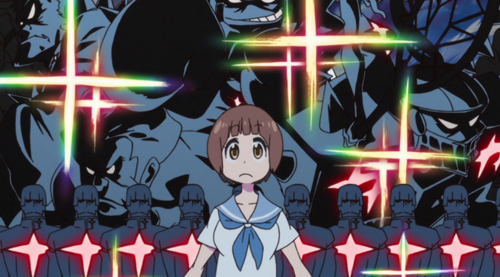
world-setting. The Japanese word for a schoolgirl sailor uniform (seifuku) is
pronounced the same as the word for "conquest". Honnouji Academy is a
school constructed atop an impoverished war-torn city as military fortress
governed by a powerful dictator on high who sanctions combat-ready school
uniforms to the best of the best to act as her soldiers. I think you can see
the connection.
Now,
the idea of a school that shelters a secret militia or one that is governed by
its student council body with zero hint of competent adults or faculty is
nothing new. Japanese culture is obsessed so much with the setting of high
school that they'll set almost any story in one: romance, horror, sci-fi,
fantasy, comedy, giant robot, you name it. Traditionally, however, nothing is
done with the visage of high school; it's simply a backdrop to whatever plot is
in process. Or, the school isn't really a regular school at all, and is
actually a government-facility training super soldiers or something, in which
case that's not the same idea. Kill la
Kill breathes new life into the concept by taking it to its roots, I.E.,
the very simple wordplay I mentioned above, and building off that. The school
setting here also feels less like the classic usage of Japanese high school and
more like, just pulling the best example from the top of my head, the school from
Matilda. The mass of disciplinary
forces (complete with the male anime equivalent of Miss Trunchbull) and fascist
rule is supreme, and more than a little excessive, but everyone just kinda
accepts it. At times it feels like a dream as a giant of a man crashes through
a classroom door to dole out punishment for insubordination, or when a field
trip boils down to a military sortie. KLK is completely in on the joke, but
not in a self-aggrandizing fashion. In true Imaishi style, you take the concept
and crank it to 11; equally make fun of and embrace your concept by pushing it
to its thematic limits. The forces of Honnouji Academy carry their missions
with the height of dramatic flair, accentuated by school president Satsuki
Kiryuin who delivers her speeches not unlike a general marshalling their troops
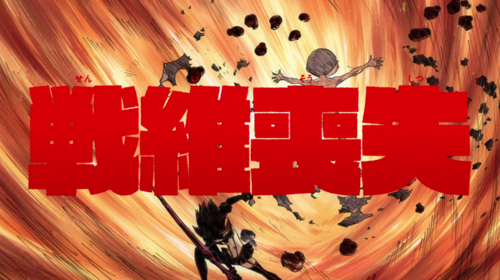
to war. This lack of restraint and total
embrace of the very simple "seifuku" pun is what makes the world of KLK instantly memorable and lavish.
While
I've mentioned the Imaishi style, I want to give a nod to KLK's technical aspects: its style of animation and visual play.
Imaishi is a master of taking simple ideas and going all out with them, just as
he does with the show's setting, and it is no different in the animation itself.
He also understands that a cartoon is a cartoon, and that you can get away with
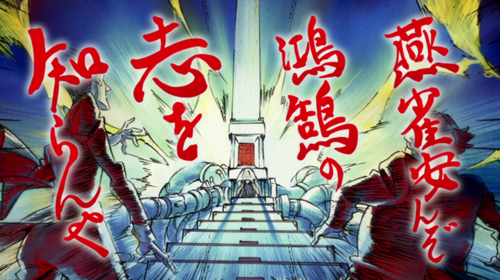
a lot you couldn't do in live action: impossible shots/gags. For instance, a
well-known anime trope is that when an important character, super technique or
powerful item is revealed to the viewer, giant text appears on-screen telling
us what/who it is. This is done for dramatic impact. KLK does this too, and takes
it a step further. The giant text that appears isn't just an aid for the
viewer; it's actually part of the world. That's not to say characters directly
reference the text or interact with it; it's just there, all the time. Like,
giant text appears scribing the name of a just-revealed Goku uniform. In the
next scene, we see a character with glasses on the sidelines; the text can
still be seen reflected in their glasses, relative to where the text was when
it first appeared. After quick sight gags like this, the text will always
disappear proper, but just those little moments provide engagingly kinetic set
dressing. It embraces and laughs at popular animated tropes just long enough
for them to not be contrived. I always felt like Gurren Lagann took itself a little too seriously and P&S didn't take itself seriously
enough. KLK hits the sweet spot right
in-between.
These
techniques embracing classic cartoon motion and sight gags I'd say are what put
KLK apart from the rest. Because
let's face it, when it comes to consistent animated continuity,
they're.........not bad, but kind of struggling. This was, after all, Studio
Trigger's first multi-cour series animated for television, and it shows. While
never quite as beautiful as, say, Little
Witch Academia, KLK still looks
mighty impressive when the budget pulls through, particularly in battle scenes.
It's hardly worth docking points for the occasional off-model shots or use of
still frames, because not only are these instances exceptionally rare (Trigger
as a studio knows how to pool their resources and budget well), but the heart
of the show's animated prowess lies elsewhere. Namely, the techniques I
mentioned above. The fun of Imaishi's style of crass, child-like wonderment is
that he injects it into every single aspect of his work: story, theme, music,
characters, animation, all of it. This is why his style oozes so copiously out
of everything he touches. In the past, Imaishi's work was remembered primarily
for its over-the-top action choreography. I think Kill la Kill will be remembered for its abandonment of modern
convention and embrace of being a silly cartoon before it is a story being
told. A lot of animation suffers from 21st century internet culture which
begrudgingly accepts the use of its own medium for the purpose of housing a
story. That's not to say animation shouldn't be a vehicle for story-telling,
but I get the feeling many animated cartoons, particularly anime, forget that
they are, in fact, a cartoon. This is what happens when you get an uninspired light
novel adaptation and the result is a boring slog of a programming block that literally
does nothing with the tools at its disposal. So much anime these days are just
talking heads that barely move, you wonder what's even the point. Not that one would ever expect a show from
Hiroyuki Imaishi to look uninspired, but I respect Kill la Kill for being a cartoon first and a story second.
But let's
get back to talking about the chief inspiration for Kill la Kill that I mentioned earlier: clothing. In this series,
the blood-pumping action comes to the viewer through Go Nagai-esque super suits.
There are mysterious energy compounds in the world of KLK known as Life Fibers. When threaded into the seams of clothing,
the wearer in a sense "merges" with the fibers embedded into their costume,
granting enhanced strength and agility. The more Life Fibers, the more powerful
the wearer can become, and in some cases, use special abilities and even
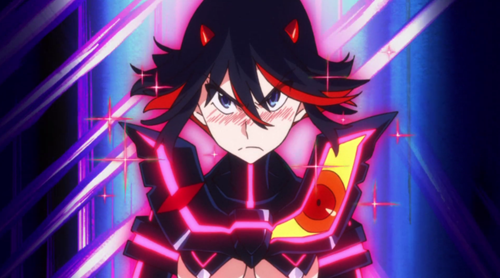
transform. Ryuko comes into a semi-symbiotic relationship with a sentient schoolgirl
uniform made entirely out of Life Fibers (known as a Kamui), which she names
Senketsu because of his insatiable thirst for her blood. One brilliant trend in
KLK is the more powerful a uniform
containing Life Fibers becomes, the smaller the uniform actually appears on the
wearer, leaving them nearly bare (there is harsh critical reception to this
feature, but I'll get to that later). This is the driving force behind KLK's narrative. Ryuko fights against the
Elite Four (no, not THAT Elite Four, Pokenerds) and Satsuki Kiryuin of Honnouji
Academy, who all use their Life Fiber outfits as tools for war. The coexistence
of Ryuko and Senketsu represents the antithesis to the academy's credo. Rather
than suit up for battle, she must get naked, as we see in how skimpy Senketsu
becomes when Ryuko merges with him. This is what it means to bond perfectly; to
fight as one mind and body.
It's
very simple: to defeat the powers that be you must shed the shackles of
conformity, defy logic, and get naked; only then will you be truly unique and
understand one another. In a sense this is the exact same message as Gurren Lagann. But KLK actually weaves its message into the visuals on screen and, in
my opinion, throws more analytical pomp and circumstance into that message. Gurren Lagann only tacked the call to
"fight the power" onto a show about giant robots beating the shit out
of each other. There's nothing deep to glean from it - it's just a show about
giant robots that continually get bigger and bigger. In my mind, Imaishi may
write the same story over and over, but Kill la Kill is to date his mastered
edition of that story. You can clearly see the themes transcribed into the
on-screen factions and their actions - never is there a moment where a
character makes a choice that betrays how the interlining themes would predict
those actions; all motivations are satisfied and make sense. The story,
setting, characters, themes, and message are so tightly woven onto the same
spool, not unlike a well-tailored suit, and make for an immaculate fitting.
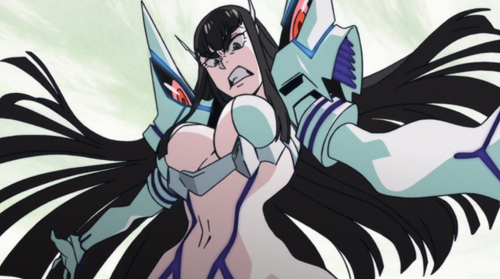
Kill la Kill's harrowing schoolyard
battlefields are populated by many memorable characters. The anime community
surmounted hype months before the series' premiere on account of one important
draw - promotional material featured two "strong female protagonists"
and promised a story where they harbored a rivalry against each other unsullied
by the presence of a man. Here's a tip to anticipating female agency in anime:
if the promo art features a lone badass girl, the series will immediately give
her a milquetoast male protagonist to cater to and eventually replace the
original target of her narrative purpose. Thankfully, Kill la Kill is not such a series. Series leads Ryuko and Satsuki
are both, as promised, strong females with indigenous sense of purpose and
completely free of man-centric motivations. They are also not flawless,
independent, unsociable shut-in's, a common caveat of the "strong
female" trope. They both have clear arcs paved out for them but can still
kick ass and take names while retaining narrative dignity; in short, extremely
well-written.
But
wait, did you say 'dignity'? I can already hear some of you objecting in order
to bring up the fanservice this show revels in. I mentioned earlier how the
more powerful a Life Fiber uniform becomes, the more skin it shows on the
wearer. In particular, Ryuko and Satsuki's Kamui synchronizations leave them in
quite skimpy get-ups, barely covering their naughty bits. Is that not a loss of
dignity, an inescapable man gaze? Many have made this argument against Kill la Kill, and it is one I do not
agree with. Remember who the director is - Hiroyuki Imaishi. There isn't an
impure bone in his body. A big part of the
problem with this mindset is people have gotten so SJW over sexual
depictions of women in media that next to NOTHING is acceptable. The truth of
the matter is there is both good and bad fanservice; you need to learn the
difference in order to accept a little overindulgence. The Kamui fanservice
comes from the mind of Imaishi, a man who admires the female body but arguably
doesn't objectify it with ill intent. The girls are never shot in a way that
implies subservience to a bodiless male gaze, and the focus is always the
on-going fight, not what they are wearing.
Time is taken to linger on regular occurrence; but through the filter of
Imaishi I can only see this as a celebration of the naked form, not a sexual
lambasting. Episode 2 is called "So Sexy She Might Pass Out"; that
should make it obvious enough. KLK is
sexy, not sexIST. I can sympathize if you just personally find girls forced to
wear skimpy outfits humiliating, but I can point out several characters that
fairly balance the scale.
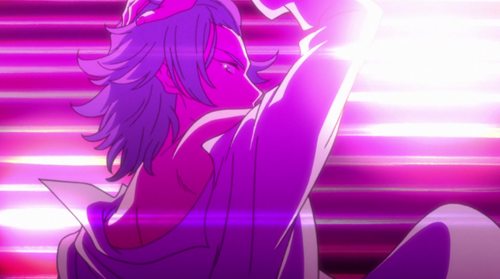
First is
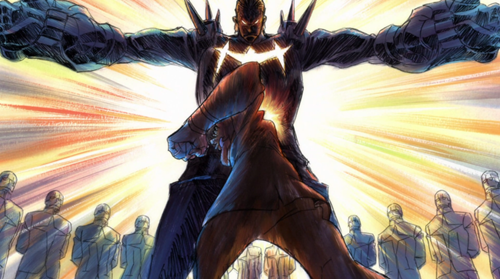
Aikuro Mikisugi, Ryuko's teacher who is secretly an operative of freedom
fighter organization NUDIST BEACH. First and foremost, he is a man; fanservice
is not exclusive to women in this show. As you may have guessed, he loves to strip.
Several scenes feature him proudly baring his skin for the camera, arguably
more shameless than any of the angles used on Kamui transformations. The other
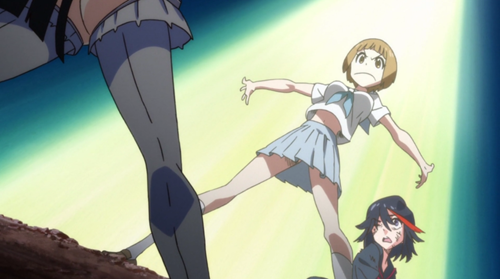
is fan-favorite Mako Makanshoku, Ryuko's sidekick at Honnouji. Mako is one of
my favorites for her role as the resident Greek Chorus; regularly she stops the
action for a comedic one-woman-show imparting thematic observations to what's
going on with her own unique spin. She's also the school's damsel-in-distress
du jour; normally in series with strong female leads, the person constantly
captured by the enemy is the weaksauce male love interest, but in KLK, both are girls. I'm not trying to
imply any combination is more desirable than another, because it ultimately
comes down to how the writers handle it. And the inclusion of Mako gives us a
very strong feminist angle to the series against one of aimless male gaze due
to how perfectly the narrative fends off any negative connotations behind her
plot-convenient role as the best friend used by the enemy to lure the hero into
combat. Even though Mako is often shipped with Elite Four member Gamagoori as a
result of their unusual giant and mouse relationship, it's mostly one-sided (on
his side) and Mako's actions don't hinge on his. Ryuko and Mako's partnership
imply a stronger yuri vibe than anything else.
Hell, I
can give you one further: Ryuko shares awkward romantic tension with Senketsu,
and he's a goddamn piece of clothing. The point I'm trying to make is KLK does not house an objectifying
male-gaze agenda because all genders and characters are objectified equally.
Where your mileage will vary is with your personal tolerance for skin shots,
but always remember; KLK does it for
everyone - it plays no favorites. Under this assumption, I found the fanservice
positively indulgent. Context and intent is paramount here.
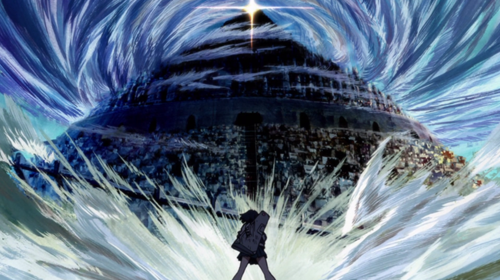
You can currently find all subbed episodes of Kill la Kill streaming online courtesy of Crunchyroll. The series has been licensed by Aniplex of America; the first volume is being released stateside late Summer '14.

No comments:
Post a Comment