


Happy October! The leaves are beginning to change, the air starts to chill, and in lieu of fall-related posts you'll just have to settle for more anime reviews from me! I have three currently cooking in the boiler, the first of which is what you're reading right now. These will most likely be my last three reviews of the year before my annual end-of-year recollection where I take several shows I skipped talking about and review them all at once. I'm planning on including a few less shows this year than last as I was a bit overwhelmed by all the writing, we'll see!
If you know anything about me, you probably know I'm not a sports guy. Likewise, I'm not the biggest fan of sports in anime. The draw is that you hold some interest in the sport in question, but my interest in sports is practically zero. I do swim, which made enjoyment of Free all the sweeter. But even in Free, the thematic point isn't really the sport, but the togetherness and friendship. That's what I'm looking for in sports anime - a serial with a message that can say something to me and not feel like a waste of time only intended strictly for people who play sports. I found such a message in today's review: Masaaki Yuasa's Ping Pong! The pedigree of talent in this show is rather high, so I don't feel properly qualified to talk about it, but I tried anyway. Enjoy! ^^;

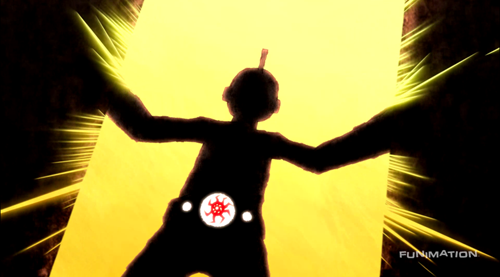
My angle for this drawing was to draw #2 in the style of a Ping Pong character, particularly with a disposition Peco might take when 'the hero appears'. I went minimalist in color as the show in question takes much the same approach. I have discovered it's harder to imitate Yuasa's style than I first thought. There's skill to be had in making something look deliberately fluid and free-form.

Smile is the robot who shuts himself away from the world; Peco is the hero who descends from the planet Ping Pong to be a light in the darkness; China is the foreigner doomed to fly; Dragon is the monster who suffers under his insatiable thirst for victory; Demon is the brute who can never exceed his own limits. This is the story of five young men who love to play ping pong.
Until
now, I had never seen a work from Masaaki Yuasa, the man behind such sleeper
hits as Kemonozume, The Tatami Galaxy, and Kick-Heart. He has never helmed particularly high profile
titles, but many flock to his work by name alone solely for his style. His
trademark is free-form fluid motion sacrificing concrete visual construction.
Not necessarily like a cartoony cartoon which will abandon structural beliefs
of the human form to accommodate physical gags; no, Yuasa's distinct look is
something you'd find in an art gallery surrounded by critics unsure whether the
abstraction of the piece is a meaningful commentary or complacent laziness.
Having now viewed a Yuasa work for the first time, I don't think it can be
argued that there is nothing inherently lazy nor meaningful about his style.
One might pass off this art as scribbles, but I see effort placed in a
direction foreign to the art world's standards. Yuasa is a master of malleable
visual oddities - he can make any
setting fit the themes he's going for solely through the way that he animates
it because of how free his style is. This is a level of acuity in design akin
to the rotoscope animation utilized in Flowers
of Evil, albeit one which doesn't directly speak to the audience.
But I'm not here to debate
whether Yuasa's animation is good or not. A more pertinent question would be:
does his style detract, add, or contribute nothing to the works they are
assigned to? Few anime require you to directly link the content of the story to
the animation so stringently, but Yuasa animation practically demands it. And
since it's now the first of his I've ever seen, I will proceed to do so with
his directorial piece from spring of this year: Ping Pong, adapted from the 1996 manga of the same name.
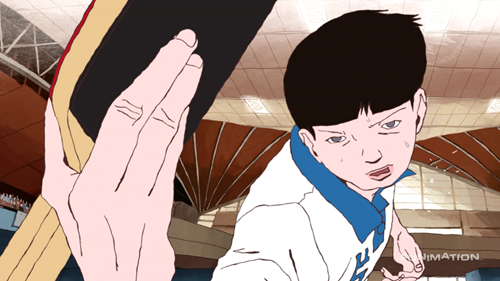
Ping Pong is a sports anime
about.........ping pong. But that's not an exciting sport; they're just
whacking tiny balls back and forth! You want your basketball and baseball and
soccer (and apparently volleyball based on recent hits), don't you? Well I know
your game; I know the stigma that has befallen sports anime. The viewers aren't
REALLY in it for the sports anymore, are they? Nowadays, many young boys and
young adults comics about sports pop out of the woodwork featuring casts of
various young boys and young adults playing their sport of choice, training
reluctant young newbies, entering tournaments, suffering defeat, learning what
it means to be a team, yes yes yes, we've all been here before. These stories
are marketed towards young boys, but you'll often find a larger demographic of
girls reading the same stories. Why is that? Some of them are probably in it
for the sport - I'm not gonna even pretend I'm some asshat misogynist who
doesn't believe that women can like sports. The stories haven't changed, but
what people ultimately remember about them has. I vividly recall many of my
fellow anime critics watching recent sports themed romps Yowapeda and Haikyu. Yet
rarely do I recall any of them actually talking about each show's respective
sport. Instead, I saw countless images of characters been shipped together and
discussion framing the shows as comedic character pieces. It's interesting to
me - I imagine a lot of people don't go for sports anime because of the sport
anymore. Many of them just want to see boys doing stuff together in a
non-sexual capacity that is strong enough to fuel their shipping fever but
innocent enough to not garner frowns from peers.
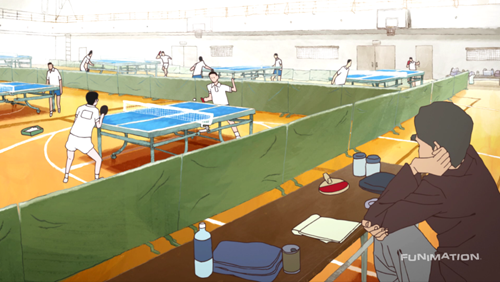
So, judging how I led in with
that angle, I must be preparing to declare that Ping Pong IS a story about the sport which is appreciated for more
than an unintentional focus. You'd be right, and wrong! The sport in Ping Pong is important, but it's not
really important WHAT that sport is. Likewise, the characters are important,
but it's not really important WHO they are. The characters are described as
ubiquitous players through abstraction which tells us their relation to the
sport and how it has affected their growth. So yes, the sport is important, and
the characters are important, but both were meant to be as paramount as their
conception. What I'm saying is Ping Pong
is not like those other sports anime which garner popularity for ancillary
features. I doubt (most) sports authors aspire to have their stories remembered
only for the characters inhabiting them - surely they want to impart their own
love of the sport to you as well. But that's a take away I've rarely seen
someone take away from a sports anime; shows about sports turn into shows about
characters and I don't get the feeling that was the intent.
Ping Pong escapes that
popularity trap by examining its characters as everymen with unique experiences
relating to compartmentalized adversity - the narrative focus is specifically
on these experiences, not the characters who live them. The story follows best
friends Peco and Smile, both skilled ping pong players who have each hit a wall
which threatens their future with the sport. Peco, born with natural talent,
loses spectacularly to a Chinese exchange student, discovering a world of skill
beyond his lax prowess. Smile is a powerhouse feared for his hard-hitting, calculating
tactics, but he is fickle and despondent without the source of inspiration that
acted as his light in the darkness as a child.
These young men embark on a journey of rediscovery - rekindling
misplaced passion in the midst of beset adolescence. It is not strictly a
coming-of-age story, but more a story of how one deals with the side-effects of
growing up, how it alters aspects of our lives and our selves we took for
granted as children, and in the end how we struggle to adapt personal value. These
boys value ping pong; for you it is likely something else. It does not have to
be something virtuous. Selfish desire very much plays a big part in shaping our
values and decision making.
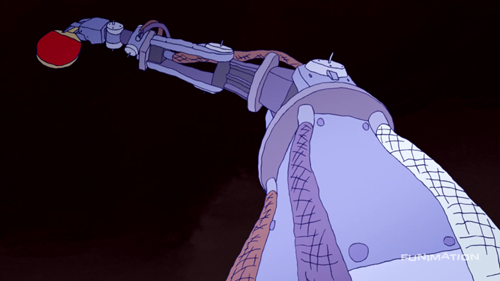
But above all else, Ping Pong is not concerned with the
difference in personal values one harbors between the past and future. It is
about living in the moment and embracing the love you have while the
opportunity is ripe. It is a story as much about the hardships of growing up as
it is respecting the perks of that tender age where puberty and the onset of
responsibility are strong. As for the future - that's left up to the individual
to decide. Each characters' values may led them down a different path with the
sport in their lives, or away from it entirely. In a rare statement of noncompetitive
nature, Ping Pong describes a
person's values as a shelter for their passion, not a destination to which
their passions must guide them. This mindset immediately clashes with a common
trend in sports anime to evaluate one's talents alongside their intended career
path. The classic arc is that you like
this sport and you've GOT to pursue options with this sport; to deny that sport
and take another path is a bad ending,
and your teammates will fervently aim to show you the error in your ways. Ping Pong recognizes that the form of
our passions change over time and people move in directions no-one expected -
and that's ok. As someone who studied on a particular career path in college
but found myself disillusioned with the material, that recognition speaks to
me.
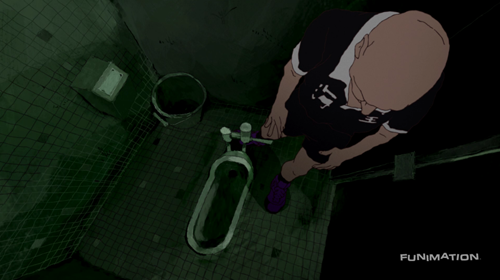
To begin examining how Yuasa's
animation recites this story, we can look at the following case of on-screen
continuity which constructs a palpable visual representation of the redemption
story. An unnamed student is Smile's opponent in one round of a local tournament.
The student is beaten so soundly that his love for the sport is broken; he
convinces himself he will never be able to play again. Unsure what to do going
forward, the young man decides to go on a journey of enlightenment. Through the
course of the series, we are given periodical reminders of where he has gone;
commonly he will be lost, morose, and unsatisfied with his current location
before moving on. By series end, the boy has become so turned around to the
purpose of his sojourn that he ends up back at the very tournament stage where
he suffered defeat. Thinking those days behind him, he is coaxed by
circumstance to watch the final match between Peco and Smile. What he witnesses
is not a grim reminder of his defeat, but the joy two true lovers of the sport
share through competition. The boy is so moved by the passion exuding from
their bout that he prostrates himself to the very concept of ping pong, begging
for forgiveness. This character is by no means a main player in the story - and
yet the subtle, literal progression of his defeat, journey, and rediscovery,
all cataloged in the background, perfectly showcases the same progression taken by the protagonists.
Yuasa's approach to animating
and directing Ping Pong relies
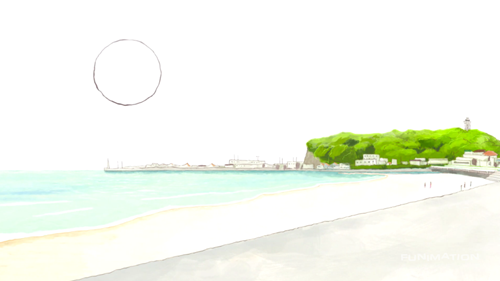
heavily on the absence of material, i.e. celebration of the white space. The color palette is often washed out to soft beige and whites, communicating the
innocence of the characters and creating a mode of isolation from the outside
world. An easier explanation for this
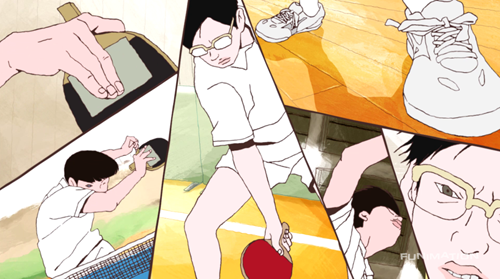
direction is that Yuasa was seeking to incite the sensation of watching a manga
animated live on-screen: this can be evidenced by the show's character designs
remaining nearly identical to the manga and the use of split-screen reaction
panels generally used on paper. It's a little tough to label Ping Pong's anime an 'adaptation' in the
classic usage because of its art direction capturing the same look as the manga
in motion - I believe this is what Yuasa was aiming for.
Were it any other director, I
wouldn't be favorable of this approach. The strength in animated medium is to
achieve with motion and controlled pacing what you can't in written form
directed by the reader's eyes and imagination - it's up to the animation to
bring that imagination to life. Many stories wouldn't work in their original
form in animation because of the gap in expectations of someone reading a comic
book vs someone watching a television show. And even when they do work,
animation is a prime opportunity to try something new with the material, to not
be strict to form and to experiment. Ping
Pong actively chooses to not innovate and rather be a carbon copy from
paper to screen. But Yuasa bellies negative notions of this approach by using
his freeform style as a meter for how loose a strict adaptation can be. Never
does Ping Pong's aesthetic feel
contrived or unsuited for animation, all because of Yuasa's talent in taking
simple designs and distilling them with life unrestricted by the frame. Ironically, the approach in this show conversely demands to remain restricted in the frame, but his talent for the former makes this detour come off naturally. As an
animator, he produces one of the most convincing and raw examples of a drawing
come to life I've ever seen. And so a strict adaptation from page to screen
suits him perfectly.
The unique sound of a ping pong
ball ricocheting off the table and the player's paddles is piercing to an
outsider, but warm, inviting, and promising challenge for those wrapped in the
world of the sport. So the omission of sounds to draw attention elsewhere is
also employed. The animation services the story well, but really, I think the
sound design deserves even more praise. One scene where Kong and his teacher follow
the ebb and flow of Peco and Smile's game through sound alone is both haunting
and transcendent to the senses. Musical tracks are less common in a show this
abstract, but those present are sublime. The BGM heard when Peco becomes the
hero and is truly living ping pong might as well be called 'fun.mp3' - it is
the most literal collection of sounds representing 'fun' I can imagine.
What Ping Pong exceeds at more than anything is representing the passions of the soul through evocative imagery; how they shape us and how life shapes our connection to them. The characters of Smile (lack of inspiration), Peco (lack of humility), China (lack of understanding), Dragon (lack of joy), and Demon (lack of identity) are all flawed adolescents who are able to begin scaling their personal walls through their shared love - their passion - of ping pong. You could say that ping pong is what makes their world go round: it is the starting point of their hardships and the ending point of their resolutions. It's an uplifting journey that may have received a significantly more rote production where it not for the Yuasa touch. Fluid, rough animation, split-frames, depth through abstraction, and more all contribute by painting a scene of childhood at times chaotic and confusing and at times serene and passive. It's a beautiful picture of growing up.
You can currently find all subbed episodes of Ping Pong streaming online courtesy of FUNimation. The series has not been licensed for home video release at this time.

No comments:
Post a Comment