


Eat your vegetables, and don't forget to share them with your friends! You'll be healthier AND happier! All this and more on a special educational edition of Pachi's Portrait! Brought to you by the letter C.
But seriously, welcome back! I haven't seen you since April. Don't worry - there are at least two more reviews for shows that wrapped up during the Winter '14 season on the way following tonight's release. I decided to postpone this review to this week because it's the week of my birthday, and the show I am presenting you with tonight is one very close to my heart. Imagine if I got the gumption to review a beast like Fullmetal Alchemist - that's basically what tonight's review is like for me. So no pressure!
Quick announcement! On the weekend of the 23rd (the weekend after this one), I will be attending my local convention in Raleigh, NC, Animazement! I won't be wearing any particular cosplay, but a surefire way to spot me is by my tote bag in which my Penguindrum #2 penguin (aka my avatar) hitches a ride all about. If you spot us, feel free to say hi! I'm looking forward to another fun convention year!
Without further ado, take the jump below the linear notes to check out my newest anime review, covering the 99-episode Space Brothers! This is the longest series I've covered yet and took my quite awhile to formulate my thoughts on it just the way I wanted. Hope you enjoy!

This drawing pays tribute to the after-episode segment that began airing late during Space Brothers' run: Mr. Hibbit. Mr. Hibbit is a light-hearted series of children's anime shorts chronicling the adventures of anthropomorphized woodland creatures on a quest to become astronauts. I felt my penguin avatar would mesh perfectly into this world of astronautical critters, so I donned him in the suit and sent him to town. Often in my drawings I find myself spending a considerable amount of time on shading and after-effects; it was nice to work on one that purposefully avoided such intricacies for a change. Bright, colorful, and positive, it warms my heart just as much as Space Brothers and Mr. Hibbit does. So I'm quite happy with how it turned out. I think my favorite is Freddie Dog. He always looks so cool.

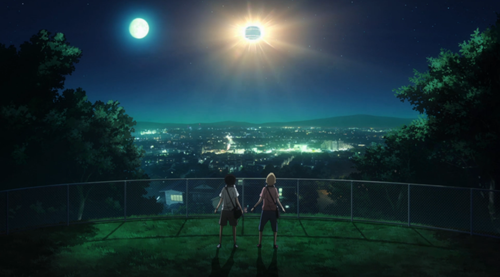
The Agony of Doha and the Miracle of Doha; these two days are considered one of the unluckiest and luckiest days in Japanese sports history respectively. And on these days, the Nanba brothers were born. Older brother Mutta and younger brother Hibito discover what they think to be a UFO one night, inspiring them to become astronauts and go to the moon. Now grown up, Hibito, born on the day of the Miracle, has achieved his dream and is the first Japanese astronaut to be assigned to a lunar mission. Meanwhile, Mutta, born on the day of Agony, has let his dream pass him by and is all washed up and between jobs, stuck in a rut. Because of the promise they made that night, Hibito gives his big brother a push to start his own journey toward the stars: by submitting his application to the JAXA Astronaut Selection Exam. And so one brother lives his dream while the other stumbles along to catch up...
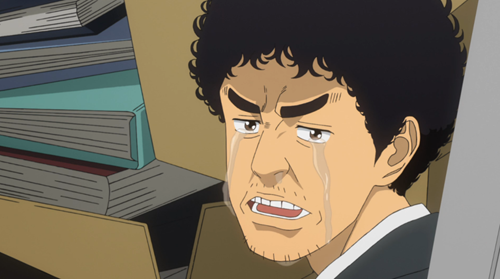
As a lover of nostalgia, by nature I compartmentalize past
periods of my life by the pleasantries I partook in during said period. With
anime it's no different. Particular years of my adolescence and early adulthood
can be defined by particular anime. These are series that are not necessarily
the best I've ever seen nor the top pegs in my favorites list, but rather
series that have touched me so profoundly that I've never forgotten them and
left a lasting impact on my personal tastes and creative thinking. The first of
these series is Dragonball Z, as it
was the first anime I ever saw. Everything I did revolved around Dragonball Z: it owned my world. I drew
pictures of it, I read magazines about it, I collected VHS tapes of the anime,
I bought the music, I frequented DBZ-themed
messageboards, I even collected the freaking card games. At one point my
brother and I even dabbled in making our own Dragonball Z fan page (which in the end was just another third
party hotlinking image site, but that's what every website was in the 90s). In
the early 2000s I watched Fullmetal
Alchemist, and for most of the decade THAT series ruled my world. Sharing
my love of FMA helped me mature
beyond shounen action series and discover a wide expanse of genres. At the end
of the 2000s I witnessed Ikuhara's Mawaru
Penguindrum. I was blown away by the depth and genius in this auteur's work
and longed to find more meaning and intellectual discourse in anime; it was
thanks to this series that I became such a stern critic, and the reason I began
writing reviews at all. These three series, more than most, helped shape me
into the anime connoisseur I am today.
Nowadays, I watch more anime than I ever have before, sometimes as many as 10+ shows per season. I've seen many good and many bad shows in the past 5 years, but out of all of them, there is one that I will remember most fondly. The one that will forever remain in my memory as the defining, most impactful series for me of the early 2010's and representative of my foray into intellectual anime discussion: Space Brothers.
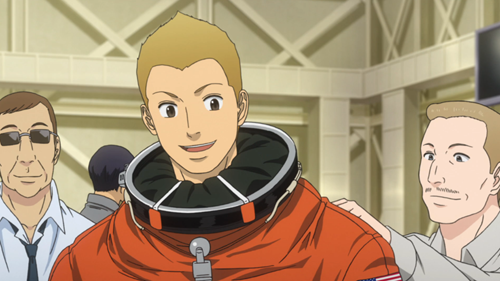
When I evaluate the way an anime has affected me on an
emotional level, there are three factors I consider. My heart, my mind, and my adolescence.
Dragonball Z firmly hits on my inner
child, the little boy who wants to see explosions and people beating the shit
out of each other: shounen action. Mawaru
Penguindrum triggers an intellectual response from me above all others; a
strong satisfaction in feeling cultured and that I have spent my time in wise
discourse. Fullmetal Alchemist is a
clean combination of all three, which is why it's my favorite anime of
all-time. As for Space Brothers? Not
one anime has touched my heart so relentlessly and yet so gently and earnestly
as Space Brothers. I've cried for
many other anime, and only cried two or three times during the entire run of Space Brothers, but no other series has
sent my heart flying in so many directions, yet at the same time made it all so
*pleasant*.

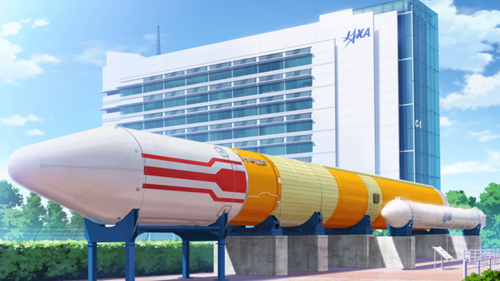
Why does this series affect my heart so strongly? There are
several reasons. When you first look at the description for Space Brothers, you might make the
mistake to assume that it is an educational series. It would be easy to make
this mistake, considering it is about the space program and has direct funding
from NASA. There are educational ELEMENTS in Space Brothers, but the real world facts here merely work as
immersion into the business of space travel - the intent is not to directly
teach the viewer about it. The line of profession quite honestly doesn't matter
- it helps to have such a recognizable and unique focus as astronaut, but at
the end of the day they could be anything.
What matters in Space
Brothers is the journey, not the destination; quite the cliched statement
to make. For this show it's even more amusing. The entire basis of the plot is
built on brothers Mutta and Hibito declaring a destination for their lives: the
moon. But in Mutta, we see that even though life may be difficult, even if
you're having trouble getting to where you want to go, it's life's little
things and the road laid out before you which holds the real adventure. And in
Hibito, we see that even once you reach your destination, the adventure isn't
over, and there is much more to be done, to see, and to learn. Life is a
never-ending staircase of mishaps, missteps, and mistakes which contains all
the same joys and lessons no matter which step of the journey you're on. The
challenge is adapting your footing to each unique step.

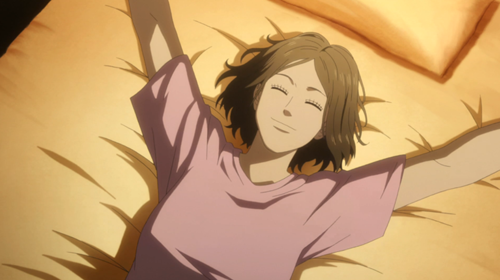
Such a broad, positive outlook on life might sound hard to
pull off without coming out hackneyed, but it manages quite effortlessly. This
is most in part due to the characters: Space
Brothers' greatest strength. This is a series filled with real people who
have real problems and real quirks and real complexities. There really aren't
any "villains" in this show, because it's not a battle between good
and evil that's going on here. Mutta is not battling against a system that's
trying to keep him down. When the "heroes" of Space Brothers are disenfranchised or at a disadvantage there's
usually a good reason for it, whether because of a legitimate flaw of the
individual or harsh, yet studious judgment from a higher power. Anyone who
could be seen as a "villain" is not playing the part out of trite
theatrics; more likely a memory from their past has colored their opinions, or
they may hold some biased prejudice due to their upbringing, or maybe they're unsure of themselves and use
others as an outlet. There are all kinds of explanations which cover this
bright, colorful world in a sea of grays: human beings who can't be defined by
base archetypes or extremes of good and evil.

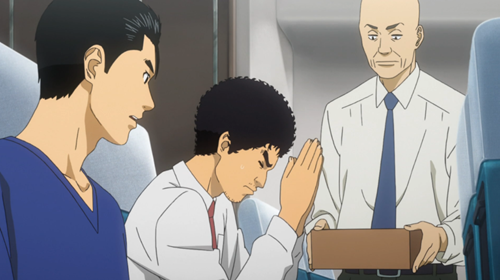
The characters are not only complex and varied, but
completely relatable. You know these people - everyone knows a Mutta, the
down-on-his-luck, clumsy eccentric with wavering self-confidence. In different hands, such a character could be
a real downer to watch. However, he's not defined solely by his misfortune
(though that plays a large part towards his thickheaded cluelessness). He's an oddball for sure, but he's also kind,
passionate, intelligent despite his frequent slip-ups, and the most determined
person in the room when shoved into a corner because he understands the
frustration of being stuck on the bottom more than most. There are countless obstacles set on his
path, and though at times he may feel it's hopeless, he'll face each one with a
goofy grin and a plan with no guarantee of success. The big oaf is so damn loveable that you
could watch him do just about anything and be entertained.
Then there's Mutta's little brother, Hibito, the successful
astronaut. The relationship between these two may be my favorite
brother/brother combo in all anime, perhaps beating Ed and Alphonse Elric. Like
the Elric brothers, the Nanba brothers can be boiled down to a hot-headed older
brother and a cool-headed younger brother. Though in this case, they're more
akin to the Okumura brothers from Blue Exorcist. Hibito started out like any
typical younger brother, but through the years he grew and grew and never let
up at his goals, soon leaving his older brother in the dust before the other
even realized it. In the end the younger brother became the responsible adult
while the older brother was still living with his parents and between jobs.
Again, the situation is treated in a very real manner. Early on in the series,
Hibito primarily serves as the distant beacon Mutta is chasing after. Even in his
superior position, Hibito ignores their roles as older and younger brothers
(something which Mutta has trouble putting aside for the sake of his pride time
and time again) and encourages Mutta on from afar. Hibito is an eager, strong
worker, considerate of others and able to keep his cool even in the toughest
situations. Some might argue that he's kind of perfect, but that's simply not
the case. His cool-headedness creates an occasional aloofness in his actions
and his complete confidence in his skills can lead to cocky and brash behavior
on the job. He's somewhat an enigma because he bottles up his innermost
feelings, making him hard to read......for everyone but his brother.

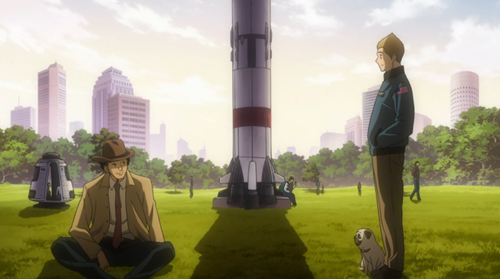
I love the way this show handles the idea of family, because
it truly understands how some feelings go unspoken. Mutta and Hibito don't act
like anime brothers, who always try to bang you over the head with the fact
that they are brothers and interpret familial connection as having a clear cut
relationship that can be defined in a single word. Not the case here. I'm often
reminded of my relationship with my own brother when I see these two. There was
a period when we lived in separate states and wouldn't see each other for
several months up to a year at a time. And when the time came, it was never a
grand reunion; we'd say "Hey" and get along like nothing had ever
changed. There's always talk about how the bond between siblings is
particularly strong in Japan, but Space
Brothers shows this strength in a different way. Whenever you see the
brothers together, there's a subtle gap in the air that could be mistaken for
awkward silence, but is really an unspoken understanding. What this story
undoubtedly is aware of is that a true family bound by love which integrates
beyond any and all flaws has no need for words. Mutta and Hibito understand
each other better than anyone because of their unique relationship, even when
they are figuratively worlds apart. This is why as brothers they can be so
passive, silently supportive, and can get along even though they're almost
polar opposites. Because they're family who've spent many years growing up
together; their relationship is established long before the series begins and
is reinforced through the quiet familiarity they share.

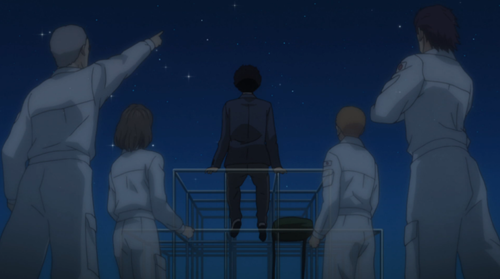
Not only is the connection between the Nanba brothers
handled well; the disconnect in their respective lot in life brilliantly
services the story. The ingenious foil of Hibito already training as an
astronaut at the same time as Mutta is taking the tests to become one lets us
see both sides of the equation; the trials and the lessons one must learn to be
proven as astronaut material, and the trials and training an astronaut must
undergo to prepare for a trip into space.
And every single person on each side of the equation serves as an
important aid to the brothers' journeys - there's Mutta's relationship with his
parents, the officials at JAXA, the friends/colleagues he encounters in
multiple stages of the astronaut exam, his brother, his brother's dog (and show
mascot) Apo; and then there's Hibito's relationship with his astronaut
colleagues and veterans and HIS relationship with his parents; and THEN there's
well-implemented flashbacks to the brothers as children where we see more interactions
with their parents, their mentor/teacher, and the officials at JAXA during
their multiple field trips to the facilities.
And all of those other characters?
We get to explore all of THEIR pasts and relationships and what drives THEM. Space
Brothers is primarily about the titular Space Brothers, but at the same
time it presents a giant world full of interesting people, each with their own
dreams and goals or lack thereof. It is an absolutely wonderful tour du force
of characters depicting a world the doesn't revolve around any single person,
compromising no-one.
That's Space Brothers
in a word: wonderful. It's a slice-of-life that doesn't try to play
up to its audience or entice them with mindless trinkets. Sometimes, rarely anything substantial will
happen in any given episode. The story
isn't rushed in the slightest; time is taken for every last detail. Depending on your level of tolerance, this
may or may not be a turn-off. But if
you're like me, when you get to those long stretches you're already beyond
invested. We don't need enhanced
world-building to feel immersed. The world is composed of people, and it is
built by their hopes and dreams. What Space
Brothers does, for me, better than any other anime, is create a world built
solely on human interaction, love, and understanding. No gaudy hooks, no
supernatural flights of fancy, no wish fulfillment. A world where the only
defining quality is that of the people who inhabit it; to me nothing could be
more pure.

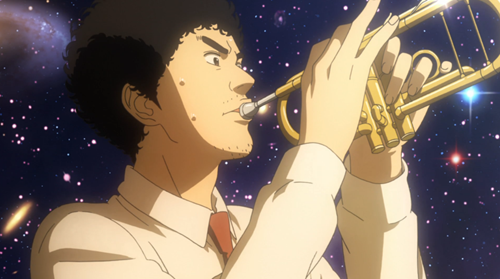
That's not to say Space Brothers won't return some day. The manga is ongoing and the anime didn't ultimately close the book to sequels. All this critic can say is in the wake of Space Brothers a hole has been left that may never be filled. It is a series I will remember forever for its brevity and wit and charm and pure appreciation for the human spirit. For these reasons it touches my heart, and why I feel it is worthy to add to that special list of anime which influence me as an individual above all others. Welcome home, Space Brothers.
You can currently find all subbed episodes of Space Brothers streaming online courtesy of Crunchyroll. The series has been licensed by Sentai Filmworks, but has not been scheduled for a U.S. release at this time.

No comments:
Post a Comment