
We made it! The dredges of Mahouka are behind us, and all that's left beyond it is ever-expanding space! Space, the final frontier, a metaphor for the possibilities that exist in artistic thought, where we're never truly out of ideas. For me there was one particular series that encapsulated that ideal, that space is the place where concepts can run wild and break barriers. One particular series which, for me, was my favorite anime of 2014 and what I consider the most influential anime of the year, and in fact of several other recent years.
Ladies and gentlemen, I am so pleased you have followed along on my journey back through 2014; there was laughter, disappointment, joy, and just pure hatred. It was a year of many ups and downs. I hope you have enjoyed this year's Retrospective and will continue to support my reviews. I do them for myself and for those who take the time to read them. Even if you don't like my reviews or don't agree with them, I thank you for reading them at all. That's all I need. Regular reviews will resume as soon as I can get off my butt to write them - already I have a few contenders in mind that just finished up. Happy New Year, welcome to 2015, and without further ado, I give you Space Dandy.
One last thing. In a later section of this review, I discuss what could be considered spoilers, but they are out-of-context conceptual bits of information as relating to the character of Space Dandy and his thematic purpose - I don't directly give away events from the show, but those who have watched it in full will know what I'm referencing. Unfortunately, it is impossible for me to give my complete analysis of his character without making this particular reference, so I have marked the place in the review if you wish to skip it. I highly suggest you read it anyway because I put a lot of thought into the analysis and find it meaningful. It is at your discretion whether you skip it or not.
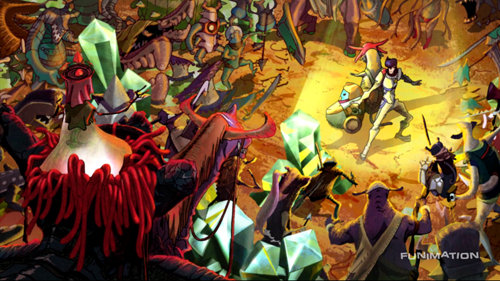
Space Dandy is a dandy guy...in space. He combs the galaxy like his pompadour, on the hunt for aliens. Planet after planet he searches, discovering bizarre new creatures both friendly and not. These are the spectacular adventures of Space Dandy and his brave space crew...in space.
Few can argue that Cowboy
Bebop was a monster of a title. It
was THE definition of anime in the Western world in the final years of the 20th
century. It still sees such international success that FUNimation just released
the series on Blu-ray for the first time. It is Shinichiro Watanabe's jazz
blues put to life in unparalleled cinematic beauty. Cut to more than a decade
later, a year after Watanabe's last project, Kids on the Slope; a decently enjoyable series that held little
right beyond Yoko Kanno's fantastic score to be remembered. We all thought the
long awaited reunion between Watanabe and Kanno, the Big Bebop Bruhaha, was exactly what we wanted - that the lightning
would strike again and create a new hit as big as Cowboy Bebop, or at least as big as Samurai Champloo. It would not be 'til Otakon 2013 that tales of a
dandy in space would flood forums and the gauntlet was raised once again - the
challenge to create a series as significant as Cowboy Bebop. That task fell to Space
Dandy. Did it succeed?
Space Dandy
chronicles the space-faring adventures of the man, the legend, the lover of the
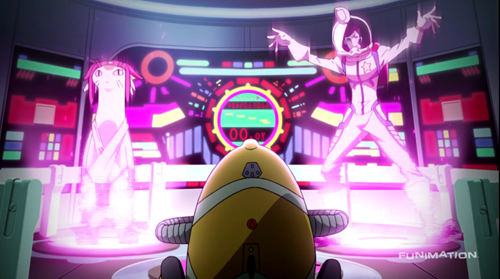
booty, the Space Dandy and his space crew aboard the Aloha Oe: neurotic
cleaning and navigation robot QT and a slovenly, tech-happy Betelgeusian named
Meow (bestowed upon him by Dandy because he looks and acts like an Earth cat).
Episodes are (mostly) self-contained vignettes following the daily lives of
these bums as they try to capture rare aliens and get them registered for cash.
Unbeknownst to this ramshackle crew, an
enigmatic gorilla alien known as Dr. Gel, chief science officer for the Gogol
Empire (along with his tiny assistant Bea), is hunting Dandy because his DNA is apparently laced with a rare
element known as 'pyonium'. We don't really know why he's got it or what it
means, but it's a thing!
If Cowboy Bebop
is, as Watanabe has said in interviews, "80% serious and 20% comedy,"
then Dandy is the polar opposite. The
latter is by and large a comedy sci-fi serial which draws its influence from
the whole of the genre, from its humble beginnings to the present day. Doctor
Who, Star Trek, Star Wars, Gundam, Transformers - you name it, Dandy has
probably parodied it, given it intelligent lip service, or otherwise. Like Bebop, Dandy also draws heavy styling from particular eras of music. In
this case, the compendium of space exploration is punctuated by motifs spanning
the 60s through the 90s, including funk, disco, and early prog rock. Space
Dandy is intended to speak to the language of cool cats, daddy-o, and indeed, a
common episode can fool the sensation of getting high on acid. If Cowboy
Bebop could be described as redefining the space genre by introducing it to
class and refinement, Space Dandy extends
the motion with a nostalgic embellishment of wild, funky fresh abandon. It acts
as a love letter to everything that ever came out of the sci-fi genre and
beyond.
Despite the
tonal differences of these series, many similarities characteristic of Watanabe's
personal touch can be found in both, such as in the protagonists. Both
are lazy, down-on-their-luck bounty hunters with their own deep philosophies on
life, the universe, and everything - their differing qualities lie in what they
believe in and their social conduct. Bebop's
Spike Spiegel is a philosophical dreamer trapped emotionally in the pangs of
his past - a man who can only look backward. The titular Space Dandy is an
addlebrained, womanizing braggart and booty philanthropist - a man who
disregards his past so defiantly that he doesn't appear to have one. Both could be said to be variations on
Lupin the Third. Spike’s relation to the character is hidden between the lines,
but with Dandy it should be more obvious. Dandy is a nuisance wherever
he goes and regarded as an infinitesimally irreverent focal point of his own
story, even by his own story. His pathos creates an image of a planet-hopping
Johnny Bravo: he's trying his hardest, and damn, does that make him pathetic.
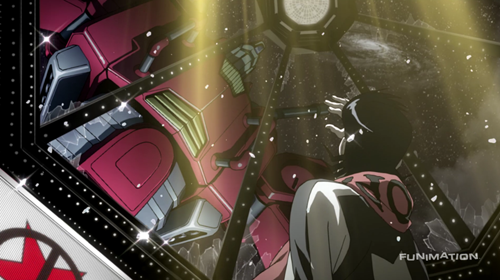
Actually, when it comes to American cartoon leading men, I like to compare
Dandy to Bugs Bunny. He doesn't possess the charm nor the cunning of the
lovable Looney Tunes hare, but he does invoke a similar state of mischief and
chaos. For instance, any cartoon where
Bugs takes that wrong turn to Albuquerque and ends up who knows where; when
Dandy appears on the scene, you know, "Oh boy, it's that rascally Dandy
here to turn everything on its head". He's a comical harbinger of anarchy
- wherever Dandy goes, some apocalyptic shit is gonna follow. As a viewer,
you'll learn this early on, and then the glee of what Dandy's gonna do this
week factors in to the show's entertainment values. Looney Tunes style was to
take a simple situation and introduce one of its classic characters onto the
scene to transform it into total insanity - I see the same formula in Space Dandy employed to great effect.
Space Dandy assembles
an ensemble production cast of many hearts and minds. The show is a hierarchal jungle gym on an
animation playground: this week, Billy is king of the jungle gym and he gets to
direct the fun; next week, it's Sally's turn. Watanabe acts as general director
with Shingo Natsume as the default main series director, but every week the
episode director, writer, animation supervisor, and storyboard artist changes.
Thus Dandy is an anthology series
made to show off a plethora of writing and animated styles.
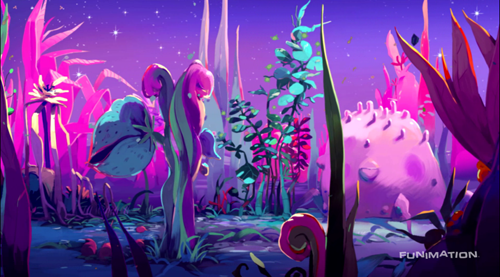
Well-known industry
professionals with very particular approaches to story-telling such as Dai
Sato, Kimiko Ueno, Keiko Nobumoto and Sayo Yamamoto make their rounds in the
Dandy-verse, but the production also gives credence to specialized one-man
powerhouses who take on the brunt of an episode on their own. Masters of visual
abstraction Eunyoung Choi and Masaaki Yuasa each get their own episode to
dazzle the audience with their free-form fluidity that brought Ping Pong the Animation to life. Lesser
known freelance animator Kiyotaka Oshiyama gets the opportunity to showcase his
particular brand of expertise in a solo episode as well, perhaps fueling more
clout and business venues for him in the future. Key animator on high profile
niche titles Angel's Egg and the
animated Night on the Galactic Railroad,
Yasuhiro Nakura, brings the mysticism and subversive atmosphere of those works
to his Season 2 directed episode, "A World With No Sadness, Baby".
Even some who have nothing to do with anime have been called upon to
contribute. Two episodes are given to author Toh EnJoe; never written for anime
in his life, but his name precedes him as an inquisitive science fiction
writer. These episodes, "I'm Never Remembering You, Baby" and
"An Other-Dimensional Tale, Baby", touch on outlandish critical
concepts surrounding quantum mechanics and string theory and other head-wracking
ideas one doesn't normally see in anime. While not the most laymen's accessible
episodes, they add to Space Dandy's
credibility as a sci-fi collection and are welcome entries to the records.
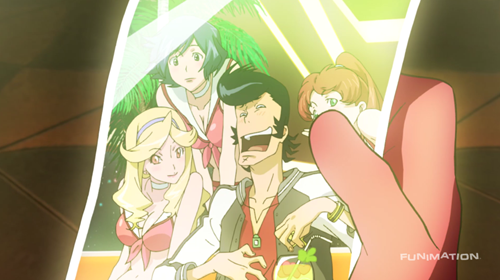
As you can see, Space
Dandy is an equal opportunity bastion for celebrating the anime industry.
Professionals old and new, popular and unknown, controversial and safe, all get
a chance to sink their teeth into this show.
One result of this is that the quality of individual episodes are variant
depending on your particular taste. For example, I LOVE Keiko Nobumoto's
masterpiece Wolf's Rain, but found my
reception to her work in Space Dandy
somewhat mixed. Her episodes "The Lonely Pooch Planet, Baby" and
"The Gallant Space Gentleman, Baby" felt like broken story bits awkwardly
managed into full episodes and lacking the best of her melancholic style.
"There's Music in Darkness, Baby" feels much more in tune with her
strengths, and "We're All Fools, So Let's Dance, Baby" is patently
ridiculous yet contains the right amount of fleeted soul-searching in nostalgia
that I love about her work. So Dandy
definitely is not a series where every episode is great; in fact, many fall
flat and don't take full advantage of the show's ever-expanding universe.
And yet, few anime feel as artistically free as Space Dandy. The first episode quickly
tells us, "We're going to take this train wherever it may lead and it
could go anywhere". A world is established
most reminiscent of the crude, absurdist continuity found in Matt
Groening's Futurama, another work
that pays homage to classic sci-fi serials. These universes operate on abstract
plausibility - it's space, this vast undiscovered cosmos, so let's populate it
with anything and everything that could happen and ever will happen!
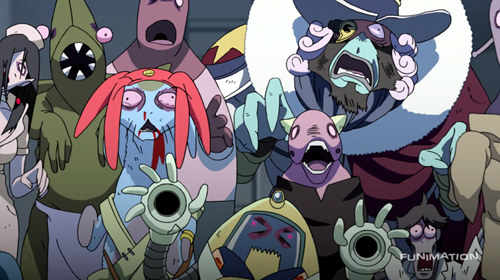
This week,
Dandy could be a trucker, or a surfer, or maybe he'll be a fisherman, or a rock
star! In this universe, the entire universe is infected and turns into zombies.
In this universe, QT falls in love. In THIS universe, the Aloha Oe explodes and
everybody dies! But everyone doesn't die. Or did they? Maybe they did,
somewhere, someplace, sometime? Space
Dandy works as a meta routine of that 'see you again next week' style of
continuity because it invents in-world
explanations for why the stage dims on a situation which seems irreversible.
How do our heroes escape certain death just in time to return to status quo
next week? Dandy cryptically responds
by not only allowing these horrible tragedies to occur uninterrupted, but by
resetting everything for the next episode anyway. The answers only raise more
questions, and Dandy never gives more
than a half explanation for how our hero returns to a new life every week. From
this there are multiple interpretations of what purpose the meta-story has to
exist and what significance it holds; the following is mine, which we can
discern by examining the narrative structure of these stories.
Both Bebop and Dandy are a seemingly unconnected series of adventurous escapades
with an underlying thread revealing the man behind the curtain bit by bit,
session by session. As said above, Space
Dandy is less concerned with the truth of the hidden machine. Bebop’s secrets are the variety of deep,
challenging characters living but not really awake - the haze of the perpetual
dreamer. In Space Dandy, the ideas
presented are that of a constant universal dream rather than a universe of
dreamers. The dream is that of the constructor - the one who brings the world
of Dandy to life - the artist. It’s
tough to find, but clear-cut exposition of Dandy’s meta-fictional journey can
be found interspersed among the Aloha Oe’s flights of fancy. In the very first
episode, their warp drive malfunctions, jettisoning the trio into a pocket of
space time populated by literal ‘cosmic threads’, which Dandy is all too eager
to yank on. It is difficult to say how long Dandy has defied the laws of
reality, but a case can be made for this action being the original catalyst -
when the character comes directly into contact with the underlying thread of
his own story. From then on, the dandy guy floats unawares from one existence
to another, donning different hats, escaping numerous fates on the cutting room floor between episodes, and mysteriously never questioning these happenstance
circumstances. In the end, the laws of the narrative folds upon itself,
heralding the awakening of a new omniscient construct which transcends fiction:
Dandy.
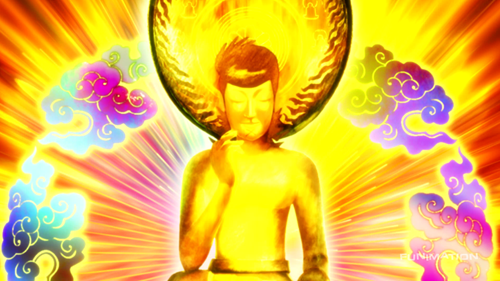
##SPOILER-ISH DISCUSSION BEGINS HERE##
What IS Dandy,
and what does Dandy represent? Well, this critic says that he is a definitive
argument for the classic form of the medium; a call to embrace animation with
the passions of the constructor at the helm. When Dandy truly awakens, the
constructor offers Dandy his chair - the opportunity to run the show. But Dandy
declines, because all the joys of his life would vanish from this position of
omniscience. On one level, this is a tried-and-true values lesson on status
versus personal happiness, but there’s more to be said of it in relation to the
medium of anime itself. Now more than ever before, the state of anime in Japan
stinks of talentless stagnation, largely in part due to the rise of moe and
otaku culture since the mid 2000s. For every show filled with unique ideas like
Penguindrum or Attack on Titan or Eccentric
Family, there are two Sword Art Online's
and four Nisekoi's for each, and god
forbid, maybe a Mahouka. These are
stories that lack the feel of an examinable creative process, in its place a
checklist of tropes and ideas seen a billion times before executed a billion
times better before, all for the sake of cheap, guaranteed sales from an easy-to-please
otaku fanbase. You've got your
reader-insert wish fulfillment protagonists, your pick-and-mix assortment of
'best girl's - characters that seem to exist in spite of their artist. They are
brought up to be loved by the material world versus the intellectual. When you
take away the power of the artist, these stereotypical constructs perpetuate
and grow a separate life unchecked by the artists' brush. Their existence
devolves into self-serving gratification.
Dandy is the
creation of an artist with inert self-awareness. Through his chaotic blunders,
he has brought the universe to the brink of destruction so many times that his
existence has been elevated to the height of astronomical significance. He has
ascended to a point where he can perceive the constructor and when given a
chance to take full control of his own story, he says NO, opting to allow a
cosmic reset. The constructor is an allusion to the artist on the way out - one
who has checked out of their artistic vision and succumbed to the wiles of
mainstream consumerism. Dandy is a construct arguing against this notion. He
defies his own evolution beyond the frame by relinquishing control and diving
back into the creative machine, to the hands of ego-less fate, to the
unpredictability of a chaotic universe, or more accurately, to the melting pot
of talented artists from all walks of life defining the production crew. Watanabe
has pieced together a construct belonging to no-one and everyone: Dandy, a pure
spirit of artistic integrity. He could bend reality to his whim if he wanted
to, but he refuses because he knows the moment he makes that leap, his purpose
in existence changes, just like an anime character's purpose changes when taken
to the consumer world outside their story. And Dandy is speaking, of course,
for the benefit of Watanabe and all artists, that he doesn't want his purpose
to evolve beyond his control. A man given a shot at freedom, but he is already
free. That is the metaphysical singularity known as Space Dandy. Is this theory
a bunch of bull-honkey? Maybe. Watanabe said in the initial announcement that
"[Space Dandy] is not a series to be taken seriously", but I
know...he's not a man to create on such a face-level scale. This is what I
believe.
##SPOILER-ISH DISCUSSION ENDS HERE##
The duplicitous nature of Dandy and its resulting machinations are exactly what raises this
show out of mere sci-fi spectacle into outstanding intrigue. The series works
best when it is fully embracing the impermanence of time and space, whether
it's lambasted in wacky theatrics or meaningfully poked at. My answer at the
show's true meaning is only one interpretation; Space Dandy should never provide concrete answers but instead get
your brain working in questioning the laws that govern our reality as they are
broken and bent to the galactic construct that is the dandy guy in space. Maybe
you get more joy out of the grounded episodes, the ones that focus on the humanity
of our heroes and relate them to our own condition. Those are fine, but they're
not what I want out of this series. That's what I want out of Cowboy Bebop, and here we can see where
the significance of these shows differs.
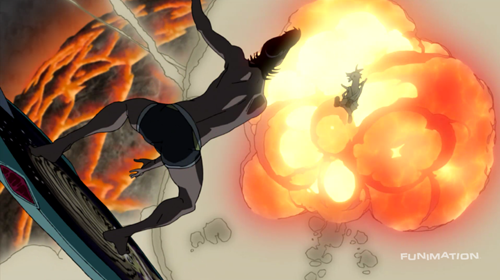
As a product, Space
Dandy can be hit-or-miss on a scale of quality, with a better chance to
miss than Cowboy Bebop. On the
surface, it is an affair of animated irreverence that values anarchy over
reason. Bebop's story beneath the
surface is more closely tied to its outward appearance and aids in the cultural
significance of that show as a whole. Meanwhile, Dandy's narrative modes are more keenly separable; the underlying
meta conspiracy theory is easy to gloss over, nor is it even required to be
addressed. This is both a weakness and a strength for the show's longevity.
Dandy will never be exalted with the same critical accolades as its big brother
Bebop because it just doesn't possess
the same pomp and circumstance that made Bebop
an instant classic. But Dandy is more
significant, perhaps more than Bebop,
specifically as a vehicle to argue for anime's artistic relevance in this day
and age. It’s a hip and happenin’
psychedelic mind trip on the surface, self-paradoxical plea for the artist
underneath which belies the current industry’s widespread abandonment of
innovative design. Watanabe’s greatest strength shines here: to take ideas of
absurd pretense and make them palatable via unforgiving and voracious adoration
for their medium. In Cowboy Bebop,
Watanabe reinforced his love of jazz, Hollywood noir, and rich narrative. In Space Dandy, he reinforces his love of
funk, science fiction, and animation as a freeing concept of anti-establishment. He is a man who loves deeply and applies his
taste with so ingrained a personal stamp that the artist’s feeling reaches the
viewer without fail - he is, absolutely, a true dandy.
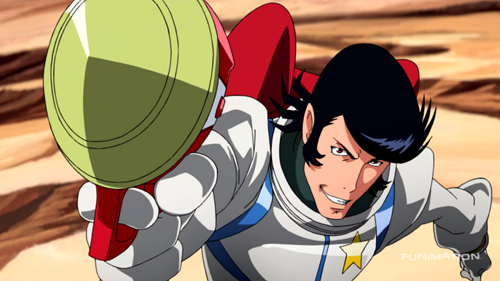
You can currently find all subbed episodes of Space Dandy streaming online courtesy of FUNimation and Hulu, as well as dubbed episodes on Amazon Prime and iTunes. The entire show will be released on home video starting with Season 1 in February 2015.


No comments:
Post a Comment