


Good evening, all. I've got a lot of stuff planned in the works, so don't worry! Life is super busy right now as I am exploring the world of real estate and wow is it frustrating. But also a great learning experience! Anyway, let's unwind from the ills of everyday monotony by indulging in some body horror action with tonight's review: Parasyte - the maxim -. Enjoy! Or be grossed out. Either is appropriate.

Without warning, the Earth is suddenly invaded by parasitic lifeforms that assimilate human bodies. One such creature lands on the window sill of mild-mannered high school student Shinichi Izumi's bedroom. It pierces Shinichi's body, but in a struggle, is unable to reach his brain and take total control. Shinichi awakens to discover that this creature is now trapped inside his right hand, over which it can assume a less complete total control. Shinichi and this creature, given the name 'Migi', are forced to learn about each other and take a stab at a dangerous coexistence.
In the late 1980s, Hitoshi Iwaaki suddenly had a thought.
That thought fermented and eventually coalesced into the beloved seinen manga Parasyte, a tale of monstrous body
horror and adolescent heroism. It was a generational hit that floated through
the ether for another half a century before it finally received an animated
adaptation courtesy of Madhouse late 2014. It's no shock to me that Parasyte was wildly popular - even my
friends who are only on the fringe of Japanese entertainment seem to know about
it. And while I've never read it myself save for the first couple chapters,
word of mouth and nostalgia always kept it alive as a cult classic among manga
geeks. So why, if this is such a popular story, did it take roughly 25 years
for an anime to be green-lit? We live in a market where the most lauded works
become slated for television within a year of serialization, if even that long.
I don't know the answer to Parasyte's
long sojourn, but can only guess that the aesthetically-similar-to-hentai body
horror and scenes such as Shinichi's right hand turning into a penis might have
caused producers to shy away.
Aesthetically,
Parasyte is a grindhouse version of the
Spiderman mythos. Teenage boy is infected by something inhuman, gains inhuman
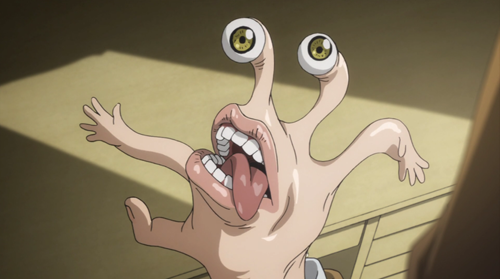
powers, uses powers to defeat other superhumans. The parasytes are able to
assume complete control of their host depending on what portion of the body
they have infected on a cellular level. If it's the brain, they seize control
of everything, destroying the human's original free will. If not, they are
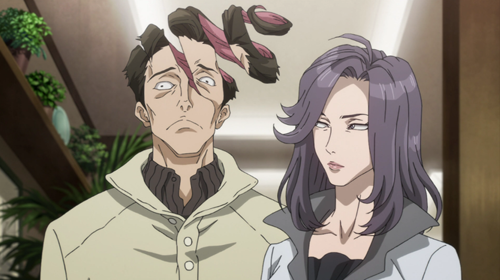
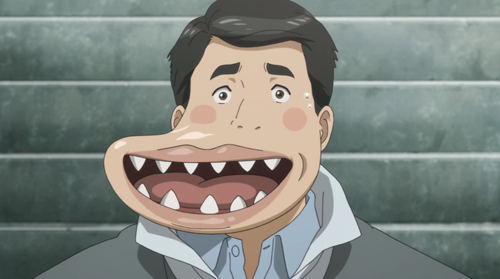
relegated to that particular body part, like Migi in Shinichi's right hand or Jaw
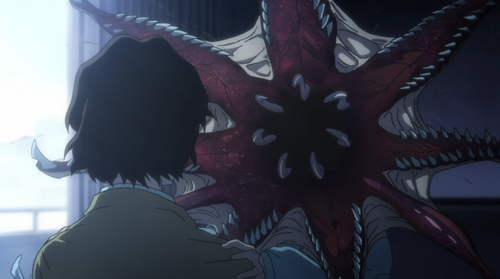
in Uda's face. No expense is spared as we are shown just how intricate their
control is: human flesh is segmented into wriggling tendrils reinforced with
raw muscle and steel, intestines turning inside out and reshaping themselves
into whatever form of weapon or tool the parasyte might need. It's nasty and
kind of cool at the same time, getting to see how the contents of the human
body can be twisted and misshapen but in a way that biologically makes sense
(as much as this kind of fictional monster story can make sense). It's like
watching Edward Elric use alchemy to modify the amount of carbon in Greed's
ultimate shield, but instead of science nerds Parasyte's brand is for exploitation film fanatics.
Well
then, the anime. What did Parasyte - the
maxim - get right, and what did it get wrong? I'll start off with what it
got right, which is in the aspects of the story modernized for today's discerning
anime critic. A core visual element to Parasyte
is the evolutionary divergence between humans and parasites, with Shinichi
Izumi acting as an unintentional missing link between them due to his unusual
circumstance. The best kinds of stories show and don't tell, but at least show
in addition to telling if they must, and this is something Parasyte does well early on, due in part to an artistic choice that
was initially seen as a betrayal.
It's
clear that if not the original creator, surely the employees at Madhouse could
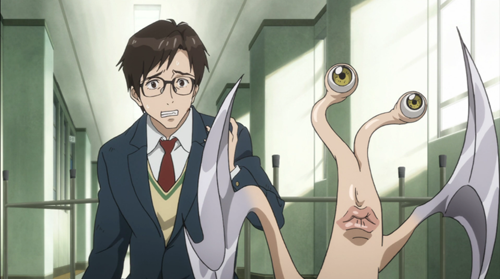
see the Spiderman inspiration in the material, and so they redesigned Shinichi
into their very own Peter Parker, a weak, wimpy pacifist complete with dorky
glasses (he never wore glasses in the manga). Shinichi's significant other,
Mary J-I mean, Murano, also got a face lift, and the ultimate result is
everyone looks more like they came out of a high school anime from the late
2000s instead of the 1980s. A smart move, as the original designs would stand
out unattractively in this mellowed out age of rounder, simplified, moe-fied
designs. But talk to any manga purist and they'll tell you the #1 rule is for
the anime to look just like the manga, so naturally fans were upset their
protagonists were drawn through a modern filter. However the progression of
Shinichi's story would soon show just how wise this redesign was.
Again,
visual story-telling is an important tool of animation, and Parasyte does this exceptionally well in
the design of Shinichi. As our hero faces the early traumas of life with a
symbiote, he suffers a nearly fatal wound which forces Migi to repair his heart
by spreading parasitic cells throughout his body. Watch closely as the
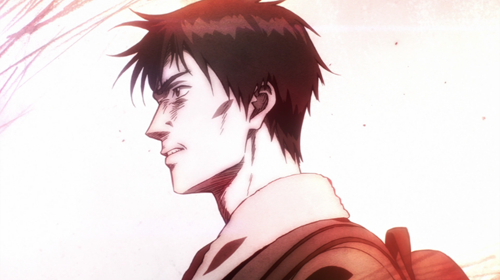
aftermath of this event plays out and you'll notice that Shinichi's design
changes as he steps deeper into the world of the parasites. First he loses the
glasses - he suddenly grows beyond the
point of needing them. Then his hair gets frazzled and he ceases mending it,
allowing his bangs to hang messily over his forehead. And finally, every muscle
in his body is strengthened by Migi's cells, turning from wafer to beefcake
practically overnight. The more Shinichi loses of his humanity, the more
beautiful, deadly, and frigid he becomes, ascending the ugliness and frailty of
base humanity via a thinly veiled metaphor for puberty to become an idealized,
autonomous Adonis. Madhouse's animation perfectly reveals this regression of
character in the writing as well as the visuals on-screen. As a bonus for fans,
the more Shinichi transforms the more he regains defining features of the
manga's original design, so you see it was never a betrayal in the first place.
At least not in this aspect of the production.
That
brings me to what Parasyte got wrong,
and that unfortunately is everything else. I'll remind you that I never read
past the first few chapters of the original manga. Despite this, it's easy to
tell that the majority of this story has not been updated for the current
times, and the result is a production that's faithful to its source in all the
wrong ways. More and more it's becoming clear that "exactly like the
manga" is an archaic method of adaptation - it is anathema to the very
notion of the word 'adaptation'. Fullmetal
Alchemist is a purpose example of this ideology because it had two anime
which covered both avenues. But in a nutshell, adapting changes from the source
material is cool and good if you are able to better utilize characters while
keeping them true to their origins and if you can remove inherent flaws. Parasyte - the maxim - fails this test
and follows the Brotherhood route of
strict, unilateral adaptation from paper to screen.
The
result is we get a story trapped thematically in the times of its creation,
along with tropes and outdated morals of the same. Parasyte, as a story, is outdated as hell, and frankly does not
stand the test of time. In today's environment where there is ever growing
support for proper representation of feminism in media, Parasyte would be chewed up and spit out as its adaptation
rightfully has had done already. Everything falls apart around the time
Shinichi goes full Spiderman 3 emo!Peter Parker short of tacky song & dance
number. Any promise the story presented grinds to a halt to explore 'tortured
comic book teenager feels' as Shinichi tries to be a normal human dude filled
with emotions for the bevy of ladies in his life until they are ceremoniously
killed (read: shoved in a fridge) so that he can eulogize on how totally
important they were to him and grow stronger as a result. Earier events evoked
real tragedy - all of that is gone in the second half's main female diversions.
The girl fated into love by an unexplained plot device, later killed because
she got too involved with her steely crush; and the parasite who learns to be
human thanks to the gift of life, infected by the eternal power that is
maternity, if you will. Both plotlines that could be adapted into strong,
progressive characters but written from an 80's mindset that just doesn't have
a proper appreciation for women; using their status as women as an empowering
light for the benefit of man which sucks their own self-worth dry. Parasyte humanizes women very poorly, is
what I'm saying. Most have no agency that doesn't relate to Shinichi and they
disappear from the plot entirely, often via death, once their purpose to
Shinichi's journey is fulfilled.
Around
the time Shinichi begins getting involved with detectives and cops and has to
hide Migi's existence from them, you suddenly realize what else Parasyte is similar to, and then more
acutely realize why Parasyte is not
fun. Because Parasyte is Death Note......were it not fun. Death Note featured a masterful
execution of one of the goofiest concepts ever: write a name in a book and that
person dies. It did that by not taking itself seriously in the slightest,
something its adaptation was keenly aware of. Tetsuro Araki brought his A-game
and directed Death Note towards a
cinematic, bombastic tour-de-force graciously lacking in all subtlety, and in
retrospect I wish he had been called in to do Parasyte. Instead we got Kenichi Shimizu's first go in the
director's chair, and it shows, despite his many lesser directorial credits.
Ironically, both series are animated by Madhouse, and yet while Death Note is sweeping and majestic and
over-the-top, Parasyte just looks
boring. The camera barely moves, the color palette is uninspired, and every
action is treated with supreme seriousness. It's an edgy sci-fi serial that
should be campy and ridiculous directed to be a melodramatic mood piece.
Finally,
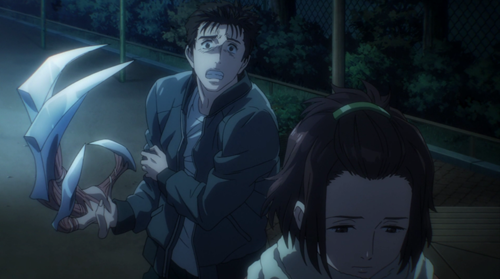
I have to touch on the ultimate make-or-break of the series, the Light and Ryuk
of this tale: Shinichi and Migi, and how their relationship is meant to
resonate. Migi is, by nature, not really a 'fun' character, because he doesn't
operate by emotions like humans do. Parasites are logic-seeking creatures that
act instinctively for self-preservation. In contrast to Shinichi's descent into
becoming more and more like a soulless parasite, Migi begins to show more and
more signs of humanity, going as far as to show concern and prioritize
Shinichi's safety above his own. This culminates in the show's final arc when
Shinichi seems fated to face off against super parasite Gotou without the
security of his dear partner in crime.
Around
this point, the adaptive team have pretty much given up trying to be clever and
just hamfistedly make characters deliver totally deep philosophies on speciesism
and environmentalism and conservationism as bookends to combat. This way we
absolutely won't miss the show's incredibly basic message on how humanity
chooses to coexist with its planet and those inhabiting it. Did you know that
humans are the real monsters? You did, because you've seen that in every anime
that explores the depths of human depravity ever? Well Parasyte did it first, and apparently thought it was just oh so
clever and rich with allegory that the adaptive team didn't change a thing. You
want to know what Shinichi and Migi's relationship spells out? That's basically
it, there's no other layers to it. It's about how humans and parasites have to
coexist like everything else humanity fails to coexist with because humans are
the true monsters blah blah blah blah blah, comic book level social commentary.
And as if you just didn't get a good grasp of all the problems in this story
unfit for today's learned critic, every single one of them is brought back in
the final episode as a send-off so you can remember how weak and flawed the whole
experience was. Shinichi rambles on with his speciest philosophies until the
psychic convict character comes back and almost gets Murano killed, all so
Shinichi can be reminded that Migi is still within him and we can all coexist
after all like a big happy family. Oh by the way, did I mention that after
Shinichi's final battle, every single parasite on Earth decides to be chill?
Forget our synapses telling us to assimilate humans to clean up the
environment, we'll just immediately ignore our natural programming. Wow, what a
phoned-in tepid peace.
Beneath the surface of Parasyte's flailing tendrils are some neat ideas about the human psyche as it would develop in a like supernatural environment - how people perceive one another and connections that can't be explained by natural physiology. Murano's repeated questioning of Shinichi's self post-Migi, and Tamura Reiko's mother realizing her daughter's 'absence' with but a word. The internal and external metamorphoses of our heroes and villains speak more to truths of the human condition than what they do with their powers. Sadly, Parasyte's ultimate message is far too naive and its execution too antiquated and drab to permeate the ether. I blame the material on this one. It was going great, but then it just drifted away. This tale of a boy and his right hand just couldn't cut it on the animated stage.
You can currently find all subbed episodes of Parasyte - the maxim - streaming online at Crunchyroll. The series has been licensed by Sentai Filmworks and has plans to be released on home video sometime in the future.

No comments:
Post a Comment