
Welcome to another Retrospective Review day! Just one more and then we'll jump back into the regular review format for the continuing 2014 anime season. Read on for my look at Watamote!
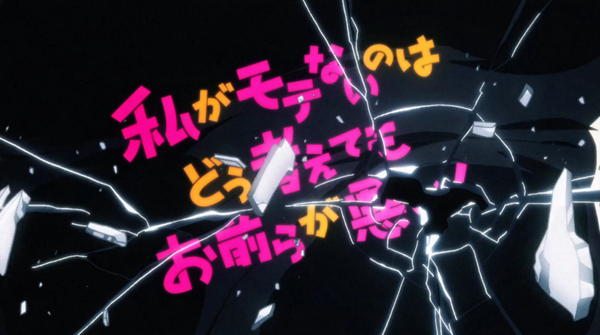
Years of watching anime and playing countless dating sim/eroge games has convinced Tomoko Kuroki that she should be popular. But she isn't. She's unkempt, fashionably bankrupt, and lacking in social skills of any kind due to her lifestyle as an otaku recluse. Now starting high school, Tomoko is determined to make friends and become popular in any way she can - if only she can figure out how to do that without dying from embarrassment.
Ever since the advent of Ore no Imouto ga Konna Ni Wake Ga
Nai (There's No Way My Little Sister Can Be This Cute, otherwise shortened to
Oreimo), light novel series with increasingly long titles have become a staple
of otaku culture. Such titles normally aren't simple descriptors or prose, but
rather a spoken phrase a character in the show might say. In Japanese
entertainment, the gap bridged between a work and its descriptor is not too
socially impersonal - titles of series and individual episodes will often have
an intimate, first person take on what it is describing. I believe this is
meant to mediate a deeper relationship between the work and the viewer. Even if
half the time that deeper relationship possesses unsettling connotations bred
from otaku spank material. Maidens Are Falling In Love With Me (OtoBoku),
Listen To Me Girls I'm Your Father, We May Be Siblings But We Can Still Have
Love (OniAi), My Girlfriend and My Childhood Friend are Fighting Too Much
(OreShura)......the majority of these long title series are male fantasies
wherein the protagonist finds themselves inexplicably surrounded by young
women. However, there are exceptions, one of which being today's topic: Watashi ga
Motenai no wa dou Kangaetemo Omaera ga Warui! (No Matter How I Look At It, It's You Guys' Fault I'm Not Popular,
otherwise shortened to Watamote).
This show is what many
have called the "anti-moe" anime, conceptually. It picks up our
preconceptions of moe culture, spits in its face and rips it a new one, they
would say. I want to clear the air on this right off the bat - I do not believe
this show is anti-moe in any sense of the word. Moe, as defined by fans, has
evolved unchecked to the point we have no precedent to declare a concrete
concept is absolutely defying everything it represents.
How is this show
making sport of moe culture? Here we have Tomoko, our protagonist. She's not
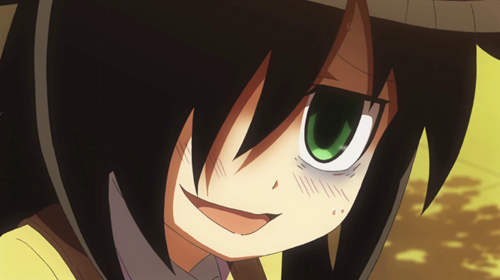
moe at all because she's not cute, she's a creep, a shut-in, smelly, stutters and avoids eye-contact, and all-around does not characterize what fans envision
when they think of moe. So they would say. I would say, consider what the term
"moe" means to you. Moe is defined from person to person: it means
that you find a character so adorable and sweet that you cannot help but have
your heart beat for them. Whether that beating is of inappropriate sexual
attraction is your own prerogative, but what remains constant is a feeling of
connected affection to the character. If we go by this definition, I believe
that Tomoko is totally moe for MANY people.
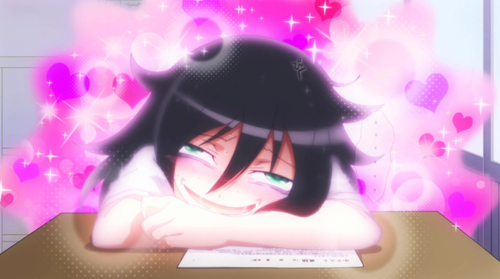
And why is that?
Because Tomoko relates to us. She was a lot of us in high school - nerdy, weak,
unpopular, into all the hip cartoons your parents said were rotting your brain
- she is a living, breathing caricature of an adolescent outcast. Otakudom has
locked in the term moe to only refer to certain types of girls we find cute,
but I believe a broader definition allows for girls like Tomoko. She may not be
'cute' , but many viewers found her actions cute and fell in love with her
rebellious fervor and shaky constitution because she speaks directly to boys and
girls alike in similar predicaments. I believe that is moe in its own right. You're right that Watamote
is an opposing talking point on a majority of moe designs in anime, but I would
not go so far as to say it totally rejects the term. It is simply a personal
redefinition.
Watamote functions
more characteristically as a semi-realistic take on actual otaku. While I said
she is not the embodiment of anti-moe, Tomoko IS the embodiment of anti-otaku,
as defined by anime. Take Lucky Star, for example. Konata Izumi is a
fetishistic depiction of otaku - she's cool and quirky and everything about her
hobby is glamorized. Watamote's strength is not in what it is but what it
isn't, and Tomoko is anything but a glamorous otaku. Likewise, Tomoko's central
drive in the story is not about what she is, but what she isn't - her desire to
be popular. She wants what those around her have, but not for the sin of
jealousy. Tomoko perceives her world as incorrect; what she engrossed herself
in, anime and manga, painted a picture of adolescence that is not happening to
her, and so she must correct what is wrong. But she can't, not the way she is
now.
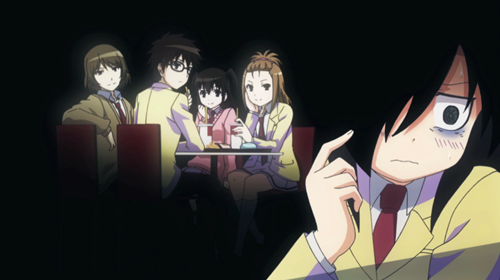
And this is perhaps
Watamote's simultaneously greatest strength and greatest weakness: the
depiction of Tomoko's failings. Tomoko is not quite a NEET, but she is on the
verge of going down that path. She reaches out to make friends, but she has
constructed a box around herself which clashes with her attempts to do so; a
box made of her own delusions of her world and her opinions of other people.
She wants to be popular, but she silently curses those she is seeking to be
popular with for having it so good. Even her best friend, Yu, who represents
EVERYTHING Tomoko is not, is labeled a 'bitch' by her awkward pal because she
fits her definition of a women who effortlessly has it all. Her quest for
popularity is a self-destructing prophecy, all because she refuses to grasp her
predicament in realistic terms. She defines all of her problems with herself
and others through her clouded otaku mind and crafts all her solutions from the
same place. That Tomoko is making an effort to be popular and have more friends
is a step in the right direction for her life - but she simply cannot do it
while she exists in the box she has created willingly of her own mind.
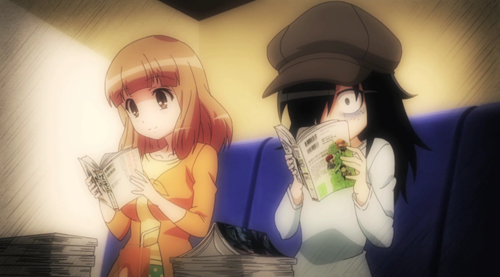
This facet of
Watamote is both a strength and weakness because Tomoko is an insanely
well-written character and completely relatable - perhaps TOO relatable? If you
were or are a frequent attendee of anime clubs or conventions, you likely know
or have met a Tomoko. A fan who is clearly making an effort, but all they
manage to do is relate their hobbies to their everyday life - the kind of fan
who will offhandedly quote one of their favorite shows in a situation that
didn't call for it, or the kind of fan who uses anime phrases in their everyday
speech even when it makes no sense grammatically. You share their interests and
want to play along, but you can tell they are struggling and are so entrenched
in their hobby that it is their only point of reference. Maybe you are or once
were that person. In which case, watching Watamote may have been extremely
awkward for you, as the show pulls no punches. The directorial intent clearly
enforces us to feel pity for Tomoko, as she consistently gets into unpleasant
social and personal predicaments which only serve to fortify the barriers of
her box world and are entirely her own fault. The title of the show, like Tomoko's box world, is made of delusions - the fault is no-one's but her own. Nico Tanigawa (the original author)
obviously cares deeply for their main character, but is absolutely
unsympathetic to that which she does to herself.
Thus, for some
viewers, Tomoko's failings hit a liiiiiiitle too close to home for their liking
and they couldn't continue watching. For me, my enjoyment of Watamote came in
part from the humor surrounding the predicaments Tomoko got herself into, which is the entire show.
If you don't find a girl struggling to improve herself and bitterly failing to
do so funny, then Watamote will do nothing but make you uncomfortable. I mean, there's an episode where Tomoko muses that getting molested on the train would be proof that someone's noticed her - this is a girl who will go to EVERY length to be recognized, even at risk of personal harm. Making light of this can be hard, but I
think I'm on to something here. The original manga has gone much farther, but
the anime ended at 12 episodes and had to end on SOMETHING. But what? Spoilers,
I suppose, but Tomoko is unsurprisingly no closer to improving herself at the end
of the series as she was at the start - she has made zero progress. She finds
herself in despair, unable to change the course of her life. But then she
experiences what we intellectuals like to call a brief moment of clarity.
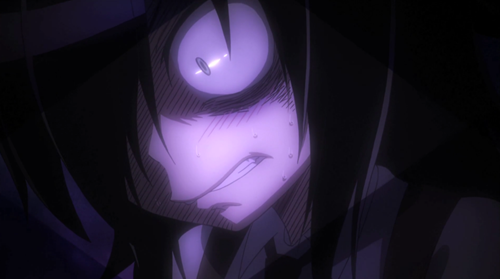
Her
final line of the anime is a smile and these words: "Seriously, it doesn't
even matter!" This moment of self-awareness and belief in her own
character is the first step to breaking free of her box - the moment she can
make light of her own failings and truly embrace who she is, to stop trying to
become someone else. It's not like a lightbulb goes off and Tomoko instantly
knows what she's been doing wrong all this time - it's just the first step in
that direction. The show achieves its humor and resonance with me for these moments
of hope and the ability to laugh at one's self. Watamote really does require
you to laugh at yourself, and for many this can be fiendishly difficult. In my
mind, it is a necessary talent, one which Tomoko has slowly begun to grasp by
show's end. She's not there yet, but she's making her way.
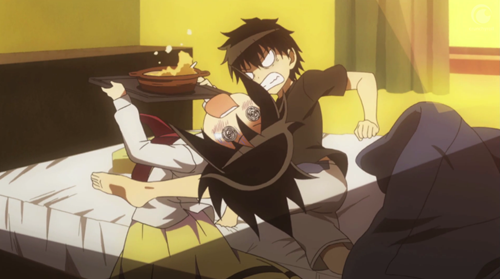
Tomoko Kuroki is arguably the most memorable and well-written character of the entire 2013 year of anime. She's real, instantly loveable - and yet the love we feel for her is conditioned by her predicament for the better. We want to see Tomoko succeed in breaking out of her box, but we pity her for her lame ass methods because they really are lame. She's like a friend who you know can solve their own problems if they try; you don't actively help, but silently coax them along. That's all Tomoko needs, a little coaxing in the right direction. And maybe a hug now and then.
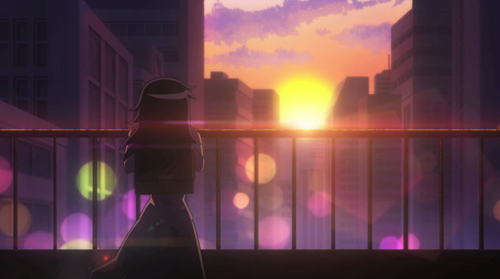
You can currently find all subbed episodes of Watamote streaming online courtesy of Crunchyroll. The series has been licensed by Sentai Filmworks and is slated for an unspecified home video release sometime this year.

No comments:
Post a Comment